What Is BAH? Complete Beginner’s Guide [2027]
BAH stands for Basic Allowance for Housing. It is a tax-free monthly payment the U.S. military gives eligible service members to cover housing costs when the military doesn’t provide a place to live. Your exact amount depends on three things: your duty-station location, your pay grade, and whether you have dependents. In 2026, BAH ranges from about $1,100 a month in the cheapest areas to over $5,000 in the most expensive ones.
If you just heard the term for the first time — maybe you’re enlisting, your spouse just joined, or you’re a landlord renting to a military family — this guide walks you through everything in plain language. I use real 2026 rates throughout, straight from the Defense Department’s official tables.
Independent guide — not affiliated with the U.S. Department of Defense or any military branch.
The 3 Things That Set Your BAH Rate
Every service member’s BAH comes down to exactly three inputs. Same inputs, same paycheck — which is why two people in the same unit can get very different BAH.
1. Your duty station’s location. The military groups the country into about 338 Military Housing Areas (MHAs), each keyed to your duty-station ZIP code — not the ZIP where you actually live. An expensive city means a bigger BAH; a cheap rural posting means a smaller one. This is the biggest of the three factors by far.
2. Your pay grade. E-1 through O-10. Higher rank means a higher BAH, because the DoD assumes senior members need larger, nicer housing. An O-5 at Fort Hood gets $2,748 with dependents; an E-1 at the same base gets $1,662.
3. Whether you have dependents. There are exactly two categories: with dependents and without. One child counts the same as four — there is no per-kid bonus. Dependents usually means a spouse and children, and they have to be registered in DEERS, the military’s dependent database.

Who Actually Gets BAH (and Who Doesn’t)
The basic rule is simple: if the military isn’t giving you a place to live, it pays you to house yourself. In practice:
- You live off base or in privatized military housing — you get full BAH for your grade and location.
- You have dependents — you almost always get the with-dependent rate, even in situations where a single member wouldn’t (for example, during an unaccompanied overseas tour, your family still draws BAH at their U.S. ZIP).
- You’re single and living in the barracks — you don’t get full BAH. You get a small partial BAH instead — here’s what partial BAH pays by grade.
- You’re in initial training — single recruits generally don’t draw full BAH until they reach their first permanent duty station.
The barracks rules trip up more new soldiers than anything else, so I wrote a full guide to them: Do Single Soldiers Get BAH? Barracks Rules. And if you’re heading to basic training soon, my new-recruit guide walks through exactly what you get at each stage of training.
How the DoD Decides the Number
This is the part most explainers skip, and it’s worth understanding, because it explains why your BAH is what it is.
Every year, the Defense Department surveys civilian rental markets across all 338 housing areas. For each area, it looks at what civilians with incomes comparable to each pay grade actually pay for adequate rental housing, plus average utility costs. Your BAH is built from those median rents — not from your specific lease, and not from homeownership costs like mortgage payments or property taxes (the Army’s official benefits page says this explicitly).
A few consequences that surprise people:
- BAH is designed to cover about 95% of typical housing costs, not 100%. The last 5% is the out-of-pocket the DoD expects you to absorb — usually somewhere around $93–$212 a month depending on the area.
- If you rent below your BAH, you keep the difference. It’s paid to you, not your landlord. Plenty of junior members pocket a few hundred a month by renting modestly.
- If you rent above it, the overage comes out of your pocket. BAH follows the median, not your taste in apartments.
- Your BAH follows your duty station, not your commute. Live 40 minutes away in a cheaper town and your BAH doesn’t change — the savings are yours.
New rates come out every year and take effect January 1.
What BAH Is Designed to Cover — and What It Isn’t
BAH covers rent (or a mortgage payment, if you buy) plus basic utilities — electricity, gas, water, trash. That’s the core of it.
What it is not: a reimbursement you have to justify. Nobody audits whether you spent every dollar on housing. It’s also not a voucher tied to a specific property. You get the money; you make the housing decision. The Army’s own guidance puts it plainly — service members are free to rent an expensive place near base or commute from a cheaper area and keep the savings.
2026 BAH Rates: Real Numbers by Grade
Enough theory. Here is what 2026 BAH actually looks like, using Fort Hood, Texas (MHA TX286) as the example — straight from the Defense Travel Management Office’s official 2026 tables.
| Grade | With Dependents | Without Dependents |
|---|---|---|
| E-1 | $1,662 | $1,374 |
| E-2 | $1,662 | $1,374 |
| E-3 | $1,662 | $1,374 |
| E-4 | $1,662 | $1,374 |
| E-5 | $1,695 | $1,530 |
| E-6 | $1,920 | $1,626 |
| E-7 | $2,070 | $1,668 |
| E-8 | $2,238 | $1,746 |
| E-9 | $2,409 | $1,806 |
| W-1 | $1,938 | $1,665 |
| O-1 | $1,731 | $1,623 |
| O-3 | $2,340 | $1,833 |
| O-5 | $2,748 | $2,169 |
Two things jump out. First, E-1 through E-4 share the same rate — the DoD doesn’t differentiate housing needs among the most junior grades. Second, the with-dependent bump is real but modest at Fort Hood: an E-5 gains $165 a month for having dependents. That gap is much wider in expensive markets, as you’ll see next.

How Much BAH Can Vary: Same E-5, Five Duty Stations
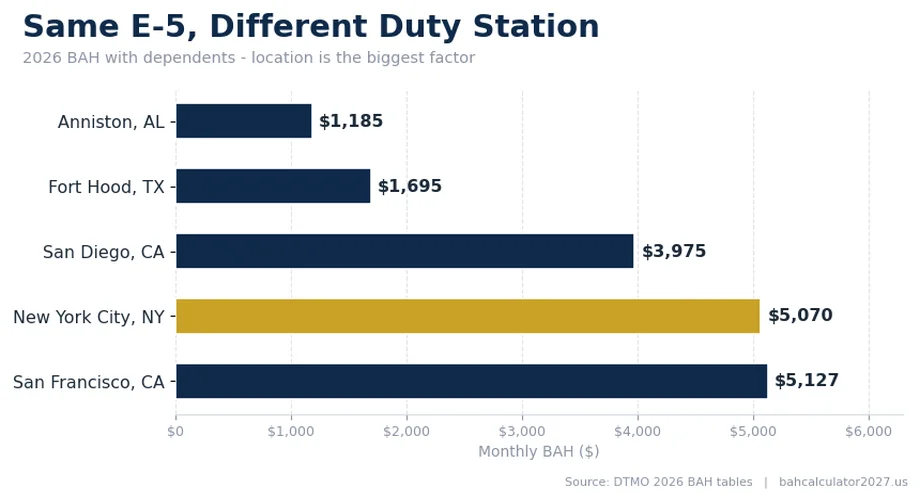
Location is the dominant factor, and this table makes it obvious. Same rank, same dependent status — five different paychecks, all from the official 2026 tables:
| Duty Station | E-5 With Dependents (2026) |
|---|---|
| Anniston / Fort McClellan, AL | $1,185 |
| Fort Hood, TX | $1,695 |
| San Diego, CA | $3,975 |
| New York City, NY | $5,070 |
| San Francisco, CA | $5,127 |
The same E-5 gets $3,942 more per month in San Francisco than in Anniston — over $47,000 a year — purely because of the local housing market. That’s not a bonus for expensive cities; it’s the system working as designed, matching local rents.
The extremes are even wider for junior members: an E-1 with dependents gets $1,134 in Youngstown, Ohio, and $5,067 in New York City. If you want the full picture for every grade and station, my 2026/2027 BAH rates complete guide has the tables, and you can look up your exact rate by ZIP code in about 30 seconds.
Is BAH Taxable?
No. BAH is not taxable income — not for federal income tax, not for Social Security. It’s an allowance, separate from your base pay, and it never shows up as gross income on your W-2. Base pay is the other half of the equation — see what every grade earns in our 2026 military pay chart.
That tax-free status makes BAH more valuable than the same number in civilian wages. A dollar of BAH is a full dollar in your pocket; a dollar of taxable pay loses a cut to taxes first. This also matters if you’re buying a home: VA lenders know BAH is tax-free, so they often “gross it up” (multiply by about 1.25) when counting it as qualifying income — meaning $2,000 of BAH can count like $2,500 of salary on a mortgage application.
I go deep on the tax side — state taxes, W-2 reporting, what happens in divorce — in Is BAH Taxable? Complete Military Tax Guide.
Why Your BAH Almost Never Drops
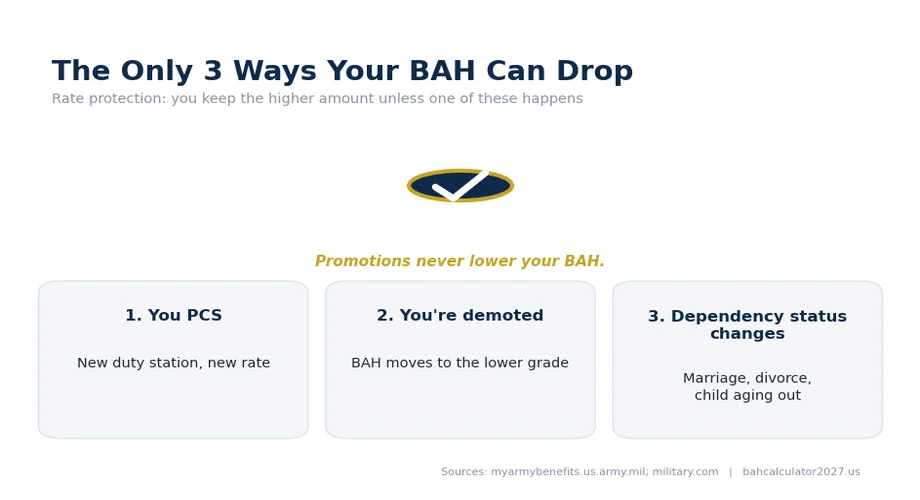
Here’s a feature of BAH most beginners don’t know about: rate protection. The published rates for an area can fall from one year to the next, but your rate doesn’t fall with them. You keep whichever is higher — last year’s rate or the new one — as long as your duty location, pay grade, and dependency status stay the same.
Your BAH only drops in three situations:
- You PCS to a new duty station — you get the rate in effect there on your report date.
- You’re demoted — your BAH moves to the lower grade’s current rate.
- Your dependency status changes — marriage, divorce, or a child aging out resets your rate.
Note what happens with a promotion: it never lowers your BAH. If the higher grade somehow has a lower published rate, you keep the higher of the two. The military explicitly built it that way so getting promoted can’t cost you housing money.
The full mechanics, with examples of how protection saved real money, are in BAH Rate Protection Explained.
When BAH Starts and Stops
For most people, the timeline looks like this:
- Basic training / AIT: single members generally get only partial BAH while the military houses and feeds them. If you have dependents, they draw the with-dependent rate based on where your family lives — not where you’re training.
- First permanent duty station: full BAH starts when you report. This is when most single members move out of the barracks (if space allows) and start drawing the real thing.
- PCS moves: your BAH switches to the new station’s rate on your report date.
- Separation or retirement: BAH ends with active-duty pay. During deployments it generally continues — I cover the deployment rules in What Happens to BAH During Deployment.
BAH vs OHA vs BAS: Don’t Mix These Up
Three acronyms get confused constantly, so here’s the clean split:
- BAH = housing money for duty stations in the 50 states (including Alaska and Hawaii). This guide.
- OHA (Overseas Housing Allowance) = housing money when you’re stationed overseas, including U.S. territories. Different system — it reimburses your actual costs up to a cap rather than paying a flat rate. Full comparison: BAH vs OHA.
- BAS (Basic Allowance for Subsistence) = the food allowance, separate from housing. Every service member gets it; officers and enlisted have different rates.
And one more that’s easy to mix in: the GI Bill Monthly Housing Allowance is a VA education benefit tied to school enrollment. BAH is active-duty military pay. They’re completely separate programs.
Similarly, Family Separation Allowance (FSA) — $300 a month when orders separate you from your dependents for more than 30 days — is its own allowance that stacks with BAH instead of replacing it.
Same idea with COLA (Cost of Living Allowance) — extra pay for high-cost duty stations that covers non-housing costs like groceries and gas. Just note the tax twist: unlike BAH, CONUS COLA is taxable income.
What Will BAH Look Like in 2027?
Confirmed: 2026 rates rose an average of 4.2% over 2025, effective January 1, 2026.
For 2027, the honest answer is: we don’t know yet, and anyone giving you exact 2027 numbers is guessing. The DoD’s FY2027 budget request proposed another 4.2% average increase — but that’s a proposal, not a decision. The official 2027 tables come from DTMO around mid-December 2026, and that’s when real numbers exist. I track this closely in BAH Increase 2027: How Much Will Your Housing Allowance Go Up? and When Will 2027 BAH Rates Be Released?.
How to Look Up Your Exact BAH Rate
Three inputs, thirty seconds:
- Your duty-station ZIP code (where you’re assigned, not where you live).
- Your pay grade.
- With or without dependents.
Plug them into the BAH calculator on the homepage for your exact 2026 figure, or use the ZIP code lookup guide for the step-by-step on the DoD’s own lookup tool.
Frequently Asked Questions
What does BAH stand for?
BAH stands for Basic Allowance for Housing — the tax-free monthly housing payment for eligible U.S. service members.
Is BAH part of base pay?
No. Base pay is your taxable salary. BAH is a separate, non-taxable allowance paid on top of base pay, and it changes with your duty station while base pay doesn’t.
Do I have to spend all my BAH on housing?
No. BAH is paid directly to you and you spend it as you see fit. If your rent is less than your BAH, you keep the difference.
Does BAH go up with each child I have?
No. There are only two rates — with dependents and without. One child gets the same with-dependent rate as four children.
Can my BAH go down from one year to the next?
The published rate for your area can fall, but your personal rate is protected — you keep the higher amount unless you PCS, get demoted, or your dependency status changes.
Do you get BAH during basic training?
Single members in training generally receive only partial BAH while housed in barracks. Members with dependents receive the with-dependent rate based on their family’s location.
Is BAH the same as OHA?
No. BAH covers the 50 states (including Alaska and Hawaii). OHA — Overseas Housing Allowance — covers stationing outside the U.S., including territories, and works as a cost reimbursement rather than a flat rate.
Is BAH the same as the GI Bill housing allowance?
No. The GI Bill’s Monthly Housing Allowance is a VA education benefit tied to school enrollment. BAH is active-duty military pay. They’re completely separate programs.
How often is BAH paid?
Monthly, as part of your regular military pay — half with each mid-month and end-of-month paycheck. See the full 2026–2027 military pay dates calendar for the exact deposit dates.
Where can I look up my exact BAH rate?
Use the calculator on this site’s homepage with your duty ZIP, grade, and dependent status, or the DoD’s official BAH Rate Lookup tool.
Independent guide — not affiliated with the U.S. Department of Defense or any military branch. Last updated: October 17, 2026. Rates shown are official 2026 figures; 2027 rates will be added when DTMO publishes them (~mid-December 2026).