When Will 2027 BAH Rates Be Released? [2027 Guide]
Every fall, the same question starts popping up in military Facebook groups, on Reddit, and in my inbox: when are the new BAH rates coming out? If you are asking it about 2027, here is the honest, verified answer.
The 2027 BAH rates will almost certainly be released in mid-December 2026 by the Defense Travel Management Office (DTMO), and they will take effect on January 1, 2027. Last year’s cycle is the template: the 2026 BAH rates were announced on December 11, 2025. As of today, the Pentagon has not announced an exact release date for the 2027 rates — but the pattern has held for years, and I will update this page the moment the official tables drop.
Let me walk you through exactly how the cycle works, what the history shows, what you should do with your budget in the meantime, and the one rule that protects your current rate no matter what happens in December.

Why mid-December? How the annual BAH cycle works
BAH is not adjusted on a whim. It runs on a strict annual rhythm, and once you see it, the December release date makes complete sense. If you’re new to the allowance, start with my beginner’s guide to BAH.
Each spring and summer — peak PCS season, when housing markets are most active — the Defense Department collects rental housing cost data across roughly 300 military housing areas in all 50 states, including Alaska and Hawaii. It gathers median rents for apartments, townhouses, duplexes, and single-family homes at different bedroom counts, plus average utility costs and renters insurance. That data gets crunched through the fall, and the final tables are published in December so finance offices, housing offices, and service members all have the numbers before they take effect on January 1.
That is why you will never see next year’s BAH rates in October, and why asking in November is a few weeks early. December is the month — and “mid-December” is the historical sweet spot.
Recent BAH release history
Here is what the last few cycles looked like. This is the best predictor we have for 2027:
| Rate year | Average change | Announced |
|---|---|---|
| 2026 | +4.2% | December 11, 2025 |
| 2025 | +5.4% | Mid-December 2024 (annual pattern) |
| 2024 | +5.4% | Mid-December 2023 (annual pattern) |
| 2023 | +12.1% | Mid-December 2022 (annual pattern) |
A few things stand out. First, the December 11, 2025 announcement date for the 2026 rates is confirmed by multiple outlets citing the Pentagon release — I treat that as verified. The earlier years follow the same documented annual pattern of mid-December releases, though I could not independently confirm their exact calendar dates, so I have labeled them honestly.
Second, notice the trend in the increases: two years of 5.4%, then 4.2% for 2026. The 12.1% jump in 2023 was the outlier — it came after housing costs surged across the country. Nobody can tell you today what the 2027 average increase will be, because the rental data for it is still being collected. Anyone claiming to know the number already is guessing.
One coincidence worth knowing: the 2026 rates averaged a 4.2% increase, and the Defense Department’s FY2027 budget request proposes a 4.2% BAH raise for 2027. Same number, two different things — one is a finished fact, the other is a proposal that Congress still has to fund. Never treat a budget request as your actual rate.
Has the Pentagon announced the 2027 release date yet?
No. As of this writing, there is no official announcement date for the 2027 BAH tables. That is completely normal — the 2026 date (December 11) was not publicized far in advance either.
What to watch for: a DoD or DTMO press release in the second week of December 2026, usually picked up immediately by Military.com, military-focused news outlets, and installation housing offices. I run a monthly rates-watch on this site, and this article has a dedicated update slot — when the official tables drop, I will add the announcement date, the headline increase, and a link to the DTMO lookup right here.
How the announcement actually happens
When December arrives, the sequence looks like this:
1. DTMO publishes the official rate tables. These are the source of truth — every calculator, news article, and finance office downstream uses them.
2. A DoD or service-level release summarizes the headline numbers — the national average increase, total BAH outlays (for 2026 it was about $29.9 billion paid to roughly a million service members), and any notable changes.
3. Installation housing offices and finance offices update their systems, and the new rates flow into pay systems for the January 1 effective date.
If you want to be first to know, bookmark DTMO’s BAH page and this article. I check for the release as part of my monthly rates-watch and update this page the same day.

What to do until December: your 2026 rate is the floor
Here is the practical part. You do not need to wait for December to plan your housing budget — your 2026 rate is not going anywhere, and for planning purposes it is the safest number you have.
Thanks to individual rate protection (more on that below), the rate you receive on December 31 is the minimum you will receive on January 1, as long as your duty station, pay grade, and dependency status stay the same. So for any lease you sign this fall, budget on your current rate.
If you want a rough estimate of what 2027 might look like, the only semi-official number available is the DoD’s FY2027 budget request proposal of a 4.2% increase. Run your 2026 rate through it as a planning exercise — not a promise:
| Duty station | 2026 E-5 with dependents | × 1.042 (projection) |
|---|---|---|
| Fort Hood, TX | $1,695/mo | ~$1,766/mo |
| San Diego, CA | $3,975/mo | ~$4,142/mo |
| Fort Campbell, KY | $1,815/mo | ~$1,891/mo |
Remember: that 4.2% is a proposal, and it is a national average anyway. Your market could move more, less, or even down. San Diego’s E-5 rate actually decreased from 2025 to 2026 in some grades — which is exactly why rate protection exists. I break down what the proposal could mean in real dollars — grade-by-grade math, the full 2020–2026 increase history, and the politics that could still reshape it — in my BAH increase 2027 guide.
You can run your own numbers on my 2027 BAH calculator using the 2026 rates, and my complete 2027 BAH rates guide explains the projection in full detail.
Individual rate protection, explained
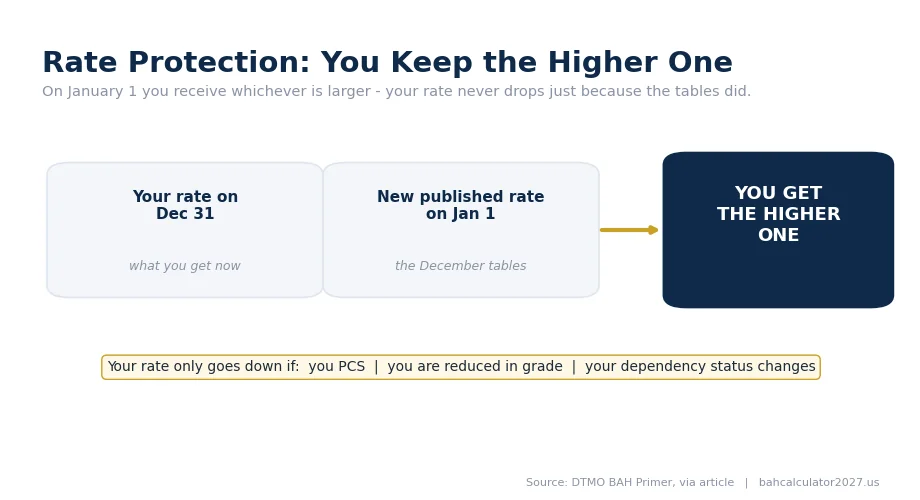
This is the rule that makes December stress-free for most people. Per DTMO’s BAH Primer, individual rate protection works like this: you receive whichever is larger — the newly published January 1 rate, or the rate you were receiving on December 31. If your area’s rates drop, your BAH does not drop with them.
Your rate can only go down in three situations:
1. You PCS to a new duty station — you get the rate in effect at the new location on your report date.
2. You are reduced in pay grade — your BAH moves to the current rate for the lower grade.
3. Your dependency status changes — for example, from with-dependents to without.
One nuance people get wrong: promotions do not break rate protection. If you pin on a new rank and the published rate for that higher grade is somehow lower than what you were getting, you keep the higher amount. I covered this in depth in my BAH rate protection guide.
When the new rate actually hits your pay
The new rates are effective January 1, 2027. In practice, you will see the change reflected in the January LES and the paychecks that follow. If your rate went up, the increase starts with January entitlement — there is no retroactive payment for earlier months, because the old rates were correct for those months.
If you are in privatized on-base housing, the housing office adjusts your allotment automatically; if you live off base, the new amount simply shows up in your pay. Either way, no action is required from you unless your status changed.
One habit worth building: check your January LES line by line. If the BAH amount does not match what you expected — especially after a December PCS or a dependency change — talk to your finance office early with your orders in hand. January is their busiest month, and a quick visit beats three months of pay corrections. That same January LES also carries your basic pay — if you want to confirm the current rate for your grade, our 2026 military pay chart has every number.

Special situations to know about
PCS in December or January. If you move around the turn of the year, your BAH follows the rate at your new duty station on your report date — the 2027 tables if you report on or after January 1. Time a December PCS carefully: reporting in December locks the 2026 rate for the new location; reporting in January gets you the 2027 rate. Neither is automatically better — it depends on whether that market went up or down.
New accessions. If you join and become BAH-eligible after January 1, you get the 2027 rates from the start. There is no “old rate” to protect because you had none.
Dual-military couples. Each spouse’s rate follows their own duty station and status. If you are stationed together, the same December tables apply to both of you. My dual-military BAH calculator handles the with-dependent rate logic for couples.
OHA recipients. If you are stationed overseas, you receive OHA, not BAH — a separate system with its own update cycle. This article’s December timeline is for BAH (all 50 states, including Alaska and Hawaii).
Our December update plan
I built this page to be the timeline you can trust, which means keeping it current is the whole point:
Monthly rates-watch: I check DTMO for the 2027 release as part of a scheduled monthly check. The week the official tables drop, this page gets the announcement date, the average increase, and a direct link to the official lookup. Once the rates are out, here’s how to look up your exact BAH rate by ZIP code so you’re using the right duty-station ZIP and the right year.
Pillar cross-link: my complete 2027 BAH rates guide carries the full rate tables and methodology; this page stays focused on the when.
Refresh commitment: every figure on this page is re-verified against official sources when the 2027 tables publish, and the “last updated” date at the top of the article will reflect it.
Independent guide — not affiliated with the U.S. Department of Defense or any military branch.
Frequently Asked Questions
When will the 2027 BAH rates be released?
The 2027 BAH rates are expected in mid-December 2026, published by the Defense Travel Management Office (DTMO). The 2026 rates were announced December 11, 2025, and the mid-December pattern has held for years. No official 2027 date has been announced yet — this page will be updated when it is.
Are the 2027 BAH rates out yet?
No. As of this writing, the 2027 BAH tables have not been published. The release is expected in mid-December 2026, with rates effective January 1, 2027. Until then, the 2026 rates remain in effect.
What date in December do BAH rates usually come out?
There is no fixed calendar date, but “mid-December” is the consistent pattern — the 2026 rates came out December 11, 2025. Expect the 2027 announcement in the second week of December 2026.
When do BAH rates go into effect?
New BAH rates take effect every January 1. The 2027 rates will be effective January 1, 2027, and will appear on the January LES.
Can I rely on last year’s rate until then?
Yes. Your 2026 rate stays in effect through December 31, 2026, and individual rate protection means it is also the minimum you can receive on January 1, 2027 — as long as your duty station, pay grade, and dependency status do not change.
Will my BAH go down if rates decrease in my area?
No — not while you stay put. Individual rate protection guarantees you keep the higher of the new January 1 rate or your December 31 rate. Your BAH only decreases if you PCS, are reduced in pay grade, or your dependency status changes.
How is the 2027 BAH increase decided?
DoD collects rental housing cost data across roughly 300 military housing areas each spring and summer, then sets rates reflecting local market conditions. The 2027 increase will reflect 2026 rental market data — which is why it cannot be known until the tables are computed in the fall.
Is the 4.2% increase for 2027 official?
No. The 4.2% figure is the Defense Department’s FY2027 budget request — a proposal, not an approved rate. (Coincidentally, the actual 2026 increase also averaged 4.2%.) Treat any 2027 number as a planning estimate until DTMO publishes the official tables.
Where can I check my exact 2027 rate when it’s released?
DTMO’s official BAH lookup is the source of truth. I will also link it here the day the tables drop, and my 2027 BAH calculator will be updated with the official 2027 rates.
Do OHA rates release at the same time?
Not necessarily. Overseas Housing Allowance follows its own update cycle, separate from the December BAH release. If you are OCONUS, follow OHA guidance from your housing office rather than this timeline.