
Dual Military BAH Calculator 2027
Both spouses serving? Get each member’s exact BAH plus your total household allowance — using real DoD rules, not estimates.
Calculate dual-military BAH
Your household BAH
How dual-military BAH actually works
When both spouses serve, each of you has your own BAH entitlement — with one big constraint I see couples get wrong all the time. Here’s the rulebook, drawn from DoD policy and the DTMO tables behind this calculator:
| Your situation | The rule | What to do |
|---|---|---|
| No children | Each of you draws the without-dependents (single) rate for your own grade and station. | Nothing special — calculate each member separately. |
| Children, stationed together | ONE of you is elected for the with-dependents rate (normally the higher-ranking member); the other draws without. | Run the calculator above — it shows which election pays more. |
| Children, stationed apart | Same election rule — one with-dependent rate per couple. Each member’s amount uses their own location. | The elected member is usually where the children live. |
| Each has a child living with them | Rare exception: both can draw the with-dependents rate. | Needs custody documentation and finance-office approval. |
| One of you deploys | BAH doesn’t change for either of you. | Family Separation Allowance may also apply — ask finance. |
| Living in base housing | Generally no BAH for either of you. | The housing itself is the benefit. |
Key point: a military spouse can never be the other spouse’s “dependent” for BAH — you’re each entitled to your own allowance.
Which of us should claim the dependent?
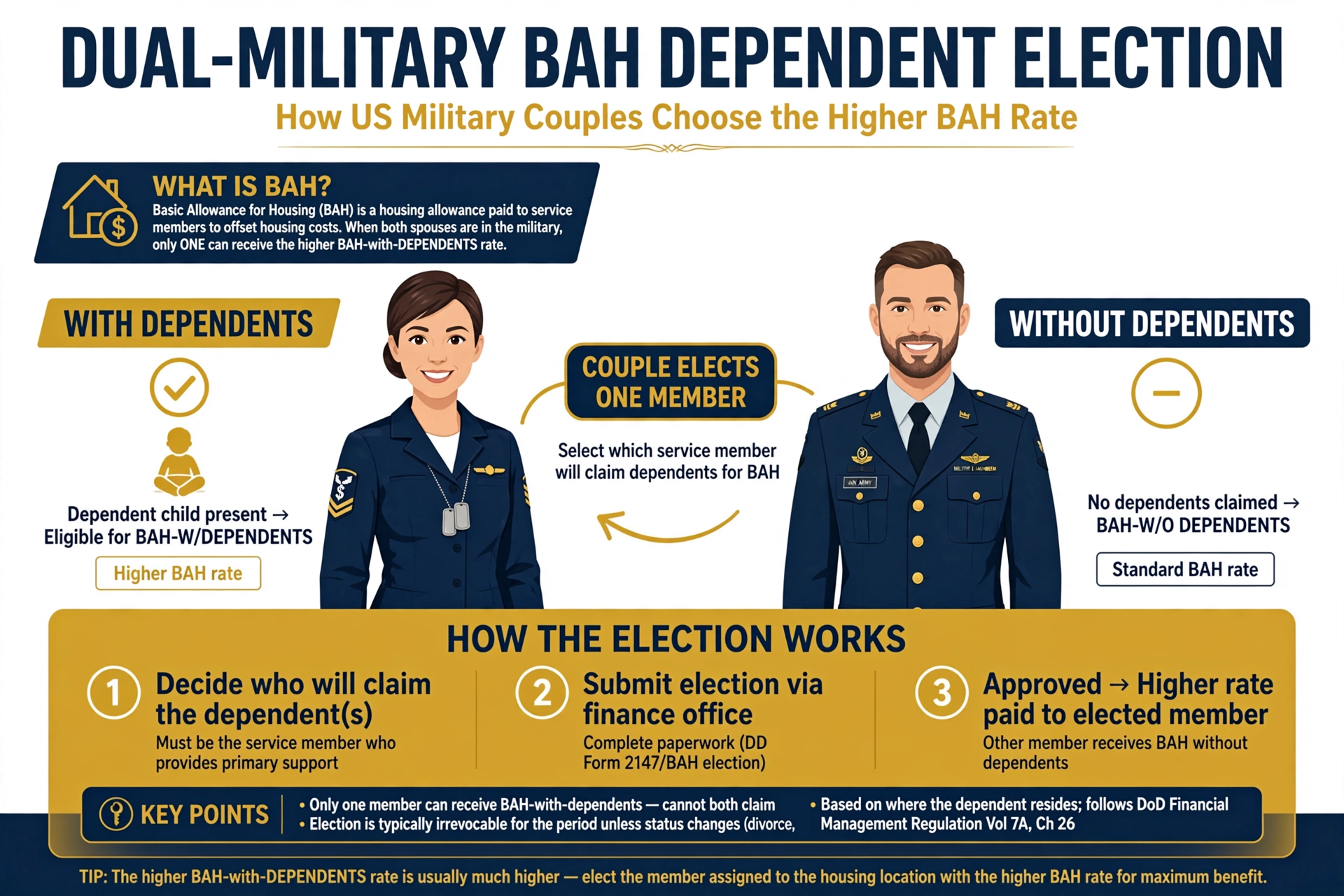
Convention says the higher-ranking member claims the child. But the math that actually matters is the household total — and the gap between with and without rates differs by grade and location. That’s why this calculator models the election instead of guessing: it defaults to whichever member’s with-dependent rate is higher and shows you both numbers.
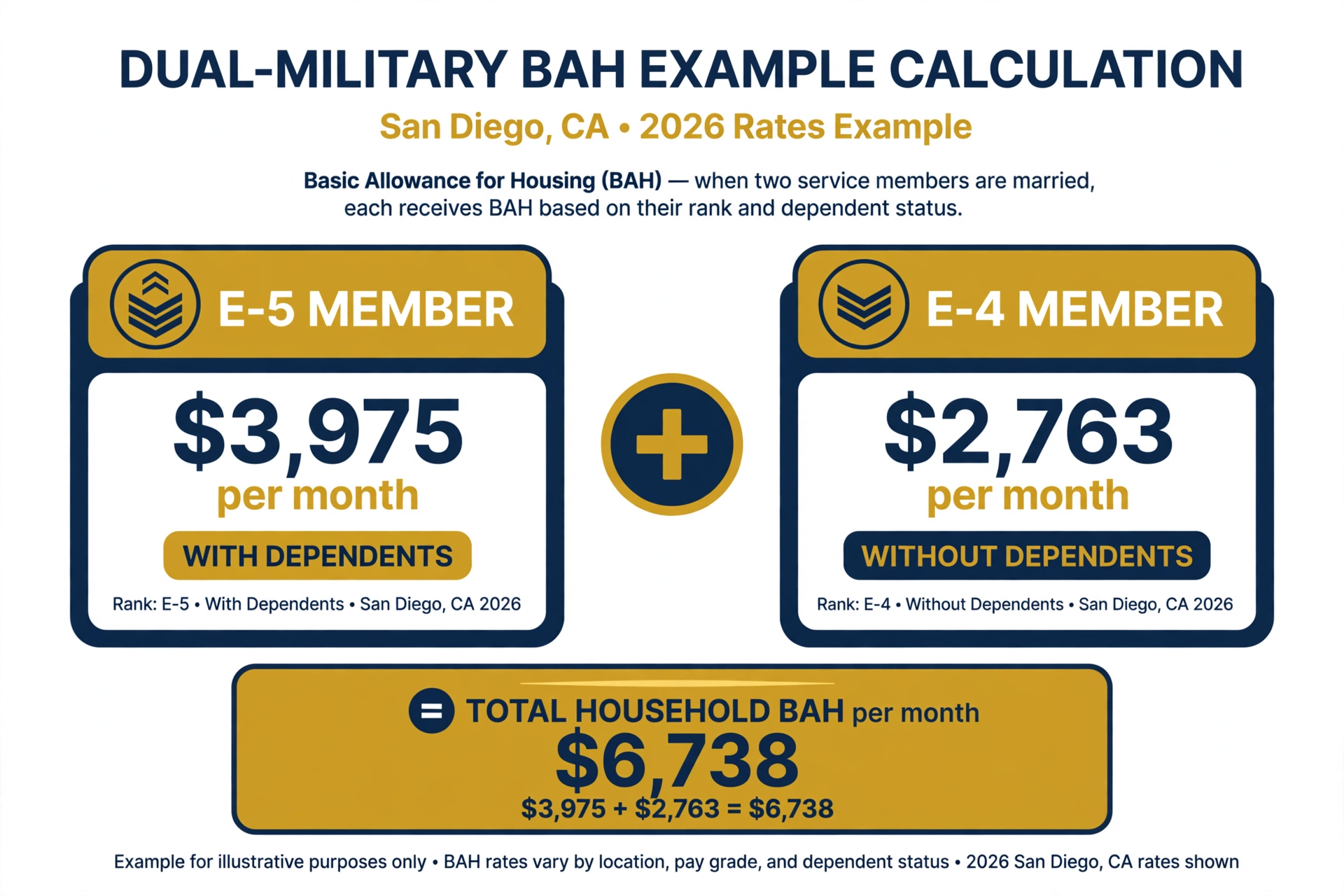
Real example: an E-5 and E-4 stationed together in San Diego with one child. The E-5 claims the dependent at $3,975/month; the E-4 draws without dependents at $2,763/month. Household total: $6,738/month — $80,856 a year, all tax-free.
What this calculator does for you
Dual-military BAH questions, answered
Can we both get BAH with dependents?
No. DoD policy prohibits both members of a dual-military couple from drawing the with-dependents rate at the same time. Exactly one member is designated for BAH purposes; the other draws the without-dependents rate.
Who should claim our child?
Normally the higher-ranking member — but run the numbers. The best election is whichever produces the highest household total, which depends on each member’s grade and location. This calculator defaults to the higher with-dependent rate and shows you the alternative.
What if we’re stationed in different cities?
Each of you draws BAH based on your own duty station ZIP. The dependent rule doesn’t change: still only one with-dependent rate per couple (unless the custody exception applies).
We each have a child from a previous marriage living with us. Now what?
This is the recognized exception: when each member has a qualifying dependent child physically living with them, both members can draw the with-dependents rate. You’ll need custody documentation and finance-office approval.
Does BAH change when one of us deploys?
No — deployment doesn’t change either member’s BAH calculation. The non-deploying spouse keeps drawing as before, and Family Separation Allowance may apply on top.
What paperwork do we need?
Typically your marriage certificate, children’s birth certificates, DEERS enrollment showing the dependents, custody orders if applicable, and the BAH election recorded through your finance office.
Can my spouse count as my dependent for BAH?
No. A service member who is entitled to their own BAH cannot be claimed as another member’s dependent. Only qualifying children or other genuine dependents count.
What if we live in on-base housing?
Then you’re generally not entitled to BAH at all — the government housing is provided in lieu of the allowance.
What happens to our BAH if we divorce?
Each of you is then rated on your own individual status: with dependents if you have qualifying custody, without if you don’t — at your own grade and location.
Does the with-dependent rate increase with more kids?
No. BAH has exactly two dependent categories — with or without. One child qualifies you; a second doesn’t raise it.
What if one of us is stationed in an OHA area?
That member falls under the Overseas Housing Allowance system instead of BAH. This calculator will flag ZIP codes with no BAH table.
How often should we recheck our BAH?
On every PCS, promotion, or dependent-status change — and each January when the new annual tables publish.
Know your household number
Model both members, both locations, and the optimal dependent election — free, official data.
Want the single-member view? Try the main BAH calculator.