BAH Increase 2027: How Much Will Your Housing Allowance Go Up?
The short answer: is BAH going up in 2027?
A 4.2% BAH increase for 2027 has been proposed in the Defense Department’s FY2027 budget request — but it is a proposal, not an approved rate. The official 2027 rates will be published around mid-December 2026. Be careful not to mix things up: 4.2% was also the actual average increase for 2026 — same number, two different years, two different meanings.
Keep reading and I will walk you through exactly what that 4.2% is, what it would mean in real dollars at your grade, why your actual increase will almost certainly be a different number, and the political moving pieces (including a $1,776 payment story you have probably heard about) that could still reshape 2027.
What “4.2% for 2027” actually means
Let me start with the sentence that matters most in this whole article: the 4.2% figure for 2027 is a budget request, not a decision. Here is how the process works.
Every year the Defense Department sends Congress a budget request with proposed pay and allowance changes. In the FY2027 request, the Air Force’s official Budget Overview lists a “4.2% basic allowance for housing raise,” corroborated by the Comptroller’s FY2027 Budget Request Overview Book. That is what the 4.2% is: the number the Pentagon asked for.
A request is not a rate. Congress has to fund it, and the actual 2027 rates are computed from rental-market data collected across roughly 300 military housing areas — not from the requested percentage. The final average will be a result of the survey math, not a copy of the request.
One more number you will see floating around: 6.2%. That figure comes from MOAA’s analysis of the FY2027 budget request, and it measures something different — the BAH program funding request versus the prior year’s request, excluding the reconciliation supplemental (include that supplemental, and it is actually a 2.5% decrease). Funding is the size of the pot Congress sets aside; the rate increase is the average change to your check. Related, but not interchangeable — never read a 6.2% funding figure as a 6.2% raise in your BAH.
Now for the confusion trap, because I have seen this mix-up all over military Facebook groups and Reddit threads. 2026’s BAH increase was also 4.2% — but that one is real and finished. DoD announced the 2026 rates on December 11, 2025, an average increase of 4.2%, paying out about $29.9 billion to roughly a million service members. The two 4.2%s have nothing to do with each other beyond coincidence: 2026’s is a locked-in fact, 2027’s is a proposal waiting on Congress and the rental surveys. Any source quoting “4.2% for 2027” as confirmed is getting ahead of reality — and if a source seems to be describing 2026’s announcement, that is probably what it is.
What the increase could look like in your paycheck
Averages are abstract. Let me make this concrete with real dollar math — with one firm condition.
I took verified 2026 rates and applied the proposed 4.2% mechanically. This is a planning exercise, not a prediction — the actual 2027 rates are set market by market from local rental surveys, and the national average may not come in at 4.2% at all. Use these numbers to get a feel for the scale of the money, nothing more. To see exactly what your rate looks like today, run a BAH rate lookup by ZIP code with your duty station’s ZIP.
| Duty station & grade | 2026 rate | ×1.042 projection | ≈ gain/mo |
|---|---|---|---|
| Fort Hood, TX — E-5 with dependents | $1,695 | ~$1,766 | +$71 |
| Fort Hood, TX — E-6 with dependents | $1,920 | ~$2,001 | +$81 |
| Fort Hood, TX — O-3 with dependents | $2,340 | ~$2,439 | +$99 |
| San Diego, CA — E-5 with dependents | $3,975 | ~$4,142 | +$167 |
| Fort Campbell, KY — E-5 with dependents | $1,815 | ~$1,891 | +$76 |
Two takeaways. First, in high-cost markets the same percentage means real money: an E-5 in San Diego could see roughly $167 more per month — about $2,000 over the year. Second, that is if 4.2% survives as the average and your market tracks it — which it almost certainly will not, exactly.
BAH increases 2020–2026: the recent history
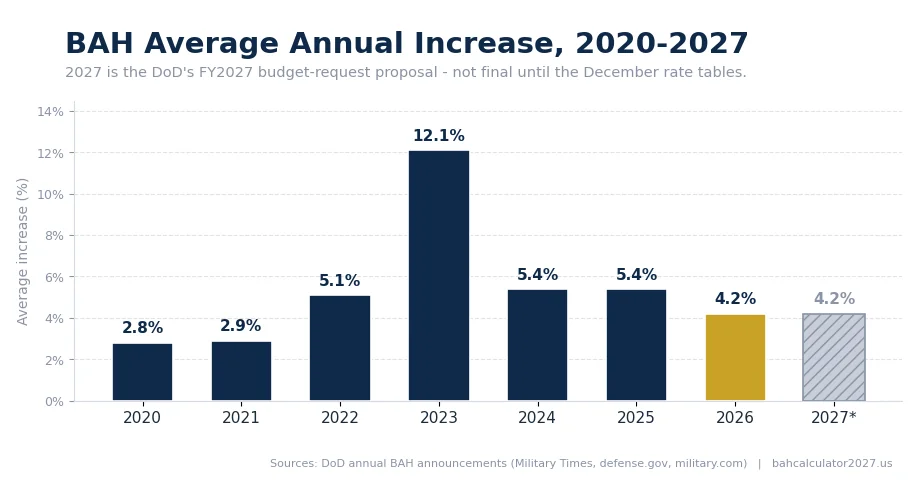
One year of data tells you nothing. Here is what the last seven years actually look like, all from official DoD announcements:
| Rate year | Average increase | Note |
|---|---|---|
| 2020 | 2.8% | Pre-inflation baseline |
| 2021 | 2.9% | About $23B paid to ~1M members |
| 2022 | 5.1% | Jumped as housing costs climbed |
| 2023 | 12.1% | Outlier — largest in recent history |
| 2024 | 5.4% | Settling down |
| 2025 | 5.4% | Second steady year |
| 2026 | 4.2% | Actual — announced Dec 11, 2025 |
The pattern is plain: 2023’s 12.1% was the freak year — by far the largest in this series — followed by two 5.4% years and now 4.2% for 2026. The increases have been cooling toward normal. If the 2027 proposal holds, it continues that trend: a moderate, mid-single-digit year, nothing like the 2023 spike.

Your increase will not be exactly 4.2%
This is the part most explainers skip, and it is the part that affects your wallet the most.
BAH is not one national rate. There are roughly 300 military housing areas across all 50 states (Alaska and Hawaii included), and each one gets its own rate based on local rental data: median rents for different home types at different bedroom counts, plus utilities and renters insurance. The 4.2% — even the actual 4.2% for 2026 — is a national average. Nobody’s personal increase is the average unless their market happens to match it.
Here is a real example of how far off the average a market can be. Blue Star Families tracked Fayetteville, North Carolina: an O-3 with dependents there went from $2,142 in 2025 to $2,175 in 2026 — a gain of about 1.5%, well under the 4.2% national average. Same force, same year, completely different increase. Some markets ran above average; a few went flat or even dropped.
So when the 2027 tables come out, your increase reflects what happened to rents near your installation — not the 4.2% headline. That is why I recommend my BAH rate protection guide: if your market drops, rate protection freezes your individual rate, so a below-average move cannot shrink your paycheck while you stay put.
The military pay raise is NOT the BAH raise
This confusion costs people real planning errors, so let me kill it cleanly.
The House-passed FY27 defense bill (H.R. 8800) proposes basic-pay raises of 7% for E-5 and below, 6% for E-6 through O-3, and 5% for O-4 and above, beginning January 1, 2027. That is a basic pay raise. It has nothing to do with your BAH. For the current basic-pay tables behind that raise — every grade and service step at 2026 rates — see our 2026 military pay chart.
BAH and basic pay are set by completely different processes on completely different logic:
| Basic pay raise | BAH adjustment | |
|---|---|---|
| Decided by | Congress, in the annual defense bill | Rental-market survey data per housing area |
| Based on | Pay comparability and force policy | Median local rents, utilities, insurance |
| Same for everyone? | Yes — same percentage by grade tier, nationwide | No — varies by duty station, grade, and dependents |
| When effective | January 1, 2027 (if enacted) | January 1, 2027 (annual tables) |
Both happen to take effect January 1, which is exactly why people merge them in their heads. But the 7%/6%/5% pay proposal says zero about what your housing allowance will do, and the 4.2% BAH proposal says zero about your base pay. Keep them in separate mental boxes — and when a headline says “military raises for 2027,” check which one it is talking about before you budget around it.
The $1,776 Warrior Dividend question
You may have heard that Congress appropriated $2.9 billion for BAH-related purposes in the reconciliation bill — and that most of it never became BAH rates. Here is what happened, and what it means for 2027.
According to reporting by The Center Square, roughly $2.6 billion of that housing money was redirected into one-time $1,776 “Warrior Dividend” payments to the force (issued around Christmas 2025), leaving about $300 million for actual housing-allowance needs. Defense Secretary Hegseth has publicly pledged to work with Congress on the shortfall. I want to be clear about the sourcing here: this is reported, not a DoD-published figure — but it is the only public accounting available, and it is the story the 2027 BAH debate is built on.
Why does this matter for the increase? Because it feeds the fight over whether BAH should return to 100% coverage (more below). Advocates argue the diverted money was meant to restore BAH, and the 2027 cycle will be watched as a test of whether Congress makes the housing accounts whole — Hegseth’s pledge included. I am not taking sides — just giving you the context to read December’s headlines correctly.
Will BAH ever cover 100% of your housing costs?
BAH is designed to cover about 95% of housing costs, with the member absorbing the remaining 5% out of pocket. For 2026, DTMO put that out-of-pocket share at roughly $93 to $212 per month, depending on grade and market. The policy logic is that the member’s small contribution keeps them price-conscious — the same logic as a copay.
Will that ever go back to 100%? Advocacy groups like MOAA keep pushing for full restoration, and the Warrior Dividend fight (above) is the latest chapter. But be honest with yourself: the official proposal for 2027 is a 4.2% increase within the current 95%-coverage system, not a return to 100%. A 4.2% raise on a rate that covers 95% of your housing still leaves the same structural gap — just against bigger numbers. If full restoration ever happens, it will be a congressional decision announced loudly, not something that sneaks into the annual rate tables.
So plan on the 95% rule for 2027. That $93–$212 monthly share is part of your budget, not a temporary inconvenience.
What Congress is actually doing about BAH in 2027
Beyond the pay-raise headline, the House-passed FY27 NDAA (H.R. 8800) contains a few BAH-specific provisions worth knowing — and worth reading correctly, since a House-passed bill is a proposal, not a law.
First, the bill would give the department permanent authority to make temporary BAH increases, with a lower threshold for triggering them. A quick explainer: when a local market spikes abnormally between the annual surveys, DoD can approve a temporary increase for that area. The House provision would make that authority permanent and lower the trigger threshold, so future rent spikes near your installation could get a faster response.
Second, the bill would remove BAH from the income calculation for Basic Needs Allowance eligibility. The Basic Needs Allowance is a supplemental payment for the most junior, lowest-income families — and currently, counting BAH as income can push struggling families over the eligibility line. Excluding it would open the program to the families it was designed for. This does not raise anyone’s BAH, but it is a real quality-of-life change for E-1 through E-4 households if it becomes law.
Third — the boring-but-important caveat: the House passed it. The Senate still has to act, and the final NDAA could look different. Treat every provision above as “likely direction,” not “done deal.”
What to do with this information right now
Here is how to turn all of this into a plan:
1. Budget on your current rate. Thanks to rate protection, your December 31 rate is the floor for January 1 — it only drops if you PCS, drop in grade, or change dependency status.
2. Use the 4.2% as a sketch, not a promise. Run your numbers on my 2027 BAH calculator with 2026 rates, then multiply by 1.042 as a rough planning exercise — and treat the result as optimistic if your market has been flat.
3. Do not sign a lease priced on projected numbers. If a landlord near base is quoting 2027 “expectations,” those are guesses. Sign on what you can afford at your current rate; any increase is a bonus.
4. If your market tracks the average, that $71–$167 monthly bump changes what you can afford — my guide on how much house you can afford on BAH turns a raise into a housing budget.
5. Watch the calendar. The official 2027 tables land around mid-December 2026 — my companion piece on when the 2027 BAH rates are released is the timeline to bookmark, and my complete 2027 BAH rates guide will carry the full tables and methodology once they drop.
How I will keep this page current
I run a monthly rates-watch on official 2027 BAH data, and this page has a dedicated December update slot: the week DTMO publishes the official tables, I will swap the proposal framing for the real numbers, add the announcement date, and refresh every figure. The “last updated” date at the top will always reflect the latest pass.
Independent guide — not affiliated with the U.S. Department of Defense or any military branch.
Frequently Asked Questions
How much will BAH increase in 2027?
The FY2027 budget request proposes a 4.2% average BAH increase — a proposal, not an approved rate. Official rates publish around mid-December 2026, and the final average depends on the rental survey data.
Is the 2027 BAH increase confirmed?
No. A budget request still has to be funded by Congress, and the actual rates are computed from local rental-market surveys. Nothing about 2027 is confirmed until the official tables are published.
Why is 4.2% quoted for both 2026 and 2027?
Coincidence. The 4.2% for 2026 is the actual average increase, announced by DoD on December 11, 2025. The 4.2% for 2027 is the proposed increase in the FY2027 budget request. Same number, two different years, two different statuses — do not treat them as one story.
Will my BAH go up 4.2%?
Almost certainly not exactly. BAH is set per military housing area from local rental data, and the 4.2% is a national average. Your market could run higher, lower, flat, or even down — for example, an O-3 with dependents in Fayetteville, NC saw only about 1.5% for 2026.
Does the military pay raise increase BAH?
No. The proposed 7%/6%/5% basic-pay raises in the House FY27 defense bill apply to base pay only. BAH is adjusted through a separate rental-survey process, and the two are set independently.
What if BAH rates go down in my area?
Your individual rate is protected: you keep the higher of the new January 1 rate or your December 31 rate. Your BAH can only decrease if you PCS, are reduced in pay grade, or change dependency status. I explain the full rule in my BAH rate protection guide.
What happened to the BAH restoration money?
According to reporting by The Center Square, about $2.6 billion of the $2.9 billion in reconciliation housing funds was redirected into one-time $1,776 “Warrior Dividend” payments (issued around Christmas 2025), leaving roughly $300 million for housing-allowance needs. Per that reporting, the Defense Secretary has pledged to work with Congress on the shortfall.
When will the official 2027 BAH rates be published?
Around mid-December 2026, with rates effective January 1, 2027. See my companion article on when the 2027 BAH rates are released for the full timeline and December update plan.
Does BAH cover 100% of rent?
No. BAH is designed to cover about 95% of housing costs, with the member paying roughly $93 to $212 per month out of pocket (2026 figures). A 4.2% increase raises your check but does not change that 95% structure.
Where can I estimate my 2027 BAH?
Use my 2027 BAH calculator with the current 2026 rates as your baseline, then apply the 4.2% proposal as a rough planning exercise — never as a confirmed number. My complete 2027 BAH rates guide will carry the official tables when they publish.