
What Is BAS? Basic Allowance for Subsistence [2027]
fetched 1657, bytes: 27338
lowance for Subsistence. It is the U.S. military’s monthly food allowance — tax-free money paid to service members to cover the cost of their own meals. In 2026, enlisted members receive $476.95 a month and officers receive $328.48 a month, regardless of rank, location, or whether they have dependents.
If you’re new to the military — enlisting soon, or married to someone who just joined — BAS is the food half of the two big allowances, the other half being BAH, the housing allowance. Unlike BAH, which moves with your duty station, BAS is one flat rate per category. This guide breaks down the real 2026 numbers, how the rate is actually decided, who gets it, and the special double-rate version most people have never heard of.
Independent guide — not affiliated with the U.S. Department of Defense or any military branch.
2026 BAS Rates: The Three Numbers That Matter
There are really only three numbers you need to know for 2026, all effective January 1, 2026:
| Category | Monthly (2026) | Annual (2026) |
|---|---|---|
| Enlisted (BAS I) | $476.95 | $5,723.40 |
| Officers | $328.48 | $3,941.76 |
| BAS II (enlisted only) | $953.90 | $11,446.80 |
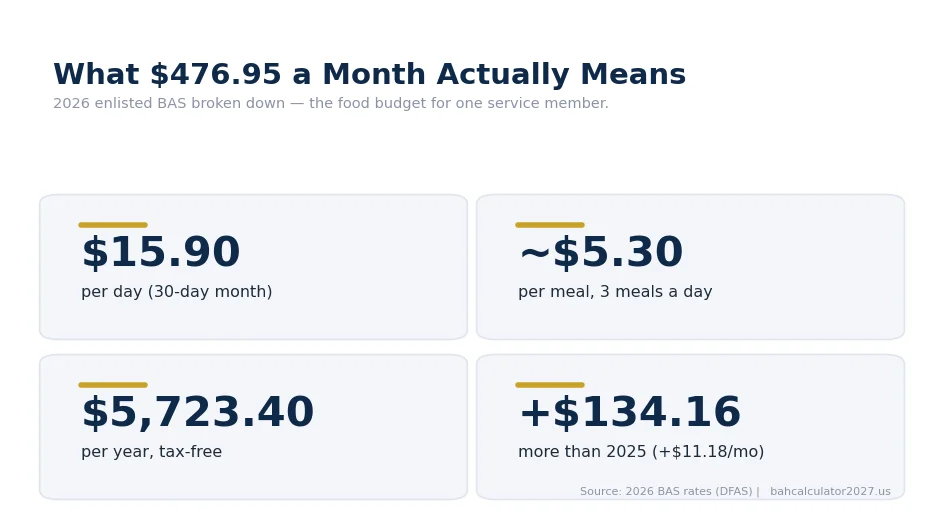
The 2026 rates rose 2.4% from 2025 — about $11.18 more a month for enlisted members ($134.16 a year) and $7.70 more for officers. That’s a modest bump, but it follows an unusually big one: BAS jumped 11.2% in 2023, the largest increase in over 20 years, when food prices surged.
A few things make BAS different from almost every other piece of military pay:
- Every enlisted member gets the same rate. An E-1 fresh out of training gets exactly the same BAS as an E-9 with 25 years in. Promotion doesn’t change it; neither does marriage or having kids.
- It’s the same at every duty station. Rural Kansas, San Diego, Germany — the number doesn’t move. Location is irrelevant, which makes BAS the simplest allowance on your LES to understand.
- It covers you, and only you. BAS pays for the service member’s meals, not the family’s. There is no extra for a spouse or children. (Other programs help with family food costs, but BAS is strictly personal.)
How Your BAS Rate Is Actually Decided
Most explainers just hand you the number. The mechanism behind it is worth two minutes of your time, because it answers half the questions people ask about BAS — including why it can differ from the military pay raise in any given year.
BAS is set by federal law — 37 U.S.C. § 402. Each year, the enlisted rate is set equal to the monthly cost of the U.S. Department of Agriculture’s liberal food plan for a male aged 19 to 50, as the Secretary of Agriculture determines it on October 1 of the previous year. The new rate takes effect the following January 1.
In plain English: the government asks the USDA what a reasonable month of food actually costs for a typical service member’s demographic, and BAS is set to match that number. The officer rate is then computed by taking the prior year’s officer rate and applying the same percentage increase the enlisted rate got — $320.78 × 1.024 = $328.48 for 2026, which checks out to the cent.
Three consequences of this system that surprise people:
- BAS tracks food prices, not the military pay raise. The annual basic-pay raise follows private-sector wage growth; BAS follows the grocery bill. In 2023, when food prices spiked, BAS jumped 11.2% while basic pay rose 4.6%. The two numbers answer different questions.
- Your BAS can never go down. The statute explicitly bars a year-over-year decrease. If food prices fell, you’d simply keep the prior rate. (For the record, the rate has never actually decreased.)
- Nobody’s commander sets it. BAS isn’t a policy choice by a service chief or a base commander — it’s a formula tied to a USDA data point. That also means you can’t negotiate it, appeal it, or lose it through an evaluation.
The One Big Divide: Enlisted vs. Officer Rates
The officer/enlisted split is the single most confusing thing about BAS, so let me be direct: the law prescribes two different formulas, and that’s the whole of it. The enlisted rate is anchored to the USDA food plan; the officer rate is just last year’s officer rate adjusted by the same percentage.
You’ll see explanations floating around — that officers historically had access to different dining facilities, or that officers are expected to cover part of their meals from base pay. Those are editorial theories, not anything the statute says. The honest answer is that Congress wrote it this way decades ago, and the formulas have diverged ever since. What matters for you practically: if you’re enlisted, your BAS is the higher number; if you’re commissioned, it’s the lower one. And BAS II — the double rate covered below — is enlisted-only by law.
What Your BAS Actually Buys: The Daily Math
$476.95 a month is hard to visualize, so here’s what it breaks down to:
| Breakdown | Enlisted | Officer |
|---|---|---|
| Per day (30-day month) | $15.90 | $10.95 |
| Per meal (3/day) | ≈ $5.30 | ≈ $3.65 |
| Per week | ≈ $110.07 | ≈ $75.80 |
| Per year | $5,723.40 | $3,941.76 |
Is $15.90 a day enough to eat on? Honestly — it depends on how you cook. If you buy groceries and cook at home, $477 a month feeds one person comfortably in most of the country. If you eat out twice a day, it’ll run dry by the third week. The allowance was designed around the cost of a home-cooked diet, not restaurant prices, and the per-meal figure (~$5.30) makes that design visible.
One more practical note: BAS shows up as its own line on your Leave and Earnings Statement (LES), separate from base pay. When you first start receiving it after training, check that first LES — the allowance should appear at the full monthly rate, and any DFAC meal charges should appear as separate deduction lines. If something looks off, your finance office fixes it.
BAS Is Tax-Free — and That Makes It Worth More Than It Looks
BAS is excluded from gross income under federal tax law (26 U.S.C. § 134). It doesn’t appear in Box 1 of your W-2, you owe no federal or state income tax on it, and it isn’t treated like housing income in mortgage calculations.
That tax-free status quietly boosts the real value. At a 22% federal tax bracket, $476.95 a month tax-free is equivalent to earning roughly $611 a month in taxable wages ($476.95 ÷ 0.78). A civilian would need to earn about $7,330 a year just to have the same food budget BAS hands you after taxes.

Two tax-related boundaries worth knowing:
- BAS doesn’t count toward retirement. Military retired pay is computed from base pay only, so BAS (and BAH) won’t inflate your pension calculation.
- BAS doesn’t help you qualify for a bigger mortgage. Most lenders exclude it from qualifying income calculations on a VA loan, treating it as food money rather than housing money. Budget it as groceries, savings, or a buffer — not as part of your home-buying power.
For the full picture of which military payments are taxed and which aren’t, I go deep in Is BAH Taxable? Complete Military Tax Guide.
Who Gets BAS (and Who Doesn’t)
The basic rule is simple: if you’re on active duty at a permanent duty station, you rate BAS. The exceptions are where people get tripped up.
You don’t get BAS during basic training. The statute says it outright: enlisted members are not entitled to BAS while in basic training. Recruits eat in the dining facility at no cost instead — the government feeds you directly rather than paying you to feed yourself. This is also why you won’t see BAS on a trainee’s first pay statements. (If you’re heading to training soon, my new-recruit guide walks through what you get at each stage.)
If you live in the barracks and eat at the DFAC, BAS is usually deducted. Here’s how it works: enlisted members in government quarters on a meal plan have their BAS reduced by mandatory meal deductions — essentially, the allowance goes back to pay for the dining facility meals. This is automatic. In some cases, when your duties genuinely prevent you from using the DFAC (shift work, field duty), waivers are possible through your chain of command. The logic is anti-double-dipping: the government won’t pay you for meals and also hand you the meals. I cover the barracks side of this in Do Single Soldiers Get BAH? Barracks Rules.
Deployed? It depends. Whether you keep BAS during a deployment is circumstantial — it depends on whether government meals are provided in your situation. Check with finance before you go.
National Guard and Reserve? BAS comes only on active-duty orders, and it’s prorated by the number of days — you don’t draw it for a regular drill weekend. Full details in my National Guard & Reserve guide.
Married or have kids? Doesn’t change your BAS by a dollar. BAS has no dependent rate, unlike BAH. Your spouse’s meals are never part of the calculation.
BAS II: The Double Rate Most People Miss
Here’s the part of BAS law almost nobody talks about. There’s a second tier — BAS II — worth exactly twice the standard enlisted rate: $953.90 a month in 2026.
BAS II isn’t automatic, and it’s not for everyone. By law, an enlisted member qualifies only when ALL of these are true:
- They’re on duty at a permanent duty station (not training, not temporary duty).
- They’re assigned to single, unaccompanied government quarters — think barracks or bachelor housing.
- Those quarters lack adequate food storage or preparation facilities — no real kitchen, no proper fridge.
- No government mess (dining facility) is available, and the government can’t otherwise make meals available.
Plus two fine-print conditions: the rate must be authorized by the Secretary of the Military Department (it’s a command decision, not a checkbox), and officers are categorically ineligible.
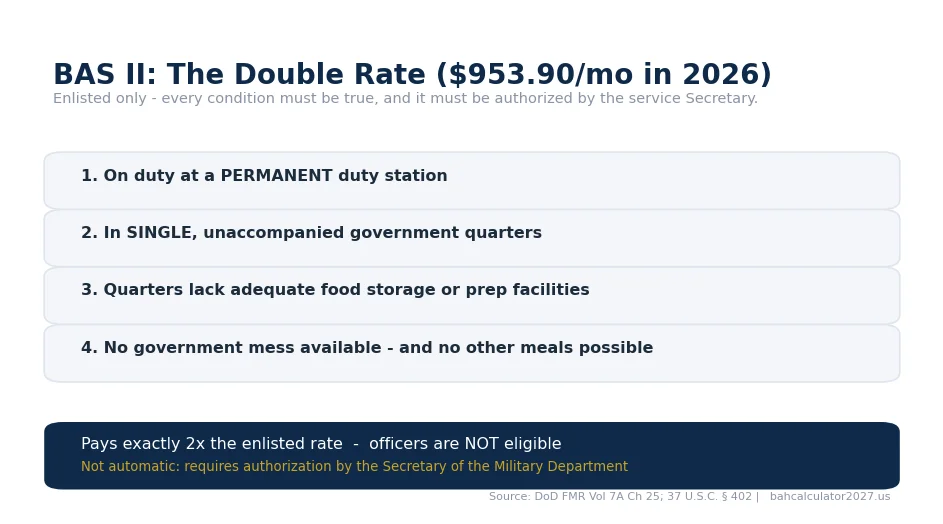
The logic is straightforward: if the government houses you somewhere you can’t cook and can’t feed you through a dining facility, your food costs are genuinely higher — eating out or buying prepared food for every meal — so the allowance doubles to match. If even one condition fails (say, a DFAC opens on post), BAS II goes away.
BAS vs. BAH vs. BNA: Stop Mixing These Up
Three acronyms, three completely different programs:
| BAS | BAH | BNA | |
|---|---|---|---|
| Full name | Basic Allowance for Subsistence | Basic Allowance for Housing | Basic Needs Allowance |
| What it’s for | Food (the member’s meals) | Housing (rent/utilities) | Household income support |
| 2026 amount basis | Flat: $476.95 enlisted / $328.48 officer | Varies by location, grade, dependents | Varies; tied to federal poverty guidelines |
| Taxable? | No | No | Yes (withholding taken) |
| Dependents matter? | No — member only | Yes — with/without rates | Yes — only paid to members with dependents |
The BAS/BNA mix-up is the most common one, because the names sound alike. They’re opposites in the ways that matter: BAS is automatic for active-duty members and tax-free; BNA is a targeted, taxable supplement for lower-income households with dependents, and you have to qualify for it. If someone tells you their BAS is being taxed, they’re almost certainly talking about BNA.
There’s a fourth allowance travelers mix into this list: military per diem — the daily travel allowance for TDY and PCS travel (lodging plus meals and incidentals). BAS covers your meals at home; per diem covers your meals when you’re traveling on orders.
And since two wrong claims are circulating online, a quick correction box:
- “BAS depends on your rank and marital status.” False. BAS is identical for every enlisted member from E-1 to E-9 and doesn’t change when you marry. Only the officer/enlisted divide (plus BAS II) exists.
- “BAS goes up with the Social Security COLA.” False. BAS is adjusted from the USDA food-cost index, not the Social Security cost-of-living adjustment. They can move in different directions in the same year.
10 Years of BAS Rates: What History Tells You
Here’s the enlisted and officer rate for each year since 2015, with the year-over-year change. Rates come from the DoD’s Financial Management Regulation (Volume 7A, Chapter 25) and DFAS tables:
| Effective Jan 1 | Enlisted | Officer | YoY change |
|---|---|---|---|
| 2026 | $476.95 | $328.48 | +2.4% |
| 2025 | $465.77 | $320.78 | +1.2% |
| 2024 | $460.25 | $316.98 | +1.7% |
| 2023 | $452.56 | $311.68 | +11.2% |
| 2022 | $406.98 | $280.29 | +5.3% |
| 2021 | $386.50 | $266.18 | +3.7% |
| 2020 | $372.71 | $256.68 | +0.9% |
| 2019 | $369.39 | $254.39 | 0% |
| 2018 | $369.39 | $254.39 | +0.3% |
| 2017 | $368.29 | $253.63 | 0% |
| 2016 | $368.29 | $253.63 | +0.1% |
| 2015 | $367.92 | $253.38 | +2.9% |
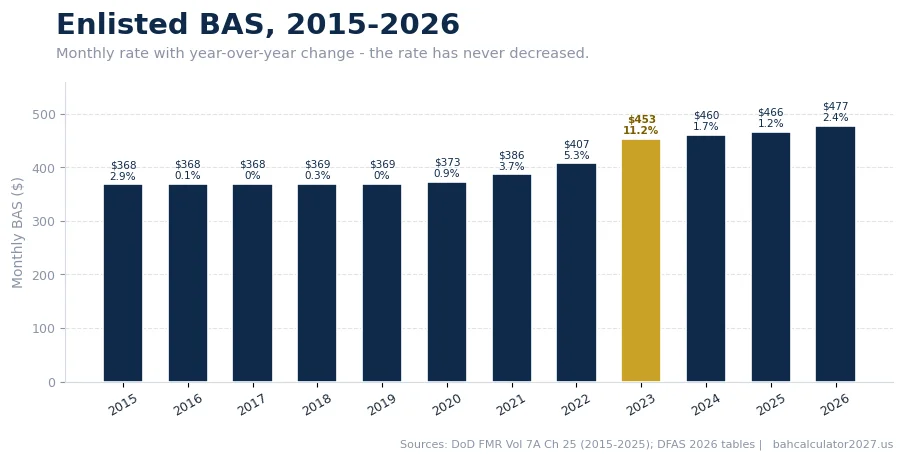
The pattern tells a clear story: in normal years BAS creeps up 1–4%, roughly tracking grocery inflation. Every so often — 2023 being the latest and biggest example — food prices jump and BAS follows. And because the statute forbids decreases, the ratchet only moves one way: in the entire 2015–2026 span, the rate never fell a single cent.
Common Situations, Quick Answers
Going through a divorce? BAS doesn’t change — it’s the member’s personal allowance, not a family benefit. What changes in a divorce is BAH dependency status and potentially BAH-DIFF; I cover all of that in What Happens to BAH in Divorce?.
Using the GI Bill while on active duty? As long as you’re still on active duty at a permanent duty station, you keep your BAS. Veterans using the GI Bill after separating don’t get BAS — it’s active-duty pay, not an education benefit. (The GI Bill’s own housing stipend is a separate VA program.)
Can you get BAS paid in advance? The statute allows up to three months of BAS to be paid in advance — a rarely used provision, mostly relevant for unusual circumstances. Your finance office handles it.
Does BAS count if you’re trying to figure out total military pay? Absolutely — and it’s part of why “military pay” comparisons with civilian salaries mislead people. BAS plus BAH is thousands of dollars a year of tax-free compensation that never appears in a base-pay figure. If you want the complete picture, start with my beginner’s guide to the whole system: What Is BAH?, and the pillar 2026/2027 BAH rates complete guide.
What About BAS in 2027?
The 2027 BAS rates don’t exist yet — DFAS publishes them around mid-December 2026, alongside the new military pay tables. When they do, the number will come from the USDA’s October 1, 2026 liberal food plan determination. Given recent food inflation, expect a modest single-digit increase, but that’s informed reading of the mechanism — not a prediction.
I’ll update this article the week the official 2027 rates drop. In the meantime, if you’re watching the 2027 numbers generally, my BAH Increase 2027 guide and When Will 2027 BAH Rates Be Released? track the same December announcement.
Frequently Asked Questions
What does BAS stand for?
BAS stands for Basic Allowance for Subsistence — the U.S. military’s monthly food allowance for service members. It’s paid on top of base pay and BAH.
How much is BAS per month in 2026?
Enlisted members receive $476.95 per month; officers receive $328.48 per month. Enlisted members who qualify for BAS II receive $953.90 per month. All rates are tax-free and effective January 1, 2026.
Is BAS taxable income?
No. BAS is excluded from gross income under federal law (26 U.S.C. § 134). It doesn’t appear in Box 1 of your W-2 and isn’t subject to federal or state income tax.
Do you get BAS in basic training?
No. Federal law specifically excludes BAS during basic training — the military provides your meals directly at no cost instead. You start drawing BAS when you reach your first permanent duty station.
What is BAS II and who qualifies?
BAS II is a double-rate BAS ($953.90/month in 2026) for enlisted members at a permanent duty station who live in single government quarters without adequate cooking facilities, where no dining facility is available and the government can’t otherwise provide meals. It must be authorized by the service Secretary, and officers can’t receive it.
Does BAS change if I get promoted, married, or have a child?
No. BAS is identical for every enlisted member regardless of rank, and identical for every officer. Marriage, children, and promotions don’t change it — only the enlisted/officer divide and BAS II matter.
What’s the difference between BAS and BNA?
BAS (Basic Allowance for Subsistence) is the tax-free food allowance every active-duty member gets. BNA (Basic Needs Allowance) is a separate, taxable supplement for lower-income service members with dependents. They sound alike but work completely differently.
Can officers get BAS II?
No. BAS II is enlisted-only by law. Officers receive only the standard officer BAS rate.
Do you get BAS if you live in the barracks?
You technically rate it, but if you’re on a DFAC meal plan, mandatory meal deductions reduce it to pay for your dining facility meals. If your duties prevent DFAC use, waivers may be available through your chain of command.
Do you get BAS while deployed?
It depends on the deployment — whether government meals are provided in your situation determines whether BAS continues or is reduced. Check with your finance office before deploying.
Does the National Guard get BAS?
Only while on active-duty orders, prorated by the number of days served. Regular drill weekends don’t earn BAS.
Can BAS decrease from one year to the next?
No. The statute explicitly prohibits a year-over-year decrease — if food costs fell, you’d keep the prior year’s rate. In practice the rate has never decreased.
Independent guide — not affiliated with the U.S. Department of Defense or any military branch. Last updated: October 17, 2026. Rates shown are official 2026 figures; 2027 BAS rates will be added when DFAS publishes them (~mid-December 2026).