
Duty Station BAH Comparison 2027
PCS orders in hand? Compare your exact BAH at two duty stations side by side — same grade, same dependent status.
Compare two stations
Comparison result
Why compare duty stations before you PCS
Your BAH resets to your new area’s published rate the day you PCS — and the gap between stations can be thousands of dollars a month. Comparing first means you sign your next lease with the real number in hand instead of discovering it on your LES.
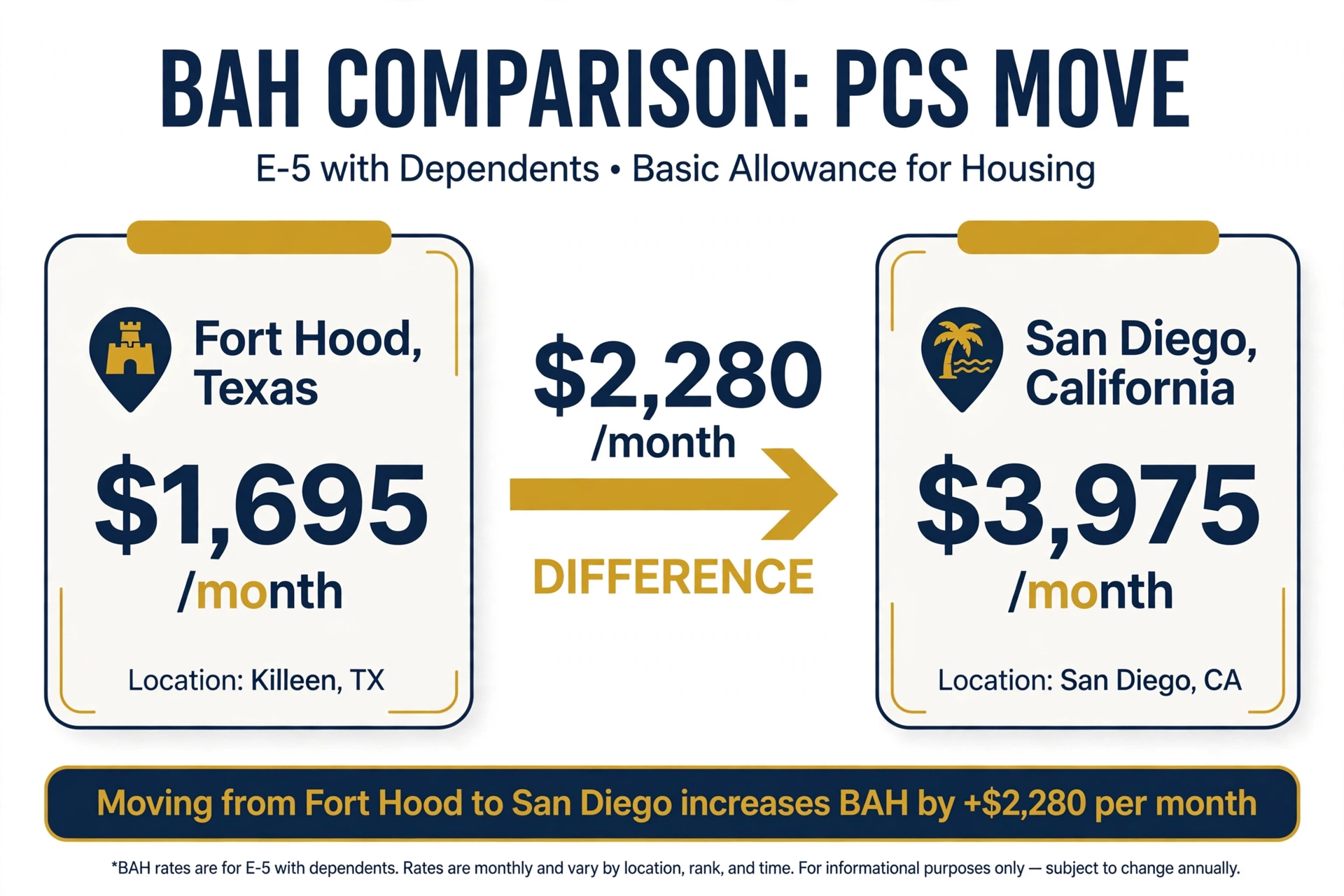
Real example: an E-5 with dependents PCSing from Fort Hood ($1,695/month) to San Diego ($3,975/month) gains $2,280/month — that’s $27,360 a year in tax-free housing money. Going the other direction, you’d need to know your budget is shrinking before you house-hunt.
Biggest BAH gaps between popular stations
E-5 with dependents, official 2026 tables — the moves where BAH changes the most:
| The move | From | To | Monthly change |
|---|---|---|---|
| Fort Hood, TX → San Diego, CA | $1,695 | $3,975 | +$2,280 |
| Tacoma, WA → San Francisco, CA | $2,556 | $5,127 | +$2,571 |
| Norfolk, VA → San Diego, CA | $2,430 | $3,975 | +$1,545 |
| San Antonio, TX → Washington DC | $1,869 | $3,132 | +$1,263 |
Every pairing is computed from the same official DTMO 2026 tables this site’s calculators use.
How to use this comparison
- Enter both duty-station ZIPs — BAH follows your duty location, not where you rent.
- Pick your grade and dependent status — the same status for both sides keeps it apples-to-apples.
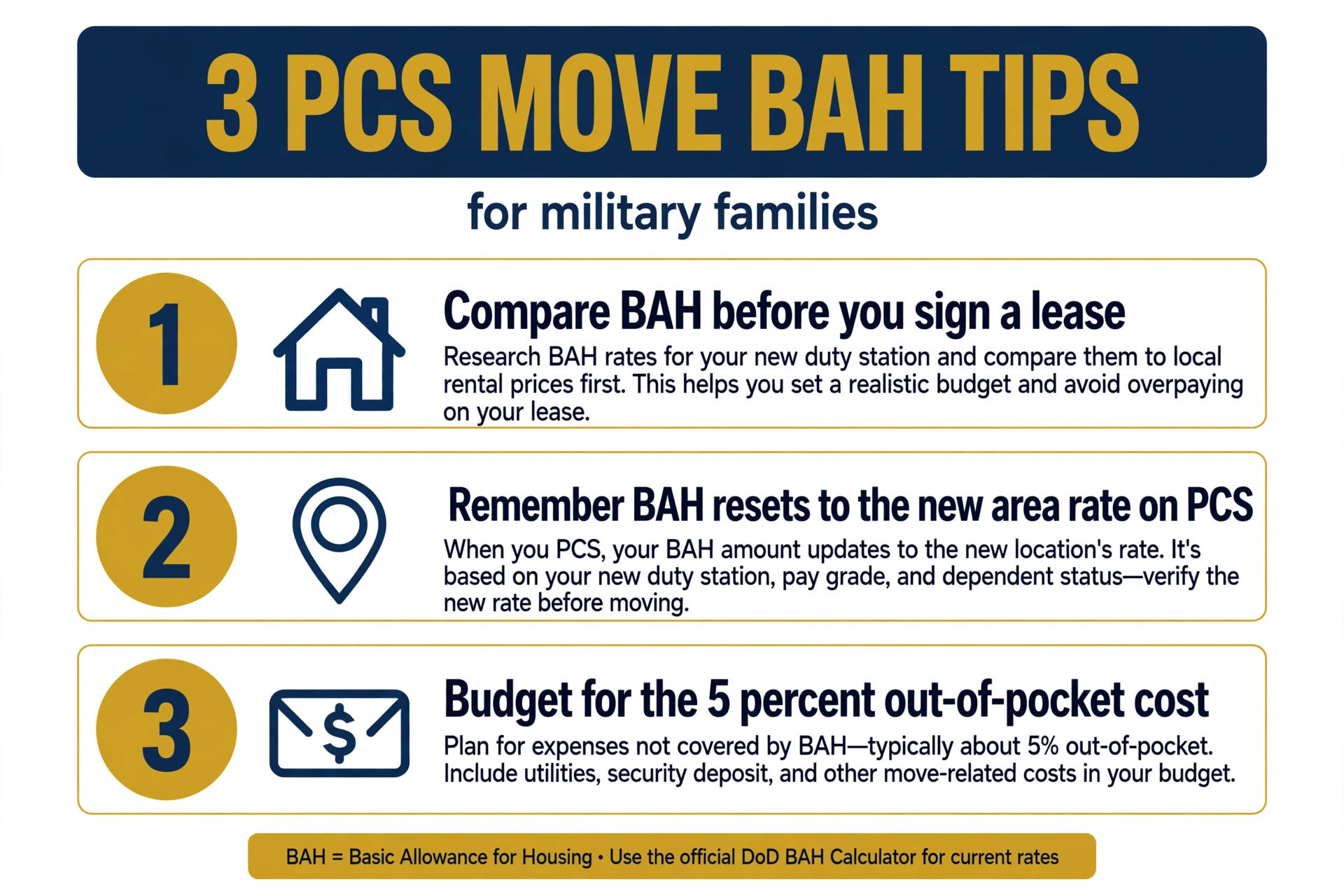
- Read the gap, then budget — the difference is your monthly swing. Subtract ~5% out-of-pocket and set your rent target.
PCS and BAH: the rules that matter
| Situation | What happens to your BAH |
|---|---|
| You PCS to a higher-cost area | Your BAH increases to the new area’s published rate. |
| You PCS to a lower-cost area | Your BAH decreases to the new area’s rate — rate protection doesn’t carry over to a new station. |
| Your area’s published rate drops while you stay | Your personal rate is protected — it can’t go down. |
| You get promoted | Your BAH moves up to your new grade’s rate for your area. |
| New annual rates publish (Jan 1) | Everyone moves to the new tables — increases apply; decreases can’t touch protected members. |
Duty-station BAH questions, answered
Does my BAH change when I PCS?
Yes. BAH is tied to your duty station’s Military Housing Area, so a PCS resets your rate to the new location’s published table — effective with your move, per your orders.
What if the new station’s BAH is lower than my old one?
Then your BAH goes down to the new area’s rate. Rate protection only shields you from published-rate decreases while you stay in the same area — it doesn’t transfer to a new station.
Can my BAH drop if I don’t move?
No. If the published rate for your area falls while you’re still stationed there, your personal rate is protected and stays put.
Which ZIP codes should I compare?
Your current and future duty-station ZIPs — BAH follows the duty location, not the neighborhood you rent in.
Does this comparison include 2027 projections?
This tool compares official 2026 rates. For 2027 planning scenarios, use the projection toggle on the main BAH calculator.
What if one station is in an OHA area?
Some ZIPs — mostly overseas and certain territories — have no BAH table and fall under OHA instead. The calculator will flag them.
Should I compare with or without dependents?
Use your actual dependent status — the gap between stations can differ between the two rate columns.
Does BAH cover my full rent?
BAH is designed to cover about 95% of typical housing costs. Plan on roughly 5% out-of-pocket — the DoD estimated $93 to $212/month in 2026.
How accurate is this comparison?
Both sides come from the official DTMO 2026 BAH tables, mapped across 40,959 ZIP codes — the same data behind the DoD’s own lookup.
When do the new annual rates take effect?
January 1 each year. The 2027 tables are expected mid-December 2026 and take effect January 1, 2027.
Compare before you sign
Two ZIPs, one grade, zero surprises on move day.
Need your exact single-station rate? Use the main BAH calculator.