
COLA Explained: Military Cost of Living Allowance [2027]
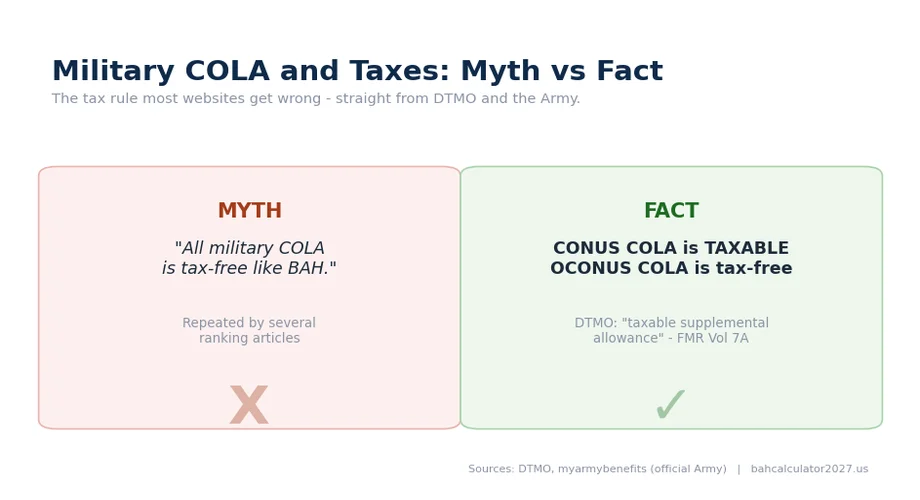
Military COLA — Cost of Living Allowance — is extra monthly pay for service members stationed in places where everyday life costs more than average. It covers non-housing costs like groceries, gas, and clothing (housing is BAH’s job, not COLA’s). There are two kinds: CONUS COLA for 18 high-cost areas inside the continental U.S., and OCONUS COLA for expensive overseas stations. Here’s the part most websites get wrong: CONUS COLA is taxable income, while OCONUS COLA is tax-free.
If you’ve ever stared at your LES and wondered what a new line of pay meant, you’re not alone. Plenty of military families first meet COLA that way — an extra $384 a month labeled “CONUS COLA” after a PCS to San Francisco, or a COLA line that vanished entirely in the 2026 update with no explanation. If you’re trying to figure out what military COLA is, whether you rate it, and how much you’ll get, this guide walks through all of it with real 2026 numbers.
Independent guide — not affiliated with the U.S. Department of Defense or any military branch. Last updated: October 19, 2026.
The Two Types: CONUS COLA vs OCONUS COLA
The military pays two completely different COLAs, and mixing them up causes most of the confusion I see online:
| CONUS COLA | OCONUS COLA | |
|---|---|---|
| Where | 18 high-cost areas in the continental U.S. | Expensive duty stations overseas (incl. AK & HI) |
| Tax status | Taxable — shows on your W-2 | Tax-free |
| What it covers | Non-housing costs (food, transport, clothing) | Non-housing costs (food, transport, clothing) |
| Updated | Once a year, effective January 1 | Twice a month (1st & 16th), currency-driven |
| Rulebook | DoD FMR Vol 7A, Chapter 67 | DoD FMR Vol 7A, Chapter 68 |
The key thing to remember: BAH handles your rent. COLA handles everything else that costs more because of where you’re stationed. An E-5 with dependents in San Francisco gets BAH of $5,127 a month for housing (2026 DTMO rate) plus $384 a month in CONUS COLA for everything else. They stack.

Is Military COLA Taxable? (The Myth Most Sites Get Wrong)
This is where I need to be blunt, because several ranking articles flat-out get it wrong: they claim all military COLA is “non-taxable.” That’s only half true.
CONUS COLA is taxable. The Defense Travel Management Office calls it a “taxable supplemental allowance” — those are DTMO’s own words. The Army’s official benefits site says the same: “Unlike other allowances, COLA is considered taxable, however, an additional amount is included to cover the average tax rate.” So your CONUS COLA shows up in your taxable wages on your W-2, and yes, you’ll owe federal income tax on it. DoD builds a little extra into the rate to offset the average tax bite, but it’s still taxable income.
OCONUS COLA is tax-free, like BAH. If you’re stationed in Tokyo or Grafenwoehr, your COLA doesn’t touch your taxable income.
Why does this matter? Because if you’re comparing two sets of orders — say San Diego versus Norfolk — the after-tax value of that $48-a-month San Diego COLA is a few dollars less than it looks. Small money, but it’s the kind of detail that separates a real guide from a copied one. (For the full tax picture on your allowances, see my guide on whether BAH is taxable.)
2026 CONUS COLA Rates by Location
Only 18 areas in the entire country qualify for CONUS COLA in 2026 — roughly 2,612 ZIP codes. Here are the official 2026 rates, with the monthly amount for an E-5 with 4 years of service and dependents (the DoD’s standard example):
| Location | COLA Index | E-5/mo (w/ dependents) |
|---|---|---|
| San Francisco, CA | 8 | $384 |
| Oakland, CA | 6 | $288 |
| Santa Clara County, CA | 5 | $240 |
| New York City, NY | 4 | $192 |
| Seattle, WA | 4 | $192 |
| Staten Island, NY | 4 | $192 |
| Los Angeles, CA | 3 | $144 |
| Sacramento, CA | 3 | $144 |
| Long Island, NY | 2 | $96 |
| Westchester County, NY | 2 | $96 |
| Baltimore, MD | 1 | $48 |
| Camp Pendleton, CA | 1 | $48 |
| Chicago, IL | 1 | $48 |
| Everett, WA | 1 | $48 |
| Marin/Sonoma, CA | 1 | $48 |
| Nantucket, MA | 1 | $48 |
| San Diego, CA | 1 | $48 |
| Warrenton, VA | 1 | $48 |
Notice the pattern: California and New York dominate the list. And notice what’s not on it — more on that in the 2026 shakeup section below, because some expensive places lost COLA entirely.
Your exact amount depends on your pay grade, years of service, and whether you have dependents. In 2025, payments ran $35–$60 per index point per month for members with dependents and $27–$46 without — so a higher index means proportionally more money.

How Your COLA Is Calculated
The formula is refreshingly simple:
Monthly CONUS COLA = Base Rate × Location Index
The base rate comes from your pay grade, years of service, and dependency status (DoD publishes the payout tables). The location index (1 to 8) reflects how far above the national average your area’s non-housing costs run. San Francisco’s index of 8 is the max.
Worked example: our E-5 with 4 years in and dependents has a base rate of $48. Stationed in San Francisco (index 8): $48 × 8 = $384/month, or $4,608 a year — on top of base pay and BAH. Same Marine in San Diego (index 1): $48 × 1 = $48/month.
Three things worth knowing about the math:
- It’s your duty station ZIP code that determines eligibility, not the base name. Two people at the same installation can get different COLA if their duty ZIPs fall in different zones.
- You don’t apply — it’s automatic. If your ZIP qualifies, it shows up on your LES.
- It can be paid even if you live in barracks, base housing, or onboard a ship. COLA isn’t about where you sleep; it’s about what groceries and gas cost around you.
Do You Qualify for COLA?
An area only qualifies if its non-housing costs exceed 108% of the national average — that’s the DoD threshold. A few things that feed into the calculation:
- Commissary, exchange, and hospital access. If your station lacks this infrastructure, your cost of living runs higher — but that alone isn’t enough to qualify an area.
- Local taxes, including taxes on privately owned vehicles.
- Actual shopping patterns. DoD runs a Living Pattern Survey of service members (the next one starts January 2027) to see where and how you really spend.
And the flip side: if your duty station’s costs are at or below the U.S. average, you get zero COLA. Most of the country gets nothing — only those 18 areas clear the bar. Being overseas doesn’t automatically qualify you either; OCONUS COLA only pays where the local economy genuinely costs more than CONUS.
Why Did My COLA Disappear in 2026?
If your January 2026 LES showed a smaller COLA — or none at all — you’re not imagining it. The 2026 update was one of the biggest shakeups in years:
| Change | Count |
|---|---|
| Areas that lost COLA entirely | 9 military housing areas |
| Areas added | 6 |
| Areas with an increase | 8 |
| Areas with a decrease | 2 |
| Areas unchanged | 2 |
| Non-metro counties removed | 21 |
The biggest drop: Humboldt County, California went from 5% to zero. The biggest gain: Seattle went from 0% to 5%. And some famously expensive places lost eligibility completely — Boston, Riverside, San Bernardino, and San Luis Obispo are all off the 2026 list.
This trips people up because COLA isn’t about rent or home prices — that’s BAH’s territory. It’s about non-housing costs versus the national average. An area can feel brutally expensive (hello, Boston rents) and still lose COLA if its groceries, gas, and services don’t clear the 108% threshold. If your COLA vanished, pull your January LES and check your duty ZIP against DTMO’s CONUS COLA Rate Lookup — that’s the official answer, not your buddy’s guess.

COLA vs BAH: How They Stack
New troops often ask whether COLA replaces BAH or duplicates it. Neither — they’re built to stack, because they cover different things:
- BAH = your housing costs (rent, utilities, insurance). Tax-free. Based on the local rental market.
- CONUS COLA = your non-housing costs (food, transportation, clothing, services). Taxable. Based on the local cost of everything else.
Real example — E-5 with dependents, San Francisco, 2026: BAH $5,127/mo + CONUS COLA $384/mo = $5,511/mo in location-based allowances, before base pay. Same grade in San Diego: BAH $3,975/mo + COLA $48/mo. That’s why comparing duty stations on BAH alone misses part of the picture — and why my BAH rate by ZIP code guide pairs well with a COLA lookup when you’re weighing orders.
One more stacking note: if you’re sent overseas, BAH swaps out for OHA (here’s how they compare), and CONUS COLA swaps out for OCONUS COLA. The system is designed so you’re never double-paid or zero-paid on either side of the ocean.
OCONUS COLA: Currency, Updates, and the 10-Point Cap
Overseas COLA plays by different rules because exchange rates move:
- Updated twice a month (effective the 1st and 16th), driven heavily by currency fluctuations. A weaker dollar usually means higher COLA.
- Decreases are capped. Under the FY2024 NDAA, data-driven COLA cuts can’t exceed 10 index points and phase in at 2 points per month — so your paycheck can’t fall off a cliff. Currency-driven changes, though, go into effect in full the next pay period.
- It’s tax-free, unlike its CONUS cousin.
- As of 2026, the market-basket price data comes from a private contractor (previously collected by Country Allowance Coordinators at each location).
If you’re headed OCONUS, check DTMO’s station allowance change notices — they’re posted with each 1st/16th update and list exactly which countries moved.
Don’t Confuse It: COLA Allowance vs the 3.6% 2027 COLA Adjustment
Quick but important clarification, because search results mix these together: there are two different “COLAs” in military life.
- Cost of Living Allowance (this article) — monthly pay for active-duty members in expensive duty stations.
- Cost of Living Adjustment — the annual inflation bump to retirement and disability checks. On October 14, 2026, the Social Security Administration announced the 2027 adjustment is 3.6%, which also raises military retired pay and VA disability compensation (the 2026 adjustment was 2.8%).
If you’re active duty wondering about your paycheck, you want #1. If you’re retired or on VA disability wondering about your 2027 checks, you want #2 — and 3.6% is your number.
2027 Outlook: When New Rates Drop
Here’s the honest answer on 2027: the 2027 CONUS COLA rates haven’t been announced yet. DoD sets CONUS COLA once a year, and the new rates are typically announced in December and take effect January 1. So expect the 2027 list — which areas gain, lose, or change index — around December 2026.
What I’ll be watching:
- The January 2027 Living Pattern Survey — its results feed future COLA decisions.
- Whether any of the 9 areas dropped in 2026 claw their way back.
- The December announcement itself — I’ll update this guide the week it drops.
One thing I won’t do: invent 2027 rates. Every number in this article is a verified 2026 figure. When the real 2027 rates publish, this page gets refreshed — that’s the deal. You can also track your total compensation picture on the BAH calculator and the 2026 military pay chart.
Frequently Asked Questions
What is military COLA in simple terms?
Extra monthly pay for service members stationed in high-cost areas. It offsets non-housing costs — groceries, gas, clothing — that run above the national average. CONUS COLA covers 18 U.S. areas; OCONUS COLA covers expensive overseas stations.
Is military COLA taxable?
CONUS COLA is taxable — it appears in your W-2 wages (DoD adds a little extra to offset average taxes). OCONUS COLA is tax-free, like BAH.
How much is CONUS COLA in 2026?
It ranges from $48/month (index-1 areas like San Diego or Chicago, E-5 with dependents) to $384/month (San Francisco, index 8). Your amount depends on pay grade, years of service, dependency status, and location index.
Do I have to apply for COLA?
No. It’s automatic — if your duty station ZIP code is in a qualifying area, it appears on your LES. Check DTMO’s CONUS COLA Rate Lookup with your duty ZIP to confirm.
Why did my COLA go away in 2026?
Nine military housing areas lost eligibility in the 2026 update (including Boston, Riverside, and San Bernardino) because their non-housing costs no longer exceed 108% of the national average. COLA isn’t based on rent — that’s BAH’s job.
What’s the difference between COLA and BAH?
BAH covers housing costs and is tax-free. COLA covers non-housing costs (food, transport, clothing) in high-cost areas. They stack — a San Francisco E-5 with dependents gets $5,127 BAH + $384 COLA in 2026.
Does COLA count if I live in the barracks?
Yes. CONUS COLA can be paid to members in barracks, base housing, or onboard ships — it’s based on area costs, not your housing situation.
How often does OCONUS COLA change?
Twice a month (effective the 1st and 16th), largely driven by currency exchange rates. Decreases are capped at 10 index points and phased in at 2 points per month under the FY2024 NDAA.
Is the 3.6% 2027 COLA the same thing?
No. The 3.6% (announced October 14, 2026) is the Cost-of-Living Adjustment for retirees, Social Security, and VA disability. The COLA allowance in this article is separate monthly pay for active-duty members.
When will 2027 CONUS COLA rates be announced?
Typically in December 2026, effective January 1, 2027. This guide will be updated when DoD publishes them.
Sources: Defense Travel Management Office (travel.dod.mil) — CONUS COLA Rate Lookup, Overseas COLA Tables, Allowances Division; myarmybenefits.us.army.mil (official Army benefits); DoD FMR Vol 7A Ch. 67/68; DoD 2026 CONUS COLA announcement via military.com; DTMO 2026 BAH rates file (bahw26.txt); Social Security Administration (2027 COLA 3.6%, Oct 14, 2026).