
What Happens to BAH During Deployment? [2027 Guide]
You’re getting deployment orders. Your mind is racing — family, packing, timelines. And somewhere in that storm, a practical question surfaces: what happens to my BAH while I’m gone?
I’ve dug through the official rules, the forum threads where real servicemembers share what actually happened to them, and the news coverage of the recent pay changes. Here’s everything you need to know — including the $300/month most guides don’t even mention.
The Short Answer
BAH doesn’t stop when you deploy
Let’s get the biggest worry out of the way first: your BAH continues during deployment. The military isn’t going to pull your housing money while you’re serving overseas. Your family still needs a roof, whether you’re home or not — and the system is designed around that reality.
The official Army guidance puts it plainly: BAH “does not normally change due to a contingency deployment.” That one sentence covers most situations. But the details matter, so let’s go through them.
The 30-day threshold
Most deployment-related pay rules kick in at 30 continuous days of separation. Shorter trips — a two-week training exercise, a brief TDY — generally don’t change anything about your BAH. Travel like that is paid under per diem — the daily travel allowance for TDY trips — rather than through your housing allowance. It’s the longer deployments, the ones that actually disrupt your household, where the full set of rules (and the extra allowances) apply.

Married? Here’s Exactly What Happens
BAH continues at the with-dependents rate
If you’re married (or have dependents), your BAH keeps flowing at the with-dependents rate for your pay grade and duty station throughout the deployment. Nothing to apply for, nothing to activate. It just continues.
This makes sense when you think about it: your spouse still has to pay rent or the mortgage, utilities still run, the kids still need their rooms. Your absence doesn’t shrink the household budget — if anything, it stretches it thinner with one parent managing everything alone.
It’s based on your duty station — not where your family goes
Here’s where it gets interesting. Your BAH during deployment is based on your permanent duty station’s ZIP code — not wherever your family happens to be.
So if you’re stationed at Fort Hood (Texas) but your spouse moves back to Ohio to stay with her parents during your deployment, your BAH stays at the Fort Hood rate. It doesn’t follow your family to Ohio. It doesn’t drop because they’re staying somewhere cheaper. It stays locked to your duty station.
There are rare command-authorized exceptions, but the default rule is simple: duty station sets the rate, period.
The spouse-relocation arbitrage (nobody talks about this)
Let’s be honest about the math here, because no official guide will say it plainly: if your BAH is based on a high-cost duty station (say, San Diego at $3,975/month for E-5 with dependents) and your spouse relocates to a low-cost area during deployment (say, rural Ohio where rent is $900/month), the difference is yours to keep.
That’s not gaming the system — it’s how the rule works. Your BAH is tied to your duty station, and where your family lives during deployment is a personal decision. Some families use this to aggressively save during deployment. Others stay put for stability, especially with kids in school. Both are valid. Just know the math.
The flip side: if your spouse moves somewhere more expensive than your duty station area, that extra cost comes out of your pocket. Plan accordingly.
Single? Three Scenarios
Single servicemembers face the most confusion here, because the answer depends entirely on your housing situation. Let’s cover all three.
Scenario 1: You live in the barracks
Simplest case. If you’re in government barracks, you’re not receiving BAH (or you’re receiving partial BAH in some cases). Deployment doesn’t change that. You deploy, you come back, your rack is still there. Nothing to think about.
Scenario 2: You live off-post with BAH
If you’re already authorized BAH and living off-post, you keep it during deployment. Even if you’re gone for 9 months. The BAH continues at your normal rate.
This surprises a lot of junior enlisted who assume BAH stops when they’re not physically in the apartment. It doesn’t. As long as you were authorized BAH before deploying, it continues.
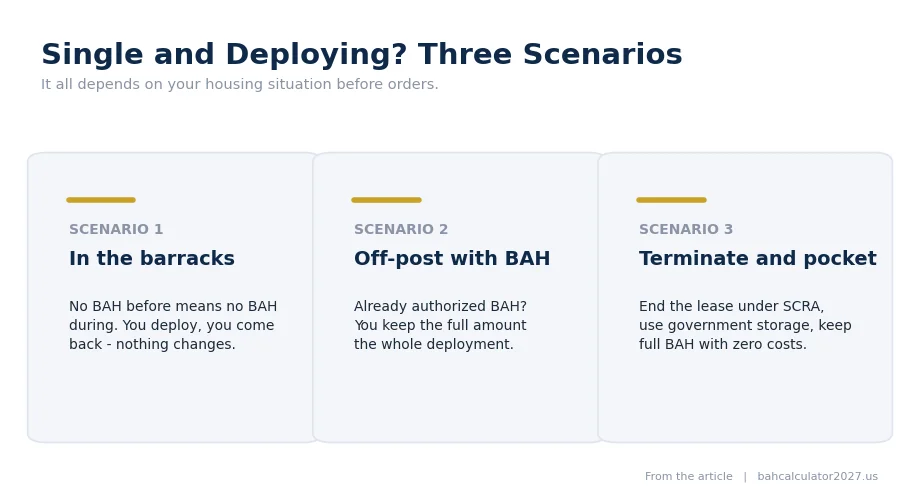
Scenario 3: The terminate-lease-and-pocket strategy
Here’s what the forums know but no official guide explains plainly: as a single soldier deploying, you can legally terminate your lease (more on the SCRA process below), put your belongings in government-paid storage, and keep collecting your full BAH while deployed.
Read that again. You can have zero housing expenses — no rent, no utilities — and still receive your full monthly BAH. For an E-4 in San Diego, that’s over $2,700/month in pure savings potential.
This is completely legal and widely done. The military provides household goods storage at government expense during deployment specifically because they expect you to do this. It’s not a loophole — it’s the system working as designed.
The one exception: if you’re reassigned back to barracks upon return (or your command requires it), BAH eligibility can change. But for most deploying single soldiers with existing BAH authorization, the money keeps flowing.
Family Separation Allowance: The $300/Month Nobody Talks About
BAH gets all the attention, but there’s a second payment that stacks on top of it during deployment — and most guides barely mention it.
What FSA actually is
Family Separation Allowance (FSA) is a separate monthly payment for servicemembers who are involuntarily separated from their dependents for more than 30 continuous days due to military orders. It’s meant to offset the extra costs of running a household solo — higher utility bills, emergency childcare, all the things that get more expensive when one parent is gone.
The key word is stacks: FSA is paid in addition to BAH, not instead of it. You get both.
The $300 rate (and why it matters)
As of January 1, 2026, FSA is $300 per month. That might not sound like much, but consider the history: it was stuck at $250/month since 2002 — over two decades without an increase, through multiple wars and relentless inflation. The FY2026 NDAA finally raised it, a 20% bump.
Here’s the frustrating part that military advocates keep pointing out: Congress actually authorized the Pentagon to go up to $400/month back in the FY2024 defense bill. The Pentagon just… didn’t do it, calling the increase “discretionary.” So families got $300 instead of $400. Keep that number in mind — we’ll come back to it in the 2027 section.
BAH + FSA combined: real numbers
This is the math nobody puts in one place. Here’s what deployment actually pays in housing-related allowances, using 2026 BAH rates for San Diego (E-5 with dependents):
| Allowance | Monthly Amount |
|---|---|
| BAH (E-5, with dependents, San Diego) | $3,975 |
| FSA | $300 |
| Combined total | $4,275 |
That’s $4,275/month — $51,300/year — in housing and separation allowances alone, before base pay, BAS, or any other entitlements. For a Fort Hood E-5 ($1,695 BAH), the combined total is $1,995/month. The BAH varies wildly by location; the FSA is the same $300 everywhere.

Dual-military couples and FSA
If both spouses serve and both receive qualifying deployment orders, each can receive FSA — that’s $600/month combined. The requirement: you must have been living together with shared dependents before the orders were issued.
There’s one cap to know about: if the couple has no dependents other than each other, they’re limited to one FSA payment ($300), not two. But with kids in the picture, both spouses qualify independently.
Combined with dual BAH continuing for both members, a deploying dual-military couple can see very substantial monthly allowances. An E-5 + E-4 couple in San Diego: $6,738 (combined BAH) + $600 (combined FSA) = $7,338/month.
Will FSA hit $400 in 2027?
This is the question I’m watching. Congress already gave the Pentagon authority to pay up to $400/month. They chose $300. But the authorization is still there, and military family advocates are still pushing.
If the FY2027 NDAA or a DoD policy update closes that gap, FSA jumps another $100/month — $1,200/year per deploying servicemember. I’ll update this guide the moment anything changes. For now, plan on $300 and treat any increase as a bonus.
The Full Deployment Pay Stack (Worked Example)
BAH and FSA are just the start. If you deploy to a combat zone or designated danger area, two more pays stack on top — and both changed on October 1, 2026, for the first time since 2002:
- Hostile Fire Pay (HFP): $225 → $450/month (paid for the full month once your commander certifies exposure)
- Imminent Danger Pay (IDP): $225 → $275/month (prorated at $9.16/day)
One critical rule: HFP and IDP are mutually exclusive — you get one or the other in a given month, never both. For the full breakdown — who qualifies, how each pay is calculated, the tax rules, and the hardship-pay cut tucked into the same 2026 memo — see my hazard pay and military special pays guide.
Here’s what a 9-month deployment actually pays for an E-5 with dependents at Fort Hood (2026 BAH: $1,695/month):
| Pay | Monthly | × 9 months |
|---|---|---|
| BAH (Fort Hood, E-5 with dependents) | $1,695 | $15,255 |
| FSA | $300 | $2,700 |
| Hostile Fire Pay | $450 | $4,050 |
| Total | $2,445 | $22,005 |
In a danger area without hostile fire (IDP instead of HFP): $1,695 + $300 + $275 = $2,270/month, or $20,430 over 9 months.
Your Lease During Deployment
The SCRA 90-day rule, explained simply
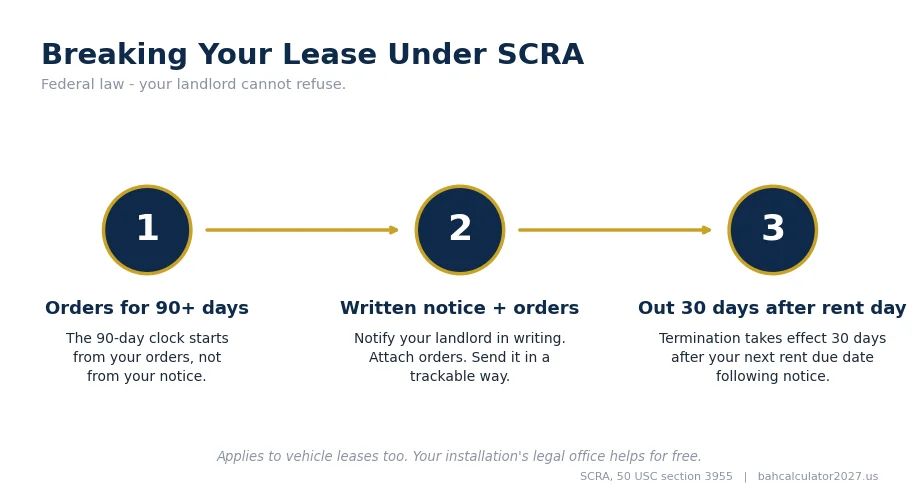
The Servicemembers Civil Relief Act (SCRA) gives you the right to terminate a residential lease if you receive deployment orders for 90 days or more. This is federal law — your landlord cannot refuse, no matter what your lease says.
Key details most summaries skip:
- The 90-day clock starts from your orders, not from when you tell your landlord
- Termination takes effect 30 days after your next rent due date following your notice — so if rent is due on the 1st and you give notice on the 15th, you’re covered through the end of next month
- Applies to vehicle leases too — same 90-day rule for car leases
How to actually break a lease — step by step
- Write a formal letter to your landlord stating you’re terminating under SCRA (50 USC §3955)
- Attach a copy of your deployment orders (or a letter from your commanding officer)
- Send it in a trackable way — certified mail, email with read receipt, anything with proof of delivery
- Document the condition of the apartment with photos/video before you leave
- Get written confirmation from your landlord acknowledging the termination date
Your security deposit must be returned under normal state law timelines. If your landlord gives you trouble, your installation’s legal assistance office will intervene for free — this is literally what they’re there for.
Should you break it or keep it?
This is a real decision, not an obvious one:
Break the lease if: you’re single, your stuff fits in government storage, and you’d rather pocket the BAH. This is the maximum-savings play.
Keep the lease if: you have a family staying in the area, you have pets that need the space, your kids are in local schools, or the hassle of finding a new place post-deployment outweighs the savings. Stability has value too.
There’s no wrong answer — just make it a conscious choice, not a default.
On-Post Housing During Deployment
Your family stays put
If you live in on-post/base housing, your family can stay there during your entire deployment. This is standard and expected. Your BAH continues to go directly to the housing provider, just as it did before you left.
You don’t need to apply, notify anyone special, or worry about losing your spot. The housing office knows deployments happen — it’s built into how they operate.
What if your spouse wants to move home?
Your spouse is free to relocate during your deployment — to stay with family, to save money, for any reason. But here’s the catch with on-post housing: if nobody is living in the unit, you may lose it.
Most installations require the housing unit to be occupied. If your family moves out entirely, you’ll typically need to terminate the on-post housing agreement. That means going through the housing waitlist again when you return — which can take months at popular installations.
Talk to your housing office before making this decision. Some installations have deployment-specific policies that are more flexible than the standard rules.
When Deployment Ends
Nobody writes about the return, but the financial transition matters.
BAH transition
Your BAH doesn’t change when you come home — it was already at your duty station rate throughout. The continuity is the point. What does change is your housing situation if you terminated your lease: you’ll need to find a new place, which means deposits, first month’s rent, and the general hassle of house-hunting after months away.
Budget for this before you deploy. Set aside the deposit money from the BAH you saved.
FSA stops
Family Separation Allowance ends when the separation ends. Your last $300 payment covers the month you return (it’s paid for full months of separation). Don’t budget for it beyond homecoming.
Re-signing a lease
If you broke your lease, start your housing search 30-60 days before your expected return date (have your spouse do the legwork if possible). Rental markets near bases move fast, and you don’t want to come home to a housing scramble. If you kept your lease, it’s just a matter of moving back in — one less thing to worry about.
What This Means for 2027
The FSA $400 watch
I’m keeping a close eye on this. Congress authorized $400/month. The Pentagon implemented $300. That $100 gap represents $1,200/year per deploying servicemember — real money for military families.
The FY2027 NDAA (working its way through Congress now) could close this gap, or the DoD could act on its existing authority. Either way, this page will be updated the moment anything changes. For planning purposes, assume $300 — but know that $400 is legally possible.
Deploying in 2027? Check the new rates first
If you’re deploying in 2027, your BAH will be based on the new December 2026 tables — not the 2026 rates. Before you go, run your ZIP through our BAH calculator to see your 2027 rate. If your area’s rate is projected to change significantly, that affects everything: your savings plan, your spouse’s budget, your lease decision.
Our 2027 BAH guide will have the official numbers the day they publish.
Frequently Asked Questions
Does BAH continue during deployment?
Yes. BAH continues at your permanent duty station rate throughout deployment. It does not stop or pause while you’re gone.
Do I get BAH at the with-dependents rate while deployed?
Yes, if you have dependents. Your dependent status doesn’t change because you’re deployed — your family still needs housing.
What is Family Separation Allowance and how much is it?
FSA is a $300/month payment (as of January 2026) for servicemembers involuntarily separated from dependents for 30+ continuous days. It’s paid in addition to BAH.
Can I receive both BAH and FSA during deployment?
Yes. They stack. An E-5 with dependents in San Diego gets $3,975 (BAH) + $300 (FSA) = $4,275/month.
I’m single and live off-post. Do I keep BAH while deployed?
Yes, if you were already authorized BAH before deploying. You can even terminate your lease and keep the full BAH while your belongings are in government storage.
Can I break my lease if I deploy?
Yes. The SCRA lets you terminate a residential lease for deployments of 90+ days. Give written notice with a copy of your orders.
What happens to on-post housing when I deploy?
Your family can stay in on-post housing for the entire deployment. Your BAH continues going to the housing provider as normal.
Does my spouse have to stay at our duty station during my deployment?
No. Your spouse can relocate anywhere. But your BAH stays locked to your duty station rate — it doesn’t follow your family.
Do dual-military couples both get FSA during deployment?
Yes, if both receive qualifying orders and lived together before separation — $600/month combined. The exception: couples with no dependents besides each other are capped at one $300 payment.
Will FSA increase to $400 in 2027?
Congress already authorized up to $400/month, but the Pentagon implemented only $300. A 2027 NDAA or DoD action could close the gap. We’re watching it.
The Bottom Line
Deployment doesn’t stop your BAH — and if you play it smart, it can actually be a savings opportunity. Here’s your checklist:
- BAH continues at your duty station rate — married or single (if authorized)
- FSA adds $300/month on top — don’t leave it unclaimed
- Single? Consider terminating your lease and pocketing the BAH difference
- Know the SCRA process before you need it
- Watch the FSA $400 question heading into 2027
Run your numbers through our BAH calculator before you go, and check our duty station comparison tool if you’re weighing a PCS alongside deployment planning. Stay safe out there.


