What Is Partial BAH? Rates & Who Gets It [2027]
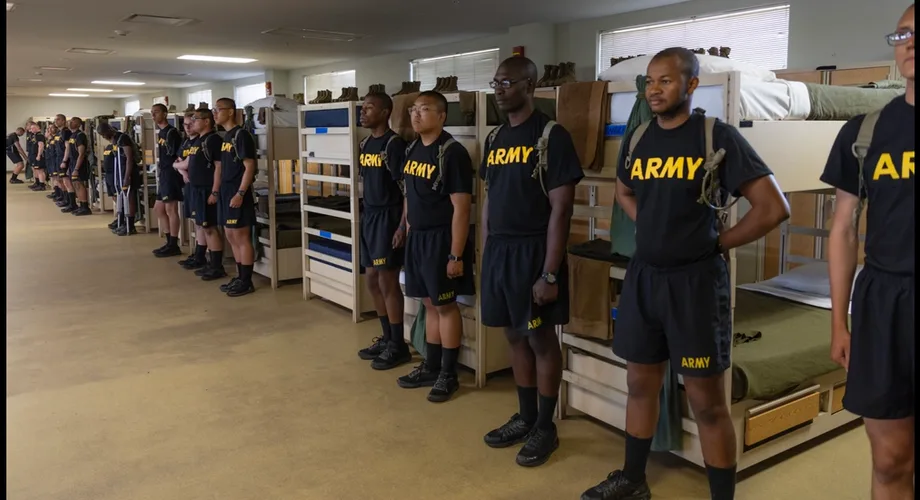
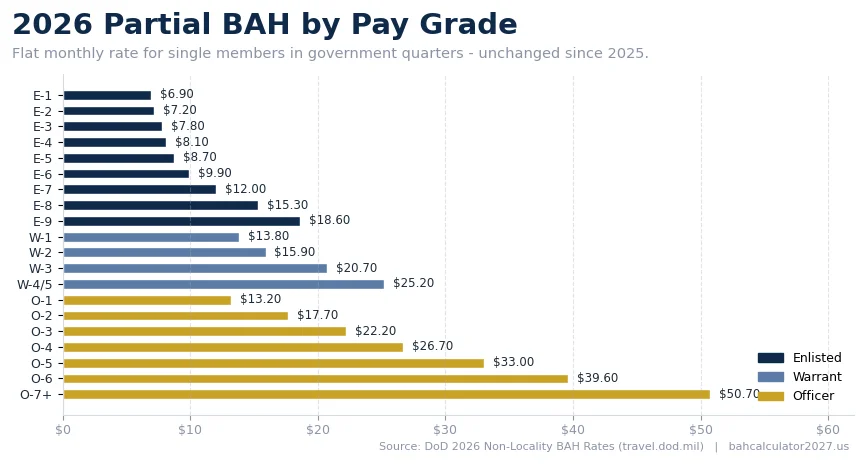
Partial BAH is the flat monthly payment the military gives single service members without dependents who live in government quarters — the barracks, dorms, or bachelor quarters. In 2026 it runs from $6.90 a month for an E-1 up to $50.70 for senior officers (O-7 and above), and it has not changed since 2025.
Most military pay sites just drop a table on the page and stop there. Below is the full picture — every figure checked against the official DoD 2026 non-locality rates table.
Why Does Partial BAH Exist?
The logic is simple once you see it. If you live in government quarters, the military is already covering your housing — the barracks bed is free, the utilities are paid, you have no rent and no commute. So there’s nothing to reimburse. But living in the barracks still costs you something: a storage unit for the stuff that doesn’t fit in your room, cleaning supplies, a lamp or a small set of dishes that make a 10×12 room feel livable. Partial BAH is a token payment to offset those incidental costs. That’s it.
This is worth saying plainly because the small dollar amounts invite the wrong assumption: partial BAH is not rent money, and it was never meant to be. It doesn’t scale with your duty station, it doesn’t care what housing costs in San Diego versus Fort Hood, and it will never come close to covering off-base rent. It’s a stipend for barracks life, full stop.
That also explains why the rates barely move: the official DoD table states that partial BAH rates are constant — no annual adjustment — and the 2026 rates are identical to 2025’s.
Who Gets Partial BAH?
Three conditions, all at once:
- No dependents. You must be a service member without dependents. The moment you have a qualifying dependent — a spouse, a child, a dependent parent — partial BAH is off the table and with-dependent BAH rules take over.
- Assigned to government quarters. Barracks, dorms, BOQ/BEQ, or a ship — anywhere the government houses you. In a civilian apartment off base, you’re in full-BAH territory instead. (My barracks and BAH guide goes deeper on how barracks life interacts with housing allowances.)
- Not entitled to another BAH type. If you’re drawing full locality BAH, BAH RC/T, or BAH-DIFF, you don’t also draw partial. One housing allowance at a time — the system picks the one that fits your situation.
There’s one common exception to the “no dependents” condition worth knowing. If you live in government quarters but pay court-ordered child support at or above the BAH-DIFF rate, you don’t get partial BAH — you get BAH-DIFF instead, which pays substantially more. Live off base and pay child support, and you draw the full with-dependent BAH rate instead — the quarters you sleep in decide which rule applies.
Dual-military couples get asked about this a lot. If you’re married to another service member and have no dependents, you can each draw BAH at the without-dependent rate — but if either of you is assigned government quarters, partial BAH applies to that spouse instead. The dual-military BAH calculator walks through those combinations.
2026 Partial BAH Rates — The Full Table
Here it is: every pay grade, exact monthly amount, effective January 1, 2026, straight from the official DoD non-locality rates table. It’s flat — the same at every duty station, in every state.
| Grade | Monthly Partial BAH |
|---|---|
| E-1 | $6.90 |
| E-2 | $7.20 |
| E-3 | $7.80 |
| E-4 | $8.10 |
| E-5 | $8.70 |
| E-6 | $9.90 |
| E-7 | $12.00 |
| E-8 | $15.30 |
| E-9 | $18.60 |
| W-1 | $13.80 |
| W-2 | $15.90 |
| W-3 | $20.70 |
| W-4 | $25.20 |
| W-5 | $25.20 |
| O-1 | $13.20 |
| O-2 | $17.70 |
| O-3 | $22.20 |
| O-4 | $26.70 |
| O-5 | $33.00 |
| O-6 | $39.60 |
| O-7 | $50.70 |
| O-8 | $50.70 |
| O-9 | $50.70 |
| O-10 | $50.70 |
| O-1E | $13.20 |
| O-2E | $17.70 |
| O-3E | $22.20 |
A few things to notice. Officers with prior enlisted service (the “E” grades) draw the same partial rate as their non-prior-service counterparts at the same grade — O-1E matches O-1, O-2E matches O-2, O-3E matches O-3. And general/flag officers are capped as one band: O-7 through O-10 all draw $50.70.
New recruits should note the E-1 row carefully: $6.90 a month is the smallest housing payment in the entire military pay system, and it’s what you’ll see on your LES while you’re in the barracks at training. My new recruits BAH guide covers how your first housing payments actually work.
How Much Is Partial BAH, Really?
Let me put these numbers in terms your wallet understands. An E-1’s $6.90 a month works out to about 23 cents a day — less than the cost of the vending-machine coffee in the barracks dayroom. An E-5 draws $8.70 a month, roughly 29 cents a day. Even at the top of the enlisted scale, an E-9’s $18.60 is 62 cents a day. These aren’t housing payments; they’re the military’s way of saying “here’s a little something for the storage unit.”
Compare that to what the same members would draw living off base, and the gulf becomes obvious — which is exactly the point of the next section. But first, a correction that matters, because I’ve seen it repeated on multiple sites: pcspayitforward.com claims partial BAH is “a flat $50.10/month regardless of pay grade.” That is wrong. As the table above shows — verified against the official DoD PDF and five independent military pay sources — partial BAH varies by pay grade from $6.90 to $50.70, and $50.10 appears nowhere in the official rates. If a site tells you one number applies to everyone, that site hasn’t read the actual table.
The honest takeaway: don’t budget around partial BAH. It covers a storage unit, maybe. The real housing money — the thousands a month — only enters the picture when you move off base or gain a dependent.
Partial BAH vs Full BAH: The Gap
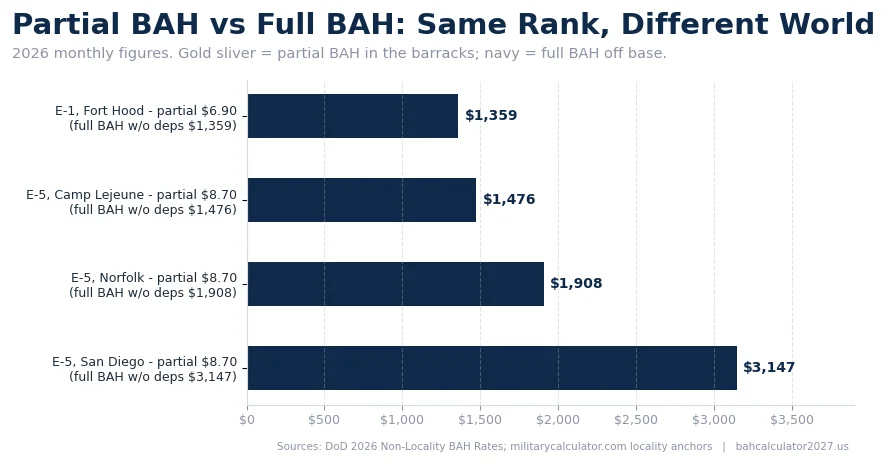
This is the comparison that makes the “why so small” question click. Same pay grade, same year — the only difference is where you sleep:
| Member | Partial BAH (barracks) | Full BAH w/o dependents (off base) | Station |
|---|---|---|---|
| E-1 | $6.90 | $1,359 | Fort Hood |
| E-5 | $8.70 | $1,476 | Camp Lejeune |
| E-5 | $8.70 | $1,908 | Norfolk |
| E-5 | $8.70 | $3,147 | San Diego |
Read that last row twice: an E-5 in San Diego draws $8.70 a month in the barracks versus $3,147 living off base — a gap of over $3,100 a month, or roughly 360 times the partial rate. Even at Fort Hood, one of the cheaper housing markets, the off-base E-1 draws nearly 200 times the barracks rate.
This is why the decision to move off base (when your service and your commander allow it — more on that below) is the single biggest housing-pay decision a single service member makes. Run both scenarios through the BAH calculator or look up your ZIP’s full rate before you decide.
When Partial BAH Ends
Partial BAH stops the moment your situation stops matching the three conditions — and the system switches you to whatever you do qualify for. The three triggers:
- You move off base. Voluntarily or by orders, once you’re no longer assigned government quarters, partial BAH ends and full locality BAH at the without-dependent rate for your grade begins. This is the big one — it’s the $8.70-to-$3,147 jump from the table above.
- You gain a dependent. Marriage, a child, a newly qualifying dependent parent — you move to the with-dependent BAH rate. Note: the dependent gain usually ends the barracks assignment too, since most services move members with dependents out of single quarters.
- You’re authorized full BAH while still assigned quarters. Rare, but it happens — certain duty situations and service-specific authorizations (like the Navy’s high-occupancy exception below) can put a member on full BAH even with a barracks room assigned.
What about deployment? Being sent downrange doesn’t automatically end partial BAH — that depends on your dependency status, not your location. My BAH during deployment guide covers how housing allowances behave while you’re gone.
One administrative note: when partial BAH ends mid-month, the change is prorated on your LES. And the PCS-travel gap is the murky one — some pay references say partial BAH isn’t authorized during proceed time and leave en route, but I couldn’t verify that in a primary regulation, so confirm it with your finance office before a move.
Partial BAH vs BAH RC/T vs BAH-DIFF
Partial BAH is one of three BAH types that ignore locality — the same rate everywhere, in all 50 states. Here’s how the three differ:
| Partial BAH | BAH RC/T | BAH-DIFF | |
|---|---|---|---|
| Who it’s for | Single members in government quarters | Guard/Reserve on active duty under 30 days; members in transit with no prior BAH rate | Members in gov quarters paying child support at/above the DIFF rate |
| 2026 range | $6.90–$50.70/mo | $811.50–$3,035.10/mo | $159–$465.60/mo |
| Annual adjustment | Constant — no yearly change | Adjusted by national average housing-cost growth | Adjusted by the basic pay raise |
A few notes on the neighbors. BAH RC/T (Reserve Component/Transit — still sometimes called BAH Type II) is the bridge rate: it covers Guard and Reserve members on short active-duty stints and members in transit from a location where they had no BAH rate, like returning from overseas. Cross 30 days of active duty and Guard/Reserve members move to full locality BAH. For reference, 2026 RC/T runs $811.50 (E-1/E-2 without dependents) up to $3,035.10 (E-7 and above with dependents). The complete 2026 non-locality BAH table has Partial, RC/T, and BAH-DIFF for every pay grade in one place, checked cell-by-cell against the official DoD release.
BAH-DIFF is the child-support rate. If you’re in government quarters paying court-ordered support at or above the DIFF rate for your grade, you draw DIFF instead of partial — never both. And if the support amount is below the DIFF rate, you don’t qualify for DIFF at all, per the official military pay site.

Service-Specific Rules: Getting Out of the Barracks
Everything above assumes you’re in the barracks. But whether you have to be there — and whether you can draw full BAH instead — depends on your service and your rank, under 37 U.S.C. §403 and service regulations. Here’s the honest summary:
The statute’s election thresholds. Federal law lets senior enlisted members decline government quarters and draw BAH instead: E-7 and above without dependents who are assigned adequate quarters may elect to move out and take BAH. E-6s get that election only if their assigned quarters are inadequate. And the service secretary can override the election entirely for mission, readiness, or discipline reasons. Junior enlisted don’t have a statutory right to decline — it’s commander’s discretion.
Navy. Single sailors E-1 through E-4 on shore duty can request BAH when barracks occupancy hits 95% or higher — at that point the Navy would rather pay you to live off base than overcrowd the barracks. The governing instruction is CNIC M-11103.2.
Army. E-5 and below may request to live off post at the commander’s discretion — but off-post without BAH authorization just means paying rent out of pocket. Actually drawing BAH requires a Certificate of Non-Availability (CNA) approved by the Garrison Commander, certifying that adequate quarters aren’t available for you.
The pattern across services: the military prefers you in the barracks when there’s room, the law gives senior NCOs an out, and everyone else negotiates with their command.

Does Partial BAH Show on Your LES? Is It Taxable?
Yes, it shows on your LES — as its own line item in the allowances section, labeled Partial BAH (or similar wording depending on your service’s pay system). If you’re in the barracks and don’t see it, that’s worth a trip to finance, because the entitlement should be automatic once your quarters assignment is in the system.
No, it isn’t taxable. BAH in all its forms — full, partial, RC/T, DIFF — is a housing allowance, and housing allowances are excluded from federal gross income under the IRS Armed Forces’ Tax Guide (Publication 3). It won’t appear in Box 1 of your W-2. At $6.90 to $50.70 a month the tax savings are pocket change, but the principle matches the full military tax guide: every allowance dollar is a dollar you keep.
Will Partial BAH Change in 2027?
Probably not — and that’s the official position, not my guess. The DoD rate table states flatly that partial BAH rates are constant: they don’t get adjusted for housing costs or pay raises the way RC/T and DIFF do. The 2026 rates are identical to 2025’s, and the reasonable expectation is that 2027’s table says the same numbers again.
Two things to watch anyway. First, the 4.2% BAH figure floating around for 2027 is a budget proposal for full BAH only — it has nothing to do with partial rates, which sit in a separate, constant table. Don’t let headlines about a BAH raise convince you your $8.70 is about to grow. Second, DoD’s Travel Management Office typically publishes the new year’s non-locality rates in December — so if anything did change, you’d see it around mid-December 2026. I’ll update this guide and the rate table the week the official numbers drop.
Frequently Asked Questions
Who gets partial BAH?
Single service members without dependents who are assigned to government quarters — barracks, dorms, bachelor quarters, or ships. You must also not be entitled to another BAH type at the same time.
How much is partial BAH per month?
In 2026, $6.90 a month for an E-1 up to $50.70 for O-7 and above, varying by pay grade. The rates are flat nationwide and unchanged from 2025.
Do I get partial BAH in the barracks?
Yes — barracks are government quarters, which is exactly what partial BAH covers. Single, no dependents, assigned a barracks room: partial BAH is your housing allowance.
Is partial BAH taxable?
No. Like all BAH, partial BAH is excluded from federal gross income under IRS Publication 3 (Armed Forces’ Tax Guide). It doesn’t appear in Box 1 of your W-2.
Does partial BAH appear on my LES?
Yes, as its own line in the allowances section. If you’re in government quarters and don’t see it, check with your finance office.
What's the difference between partial BAH and BAH Type II / RC/T?
Partial BAH is for single members in government quarters, with rates that stay constant year to year. BAH RC/T (still sometimes called BAH Type II) covers Guard/Reserve members on active duty under 30 days and members in transit, and adjusts annually with national housing costs.
Can I get partial BAH and BAH-DIFF at the same time?
No. If you live in government quarters and pay court-ordered child support at or above the BAH-DIFF rate, you draw BAH-DIFF instead of partial BAH — never both.
What happens to my BAH when I move out of the barracks?
Partial BAH ends and you switch to full locality BAH at the without-dependent rate for your pay grade and duty station — often a jump of $1,000+ a month. The change is prorated if it happens mid-month.
Do officers get partial BAH?
Yes. Single officers without dependents in government quarters (like the BOQ) draw partial BAH: $13.20 for O-1 up to $50.70 for O-7 and above. Prior-enlisted officers (O-1E through O-3E) draw the same rates as their grade counterparts.
Will partial BAH increase in 2027?
Don’t count on it. Partial BAH rates are officially constant — they don’t adjust annually — and the 2026 rates match 2025 exactly. The 4.2% BAH figure in the FY2027 budget proposal applies to full BAH only. Watch for the official DTMO release around mid-December 2026 for confirmation.
For the full picture of how 2026 rates were set and what 2027 might bring, see the BAH Rates 2027 complete guide.
Sources
- Official DoD 2026 Non-Locality BAH Rates table (travel.dod.mil, effective January 1, 2026)
- Basic Allowance for Housing — militarypay.defense.gov (official DoD pay site)
- 2026 Partial BAH Rates — military.com (updated December 11, 2025)
- 2026 Non-Locality BAH Rates — veteran.com
- 2026 Non-Locality BAH Rates — themilitarywallet.com
Independent guide — not affiliated with the U.S. Department of Defense or any military branch.
Last updated: October 21, 2026. Reviewed against the official DoD 2026 Non-Locality BAH Rates table, 37 U.S.C. §403, and IRS Publication 3 (Armed Forces’ Tax Guide).