
What Happens to BAH in Divorce? [2027 Guide]
If you’re going through a divorce and you’re in the military, BAH is probably the line item that scares you most. Here’s the short answer: separation alone doesn’t change your BAH — the military still treats you as married until the divorce is final. The day the decree is signed, your with-dependent BAH usually drops to the single rate, unless you have kids and either custody or a child-support obligation keeps you in the with-dependent or BAH-DIFF category. Everything below is the detail behind that sentence, with real 2026 numbers.
I’m going to walk you through this the way it actually happens: first while you’re separated but still legally married, then the day the divorce becomes final, then the long-term picture for you, your kids, and your ex-spouse. I’ll use real 2026 rates because those are the current official numbers — the 2027 rates don’t come out until around mid-December 2026.
BAH While You're Separated: You're Still "Married" to the Military
This is the part that surprises most people. Until a judge signs the final divorce decree, the military considers you married. Your BAH keeps flowing at the with-dependent rate. Your spouse keeps their dependent ID card, TRICARE, and commissary access. Nothing in your pay changes just because you moved out or filed papers.
But — and this is a big but — every branch requires you to financially support your family during the separation. This isn’t optional, and it isn’t based on who’s at fault. Cheating, desertion, none of that gets you out of it; only a battalion-level commander or higher can release you from the obligation, and that rarely happens.
The catch: until a court order or a written agreement sets an amount, each branch has its own interim rule:
Army (AR 608-99): You owe each supported family member a pro-rata share of BAH RC/T-WITH — that’s the non-locality BAH rate, the same dollar amount regardless of where you’re stationed. For 2026, an E-5’s BAH RC/T-WITH is $1,403.70 per month. If you’re supporting just your spouse, she gets the full $1,403.70. If you’re supporting a spouse and one child, each gets half — $701.85. One exception: if your family is still living in government family housing, you don’t owe additional cash support under the regulation.
Navy (MILPERSMAN 1750-030): The Navy publishes an interim chart based on fractions of gross pay — a spouse alone gets 1/3 of gross pay, a spouse plus one minor child gets 1/2, a spouse plus two or more children gets 3/5. It’s a guide, not a court order, and it only stands until a judge or an agreement replaces it.
The Air Force, Marine Corps, and Coast Guard each have their own version of these interim rules — same principle everywhere: a court order or signed agreement always wins, and the branch formula is just the fallback when nothing’s agreed yet. If you’re in this situation, talk to your installation’s legal assistance office before you guess; they handle this exact question every week.

The Day the Divorce Is Final: What Changes Overnight
The divorce decree changes your dependency status in the military’s eyes, and dependency status is one of the three things BAH is built on (the other two are rank and duty-station ZIP). So yes — the final decree is the trigger, not the separation, not the filing.
Here’s what happens, roughly in order:
- Your BAH rate is recalculated. With no dependents, you drop to the without-dependent rate. With kids, it depends on custody and support — I’ll lay out the exact matrix in the next sections.
- Your ex-spouse is removed from DEERS. This is the big administrative step. Their dependent ID card is deactivated. They lose TRICARE, commissary, and exchange privileges, and access to base facilities — with a few narrow exceptions I’ll cover below.
- Your children stay dependents. Kids keep their dependent status, their ID cards, and their TRICARE. The divorce doesn’t touch their military benefits.
- You update finance. Take the divorce decree to your finance office and update your records. Don’t drag your feet here — if you keep collecting the with-dependent rate after the decree, that’s an overpayment, and DFAS will come back for it.
One more thing worth knowing: if military service keeps you from making a court date, the Servicemembers Civil Relief Act (SCRA) lets you ask the court to pause the proceedings — the initial stay can be up to 90 days.

Divorced With No Kids: The Simple (Painful) Math
If the marriage produced no children and your spouse was your only dependent, the math is straightforward: you go from BAH with dependents to BAH without dependents, at your rank and your duty station.
How much does that actually cost? It depends entirely on where you’re stationed, because the gap between the two rates is a local number. Two real 2026 examples:
| Duty station (2026) | Grade | With dependents | Without dependents | Monthly change |
|---|---|---|---|---|
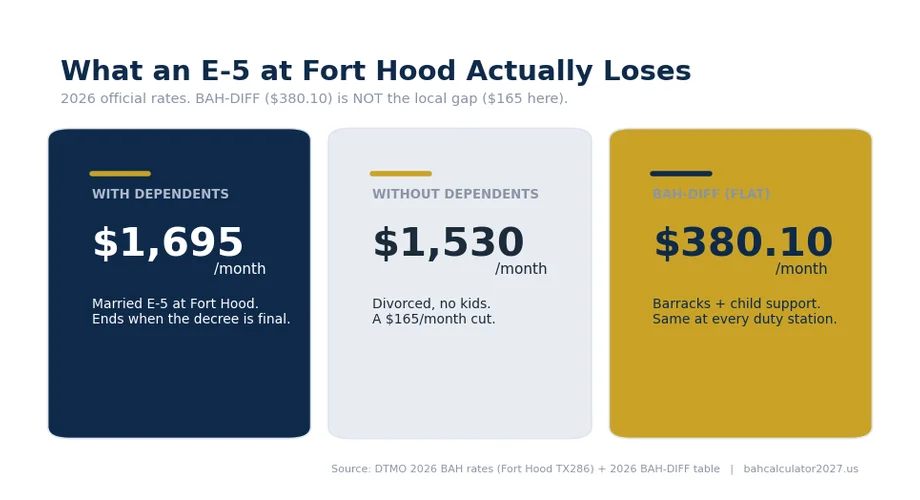
| Fort Hood, TX | E-5 | $1,695 | $1,530 | −$165/mo |
| Fort Hood, TX | E-6 | $1,920 | $1,626 | −$294/mo |
| Fort Hood, TX | E-7 | $2,070 | $1,668 | −$402/mo |
| San Diego, CA | E-5 | $3,975 | $3,147 | −$828/mo |
The Fort Hood E-5 loses $165 a month. The San Diego E-5 loses $828 a month — nearly $10,000 a year — for the exact same life event. That’s not a mistake in the tables; the with/without gap is set by local housing costs, so expensive areas swing harder.
One thing that does NOT change: rate protection. If your BAH rate drops because of the annual rate tables, you’re still protected at your old rate as long as you stay at the same duty station with uninterrupted eligibility. But a divorce isn’t a rate-table drop — it’s a dependency-status change, so protection doesn’t apply to this particular cut.
After the drop, you’re in the same boat as any other single service member: you can live off base on the single rate, or if your rank and branch policies put you back in the barracks, your BAH situation follows the normal single-soldier rules.
Divorced With Kids: Custody Decides Everything
This is where most of the confusion lives, so let me lay it out as plainly as the regulation does. The Defense Travel Management Office’s own FAQ gives the rule, and it comes down to three questions: who has legal and physical custody, are you paying child support, and where do you live?
| Your situation | Your BAH |
|---|---|
| You have legal AND physical custody, living off base (not in family-type government quarters) | With-dependent rate |
| Ex-spouse has custody, you pay child support at or above your BAH-DIFF amount, living off base | With-dependent rate |
| Ex-spouse has custody, you pay child support at or above your BAH-DIFF amount, assigned to single-type government quarters (barracks/ship) | BAH-DIFF |
| Ex-spouse has custody, your support is LESS than the BAH-DIFF amount | No BAH-DIFF — you get Partial BAH instead |
Read that second row again, because it’s the one people miss: if your ex has the kids but you’re paying real child support — at least your BAH-DIFF amount — and you live off base, you keep the full with-dependent BAH rate. The military treats the support obligation as keeping your dependent status alive for housing purposes.
But watch the threshold. “At least your BAH-DIFF amount” is doing real work in that sentence. If your monthly support drops below the BAH-DIFF rate for your grade, the regulation says DFAS can cancel your BAH-WITH or BAH-DIFF entitlement and recoup what was already paid. So if your support order ever gets modified downward, tell finance immediately — a quiet $50 reduction in child support can snowball into a BAH debt.
A quick note on custody paperwork: if you’re heading into an unaccompanied tour or PCS and a divorce decree gives you custody for a specific period, BAH at the with-dependent rate is authorized only for the period the decree actually states. Vague “joint custody” language doesn’t cut it — the decree needs dates.
BAH-DIFF: The Flat Rate Everyone Gets Wrong
BAH-DIFF (the differential) is probably the most misunderstood number in this whole topic, and I see it described wrong on half the sites I researched. So let me fix it clearly:
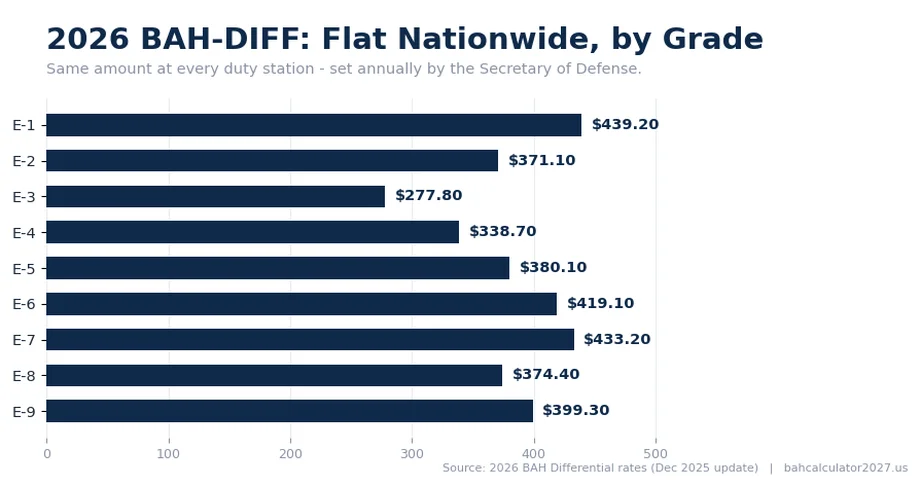
BAH-DIFF is a flat national amount set by the Secretary of Defense. It is the same at every duty station on earth. It is NOT the difference between your local with-dependent and without-dependent rates.
Proof: in 2026, BAH-DIFF for an E-5 is $380.10 — at Fort Hood, at San Diego, everywhere. But the actual local gap for an E-5 is $165 at Fort Hood and $828 in San Diego. Neither matches $380.10, because BAH-DIFF was never meant to match your locality. It’s a standardized amount, adjusted each year with the basic pay raise.
Here are the 2026 BAH-DIFF rates for enlisted grades:
| Grade | 2026 BAH-DIFF / month |
|---|---|
| E-1 | $439.20 |
| E-2 | $371.10 |
| E-3 | $277.80 |
| E-4 | $338.70 |
| E-5 | $380.10 |
| E-6 | $419.10 |
| E-7 | $433.20 |
| E-8 | $374.40 |
| E-9 | $399.30 |
You get BAH-DIFF in one specific situation: you’re assigned to single-type government quarters (barracks, ship, that world) and you’re legally required to pay child support of at least the BAH-DIFF amount. It exists so a barracks-dwelling parent paying support isn’t left with nothing. If you live off base and pay support, you don’t get BAH-DIFF — you get the full with-dependent rate instead, which is better anyway.
No 2027 BAH-DIFF numbers exist yet. They’ll be published with the rest of the 2027 rates around mid-December 2026, and I’ll update this guide when they are.
How Divorce Affects Child Support Calculations
Two facts that pull in opposite directions, and you need both:
BAH counts as income when courts calculate child support. In most states, your full BAH — including the tax-free part — goes into the income figure the guidelines use. Some states go further and “gross up” the tax-free allowances, meaning they calculate what taxable income a civilian would need to match your take-home pay, so the support number reflects your real purchasing power. Don’t walk into a support hearing quoting only your base pay; the court will use the bigger number.
BAH itself can’t be divided like property. Your BAH is an allowance, not an asset or income stream a judge can split down the middle. Your ex can’t be awarded “half your BAH.” What they can be awarded is spousal or child support, and the judge will absolutely look at your BAH when deciding how much support is fair.
The trap to watch: the circular math. Your support is calculated using your with-dependent BAH — then the divorce drops you to the without-dependent rate (or BAH-DIFF), which means the income figure the court used is now higher than what you actually receive. If custody or your BAH status changes after the order, that’s grounds to ask for a modification. Keep your LES, your BAH rate printouts, and every support order in one folder; you’ll need all three if anything changes.
Practical note: once there’s a court order, a copy can be sent to DFAS so support is paid directly from your pay to your ex. It removes the monthly argument about whether the money was sent.
What Your Ex-Spouse Keeps (and Loses)
Let me be direct about this, because there’s a lot of wishful thinking on both sides:
Lost at final decree: dependent ID card, TRICARE, commissary and exchange privileges, and base facility access. Also base housing — a civilian ex-spouse is not authorized to live in military housing, even if the divorce decree tries to grant it. The housing office and the command manage the move-out; you can’t evict your spouse yourself, and they typically get a short grace period (often around 30 days, though it varies by branch and housing office).
The two big exceptions — TRICARE: – 20/20/20 rule: married 20 years + you served 20 years + at least 20 years of overlap → your ex keeps TRICARE. – 20/20/15 rule: same 20/20 but only 15 years of overlap → one year of transitional TRICARE coverage after the divorce. – Either way, remarriage ends it. And there’s the Continued Health Care Benefit Program (CHCBP) — up to 36 months of purchasable coverage, but you have to buy in within 60 days of losing TRICARE.
Retirement pay: under the Uniformed Services Former Spouse Protection Act (USFSPA), a court can award a portion of military retired pay to a former spouse. That’s a separate fight from BAH, but it’s usually happening in the same divorce.
Survivor Benefit Plan (SBP): divorced spouses can be named as SBP beneficiaries — it’s optional, it costs a monthly premium, and for some former spouses it’s the most valuable piece of the whole settlement. Don’t overlook it in negotiations.
One more nuance: until the divorce is final — during a court-approved separation or an interlocutory decree — your spouse keeps every benefit. The cutoff is the final decree, not the filing date.
The Paperwork: DEERS, Finance, and Court Orders
Nobody loves this section, but getting it wrong costs real money. The checklist:
- Report the divorce to DEERS promptly. Your spouse’s record has to be updated to remove them. Your children’s records stay — just confirm they’re current.
- Take the decree to finance. Your dependency status change has to hit the pay system. The longer the lag, the bigger the overpayment you’ll owe back.
- Update allotments and your SGLI beneficiary. Divorce doesn’t change your Servicemembers’ Group Life Insurance beneficiary automatically — that one’s on you.
- Keep copies of everything. Decree, support orders, BAH rate tables for your grade and ZIP, LES showing the change. If DFAS ever questions a payment, this folder is your defense.
Dual-Military Divorce: One Extra Wrinkle
If both spouses are service members, the divorce simplifies one thing and complicates another. The simple part: after the divorce, you’re each just a single service member — nobody’s BAH depends on the other anymore. The complicated part is the kids: the parent with primary custody is typically the one who keeps the with-dependent BAH rate, and if custody is genuinely shared, the couple designates the with-dependent recipient (with seniority as the tiebreaker only). If you’re in this situation, my dual-military BAH calculator walkthrough covers the married version of these rules in detail.
BAH in 2027: What Changes for Divorced Members
Everything above uses 2026 rates because those are the current official numbers. Here’s the 2027 picture:
– Official 2027 BAH rates are expected around mid-December 2026. When they publish, every number in this guide — the BAH-DIFF table, the Fort Hood and San Diego examples, the AR 608-99 interim amounts — gets refreshed. – The 4.2% figure you’ve probably seen is the Department of Defense’s FY2027 budget-request proposal for the BAH increase. It is not final, not guaranteed, and not something to build a budget on. I’ll swap in the real numbers the week they drop. – BAH-DIFF for 2027 will move with the basic pay raise, whatever Congress finally approves — there is no 2027 BAH-DIFF number to quote yet, and anyone quoting one is guessing.
The rules themselves — custody matrix, DEERS, the branch support obligations — don’t change year to year. Only the dollar amounts do.
Frequently Asked Questions
Do I lose BAH if I get divorced?
Not automatically. If you have no dependents after the divorce, you drop to the without-dependent rate. If you have kids, custody and child support decide: legal and physical custody keeps you at the with-dependent rate, and even without custody, paying support at or above your BAH-DIFF amount keeps the with-dependent rate if you live off base.
Does my ex-spouse get any of my BAH after divorce?
No — BAH is paid only to the service member, and it can’t be divided as property. But courts count your BAH as income when setting child and spousal support, so your ex may receive support money that reflects your BAH.
What is BAH-DIFF in a divorce?
It’s a flat monthly amount (E-5: $380.10 in 2026) paid to service members who live in single-type government quarters and are legally required to pay child support of at least that amount. It’s the same at every duty station — it’s not your local rate gap.
How much BAH do I owe my separated spouse before the divorce is final?
Until a court order or agreement sets an amount: Army — a pro-rata share of BAH RC/T-WITH per family member (E-5: $1,403.70/month total in 2026); Navy — interim fractions of gross pay (spouse alone: 1/3). Court orders always override these fallbacks.
Can my ex-spouse stay in base housing after the divorce?
No. A civilian former spouse isn’t authorized military housing, even if the decree says otherwise. They typically get a short grace period to move out — often around 30 days, depending on the branch and housing office. You can’t evict them personally; the housing authority handles it.
Do my kids lose TRICARE if I divorce?
No. Children keep their dependent status, ID cards, and TRICARE after a divorce. Only the former spouse loses coverage (with the 20/20/20 and 20/20/15 exceptions).
When does my BAH actually change — separation or final decree?
The final decree. Separation changes nothing in your pay; the military treats you as married until the divorce is final. Report the decree to DEERS and finance promptly so the new rate starts cleanly.
Can DFAS take back BAH after a divorce?
Yes, in two situations: if you kept collecting the with-dependent rate after the decree without updating your status, or if your child support dropped below the BAH-DIFF threshold while you were drawing BAH-WITH or BAH-DIFF. Both create a debt DFAS will recoup.
Does remarriage restore my with-dependent BAH?
Yes — a new spouse is a new dependent. Update DEERS with the marriage certificate and your BAH flips back to the with-dependent rate.
Where do I look up my new BAH rate after divorce?
Use the DTMO BAH Rate Lookup with your duty-station ZIP, 2026 (current year), your grade, and your new dependency status — or run your numbers through a BAH calculator to see the with-vs-without difference for your ZIP. —
Independent guide — not affiliated with the U.S. Department of Defense or any military branch. Last updated: October 16, 2026. Rates shown are official 2026 figures; 2027 rates will be added when DTMO publishes them (~mid-December 2026).