Family Separation Allowance (FSA): Complete Guide [2027]
Family Separation Allowance (FSA) is a $300-per-month payment for service members with dependents who are involuntarily separated from their families for more than 30 continuous days because of military orders — deployments, unaccompanied tours, ship duty, or long TDYs. It stacks with BAH and per diem, it’s generally tax-free, and you claim it by filing DD Form 1561.
I’ve read the finance briefings, dug through the actual law (37 U.S.C. §427), and compared what a dozen military-pay sites say about FSA. Here’s the short version of what I found: if orders send you away from your family for more than a month, you’re owed extra money for it — and as of January 2026, that amount is $300 a month. It’s not automatic; you have to file for it. And most of the guides online still list the old $250 rate or get the tax rules wrong, so read carefully.
What Is Family Separation Allowance?
Family Separation Allowance exists for one simple reason: being separated from your family costs money. The spouse left behind runs a household solo — higher utility bills, emergency childcare, the car breaking down with no second driver to help. DoD’s own regulation calls it “compensation for added expenses incurred due to enforced family separation.”
The key word is enforced. FSA is for involuntary separation — orders send you away. If you choose to leave your family behind when the military would have moved them with you (the classic “geobachelor” setup), that’s voluntary, and FSA doesn’t apply. More on that below.
FSA is defined in federal law (37 U.S.C. §427) and DoD’s pay regulation (FMR Volume 7A, Chapter 27). Every branch pays it the same way, because Congress — not your service — sets the rules.
How Much Is FSA in 2026–2027?
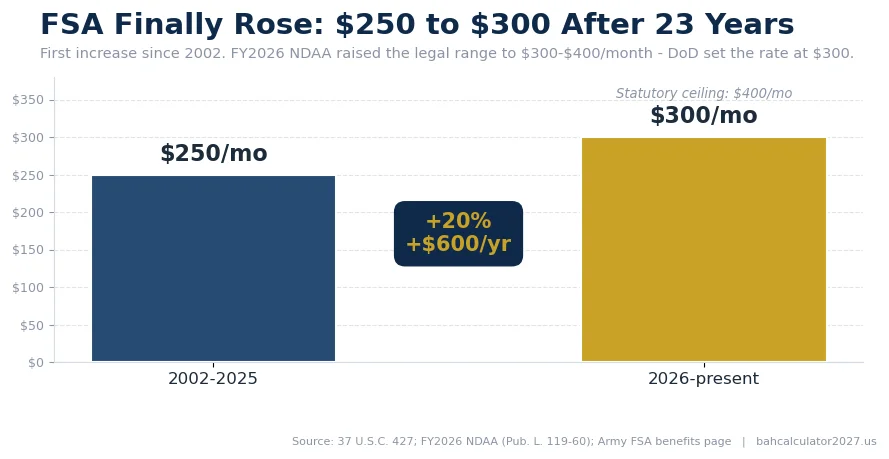
$300 per month. That’s $3,600 over a full year of separation.
This number matters more than it looks, because it just changed. For 23 years — from 2002 through 2025 — FSA sat at $250 a month. Congress finally raised it in the FY2026 defense bill, and the new $300 rate took effect January 1, 2026. It’s a 20% raise, worth an extra $600 a year to a family on a 12-month deployment.
Here’s the part most guides miss: the law now sets a range, not a fixed number. The FY2024 defense bill first gave the Pentagon discretion to pay anywhere from $250 to $400 a month — and the Pentagon never used it. Then the FY2026 bill raised the floor to $300, so the legal range is now $300 to $400. DoD chose $300 for now, which means a future increase toward $400 is possible without any new law. I’ll cover what that means for 2027 later in this guide.
| 2002–2025 | 2026–present | |
|---|---|---|
| Monthly rate | $250 | $300 |
| Daily proration | $8.33 | $10.00 |
| Full year | $3,000 | $3,600 |
| Increase | — | +20% (+$600/yr) |
If you see a site still quoting $250, it’s out of date. Bookmark this page instead — I update it when the rate changes.
The 3 Types of FSA
All three types pay the same $300. The difference is what triggers them — and slightly different rules about dependent visits, which I’ll cover below. If you somehow qualify under more than one type at the same time, you still get just one $300 payment per month. No double-dipping.
FSA-R (Restricted). This is the unaccompanied-tour type. Your dependents aren’t authorized to move to your duty station at government expense, and they don’t live near it. Think unaccompanied overseas tours. There’s also a medical exception: if dependent travel is authorized but a family member can’t accompany you for certified medical reasons, and you elect the unaccompanied tour, FSA-R still applies.
FSA-S (Ship). For sailors and Marines assigned to a ship that’s away from its homeport for more than 30 continuous days — or who are ordered to stay aboard while the ship sits in homeport for more than 30 days. Redeploying home for 30 days or less and then heading back out doesn’t reset the clock.
FSA-T (Temporary). The TDY/TAD type. You’re away from your permanent station for more than 30 continuous days on temporary duty, and your dependents aren’t living at or near the TDY location. This covers the obvious cases — a 60-day training course across the country — plus some you might not expect, like TDY you’re ordered to perform before reporting to your first permanent duty station.
| Type | Trigger | Dependent-location rule |
|---|---|---|
| FSA-R (Restricted) | Unaccompanied assignment; dependent travel not authorized at govt expense | Dependents don’t live at/near the PDS |
| FSA-S (Ship) | Ship away from homeport (or confined aboard in port) >30 days | No residence requirement near homeport |
| FSA-T (Temporary) | TDY/TAD away from permanent station >30 continuous days | Dependents don’t live at/near the TDY station |

Who Qualifies: The 30-Day Rule
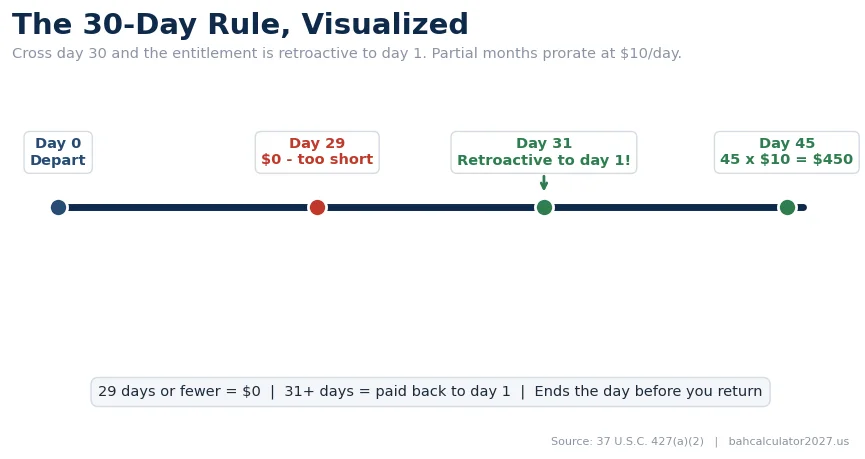
Everything about FSA hinges on one number: 30. You must be separated from your dependents for more than 30 continuous days because of military orders.
Here’s the part that surprises people: once you cross day 30, the entitlement is retroactive to day 1. The law says so explicitly. So a 45-day TDY doesn’t pay you for 15 days — it pays you for all 45. The clock starts the day you depart your home station and stops the day before you arrive back.
Partial months are prorated at $10 a day ($300 divided by 30, no matter how many days the month actually has). Some real examples:
| Separation length | FSA paid |
|---|---|
| 29 days | $0 — didn’t cross 30 |
| 35 days | $350 (35 × $10) |
| 45-day TDY | $450 |
| 90-day deployment leg | $900 |
| 6 months | $1,800 |
That 29-day row hurts, and it’s deliberate — Congress drew the line at 30. But notice the flip side: day 31 pays for days 1 through 31. If your orders say 28 days and the mission stretches to 33, tell finance. That extension just made the whole trip payable.
One more timing detail worth knowing: if you finish one qualifying assignment and start another within 30 days, the law treats the gap as continuous — you don’t lose the entitlement between them.
Who Does NOT Qualify
FSA has hard exclusions, and misunderstanding them is how people end up with pay debts they have to repay:
- Voluntary separation. You chose an unaccompanied tour at a station where the military would have moved your family? No FSA. The law specifically blocks this — it’s the geobachelor scenario.
- Permissive orders. If you’re traveling on permissive (non-paid) orders, FSA doesn’t apply.
- Dependents living near the TDY station. For FSA-T, if your family is at or near where you’re temporarily assigned — or close enough that you could reasonably commute daily — you’re not “separated” in the eyes of the regulation.
- Dependency status changes. FSA requires you to be a member with dependents. Divorce, legal separation, or a custody change can end it. (If you’re going through this, my divorce and BAH guide walks through how dependency changes ripple across your pay.)
- Short separations. Under 30 continuous days: nothing. No exceptions, no partial credit.
When in doubt, ask your finance office before you assume. Repaying an allowance you weren’t entitled to is worse than never getting it.
Is FSA Taxable?
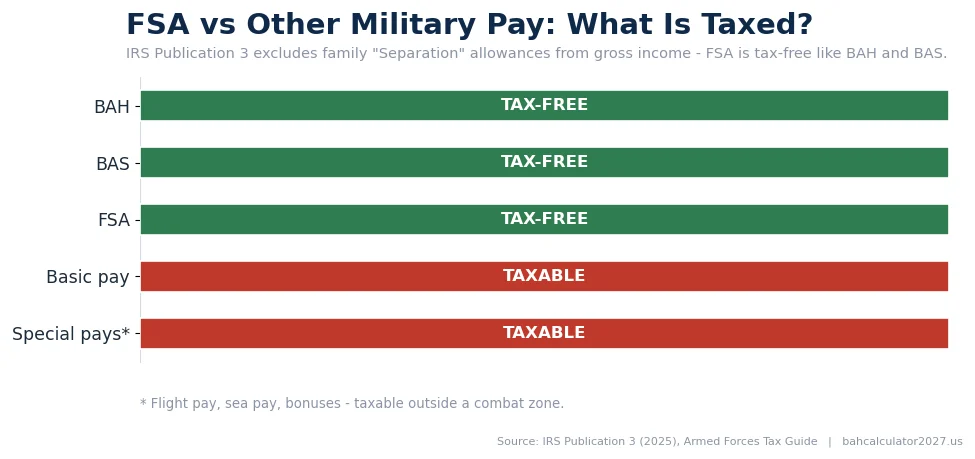
No. Family Separation Allowance is generally tax-free for federal income tax purposes.
I want to be precise here because I’ve seen a recent legal blog claim the opposite — that FSA shows up in your gross wages and gets taxed. That is wrong, and the IRS’s own publication settles it: the IRS Armed Forces’ Tax Guide (Publication 3) lists the pay items excluded from gross income, and under “Family allowances” it explicitly includes Separation. FSA doesn’t land in Box 1 of your W-2. It sits on your LES as an allowance, alongside BAH and BAS in the tax-free column.
How does that compare to the rest of your paycheck?
- BAH: tax-free
- BAS: tax-free
- FSA: tax-free
- Basic pay: taxable
- Special/incentive pays (flight pay, sea pay, bonuses): taxable outside a combat zone
So the $3,600 a full year of FSA puts in your pocket is $3,600 you keep — no federal withholding taken off the top. (For the full breakdown of what’s taxed and what isn’t, see my military tax guide.)
FSA + Your Other Pay: What Stacks
New families always ask whether FSA replaces something else. It doesn’t — the statute says it’s payable “in addition to any allowance or per diem” you’re otherwise entitled to. Here’s how the stack works during a typical deployment:
- BAH: keeps paying at your with-dependent rate the whole time you’re gone. Your family’s housing doesn’t get cheaper because you’re deployed, and the system knows it. (Full details in what happens to BAH during deployment.)
- Per diem: if your orders put you in a per-diem status, you collect that too — FSA is separate money for a separate purpose. (See what per diem means.)
- Hostile fire / imminent danger pay: $450/month (hostile fire) or $275/month (imminent danger) — one or the other, never both — stacks right on top. (New rates effective October 1, 2026; first increase since 2002.)
- Family separation, the allowance itself: $300/month on top of all of it.
A deployed E-5 with dependents, for example, could be collecting with-dependent BAH + $300 FSA + hostile fire or imminent danger pay + per diem simultaneously. That’s the system working as designed — each payment covers a different cost of the separation.
Dependent Visits: The Rules by Type
Life happens during long separations — your spouse flies out to see you, or you get emergency leave home. Visits don’t automatically kill your FSA, but each type has its own limit, and crossing it pauses or ends the payment:
| FSA type | Visit rule | If the visit runs long |
|---|---|---|
| FSA-R | Dependents may visit the PDS up to 30 days | FSA stops; resumes the day they depart |
| FSA-T | Visits to the TDY station up to 30 days are fine | No FSA for any part of the over-30-day period (illness/emergency: payment limited to 30 days) |
| FSA-S | Visits under 30 continuous days are fine | Entitlement ends the day before dependents arrived (illness/emergency: limited to 30 days) |
The key detail: the facts have to clearly show it’s a visit, not a change of residence. And if only some of your dependents visit while others stay behind, you can keep getting FSA on behalf of the ones still separated from you.
Dual-Military Couples: $600 a Month
If both spouses serve, both of you can draw the full $300 — $600 a month combined. The conditions, in place since October 2008:
- You were residing together (with dependents, if you have them) immediately before the assignments, and
- Both of you are assigned to duty that independently qualifies for FSA.
The dual payment keeps going as long as both of you are in qualifying assignments. When one spouse’s qualifying assignment ends, that spouse’s FSA stops — but the other keeps drawing theirs until their own assignment ends.
Dual-military pay rules have more wrinkles than this (BAH works differently for couples too), so run your specific situation through my dual-military BAH calculator and read the complete 2027 BAH rates guide for the full picture.
Guard, Reserve & Wounded Warriors
National Guard and Reserve: yes, you can get FSA. If you’re on federal active-duty orders that separate you from your dependents for more than 30 continuous days — a mobilization, a long activation — the same rules apply to you. For Reserve Component members, your “permanent station” is generally the place you were ordered to active duty from. (More Guard/Reserve pay specifics in my Guard & Reserve BAH guide.)
Wounded warriors: FSA continues after the date of injury under the Pay and Allowance Continuation program — one less financial thing to fight about while recovering.
How to Claim FSA: DD Form 1561 in 5 Steps
Here’s the step most people miss: FSA is not automatic. Nobody files it for you, and I’ve seen families go weeks without it simply because nobody told them the form existed. The form is DD Form 1561, “Statement to Substantiate Payment of Family Separation Allowance,” and here’s the process:
- Confirm your orders qualify. Involuntary separation, more than 30 continuous days, dependents not at/near the duty location.
- Verify the 30-day threshold. If your orders are written for 30+ days, you’re good from day 1 (retroactively). If they’re shorter but get extended past 30, eligibility starts when the extension makes it real.
- Complete DD Form 1561. Your admin/personnel office has it. Fill it out completely — errors and missing signatures are the #1 cause of delays.
- Submit it through your chain to your servicing personnel or finance office. Do this before you leave if possible.
- Check your LES. FSA should appear as its own line. If two pay periods pass with nothing, follow up — don’t assume it’s processing.
File a new 1561 for each new qualifying assignment, and report changes immediately: divorce, a dependent moving, orders canceled. Overpayments get collected back, and finance shows no mercy on the timeline.
FSA in 2027: What Could Change
Honest answer: nothing is confirmed for 2027 yet. Here’s what I’m watching:
- The statute now allows $300 to $400 a month. DoD set the current amount at $300, so a raise toward $400 needs no new law — just a Pentagon decision.
- The FY2027 defense bill (working its way through Congress as I write this) could address FSA again. The FY2024 bill’s unused $400 authority is still fresh in lawmakers’ minds, and military family advocates keep pushing.
- If anything changes, I’ll update this guide and the rate tables the same week. You can also run your numbers anytime with the BAH calculator on the homepage.
Don’t plan your 2027 budget around a raise that hasn’t happened. But know the ceiling is higher than what you’re getting today — that’s genuinely new, and it’s the first time in two decades the law has allowed more.
Frequently Asked Questions
How much is Family Separation Allowance in 2027?
Family Separation Allowance (FSA) is $300 per month as of January 1, 2026 — the first increase since 2002, when it was $250. That’s $3,600 over a full year of separation, prorated at $10 per day for partial months. The FY2026 defense bill raised the statutory range to $300–$400 per month; no further 2027 change has been confirmed.
Is FSA taxable?
No. FSA is generally tax-free for federal income tax purposes. The IRS Armed Forces’ Tax Guide (Publication 3) lists family “Separation” allowances among the pay items excluded from gross income, so FSA does not appear in Box 1 of your W-2 — just like BAH and BAS.
How long must I be separated to get FSA?
More than 30 continuous days, due to military orders. Once you cross day 30, the entitlement is retroactive to day 1 — a 45-day TDY pays for all 45 days. The clock starts the day you depart your home station and stops the day before you return.
Can I receive FSA and BAH at the same time?
Yes. FSA is payable “in addition to any allowance or per diem” under 37 U.S.C. 427. During a deployment, your BAH continues at the with-dependent rate while FSA ($300/month), per diem, and hostile fire pay can all stack on top.
Does FSA replace my TDY per diem?
No — they are separate entitlements for separate purposes. Per diem covers your meals, lodging, and incidental expenses while traveling; FSA compensates your family for the added costs of your enforced absence. You can receive both at once.
What happens to FSA if my dependents visit me?
It depends on the FSA type. Visits of 30 days or less generally don’t affect payment. Longer visits pause FSA-R (resumes when dependents depart), suspend FSA-T for that period, or end FSA-S entitlement. The visit must clearly be a visit, not a change of residence.
Can dual-military couples both receive FSA?
Yes. Since October 2008, both spouses in a dual-military couple can each draw the full $300 — $600 combined per month — if they resided together immediately before both being assigned to qualifying duty. Each spouse’s payment continues until their own qualifying assignment ends.
Does the National Guard or Reserve get FSA?
Yes, when activated under federal orders that involuntarily separate the member from dependents for more than 30 continuous days — for example, a mobilization or long activation where dependents can’t accompany the member. The same >30-day rule and $300 rate apply.
What form do I file to claim FSA?
DD Form 1561, “Statement to Substantiate Payment of Family Separation Allowance.” Complete it and submit it through your chain to your servicing personnel or finance office — FSA is not automatic and won’t start until the form is processed. File a new one for each qualifying assignment.
Will FSA go up in 2027?
No increase has been confirmed for 2027. The law now permits $300–$400 per month, and the Pentagon could raise the payable amount toward $400 without new legislation. The FY2027 defense bill is the item to watch — this guide will be updated if the rate changes.
The Bottom Line
FSA is $300 a month of tax-free money for enduring what military families already endure for free: the separation. The 2026 raise was the first in 23 years, the law now allows up to $400, and the payment stacks with your BAH, per diem, and hazard pays instead of replacing them. The catch — and it’s a big one — is that nobody files DD Form 1561 for you. Confirm your orders qualify, get the form to finance before you leave, and check your LES. Thirty-one days of separation pays back to day one; zero days of paperwork pays nothing. And while you’re planning around a deployment, run your BAH numbers on our calculator too — knowing the full stack is how you budget a separation instead of guessing.
Sources
- 37 U.S.C. §427 — Family Separation Allowance (as amended by Pub. L. 119-60, FY2026 NDAA)
- DoD FMR Volume 7A, Chapter 27 — Family Separation Allowance
- myarmybenefits.us.army.mil — Family Separation Allowance (official Army benefits page)
- IRS Publication 3 (2025), Armed Forces’ Tax Guide — pay items excluded from gross income
- military.com — Family Separation Allowance explainer and June 2026 raise coverage
- veteran.com — Family Separation Allowance FAQ (proration, stacking)
Independent guide — not affiliated with the U.S. Department of Defense or any military branch.
Last updated: October 19, 2026. Rate is the official $300/month figure effective January 1, 2026; this article will be refreshed if the FY2027 NDAA or a DoD decision changes the rate.