BAH Rate Protection Explained: 2027 Guide
Here’s something most military guides get wrong about BAH: they tell you the rate, but they don’t tell you the rate can’t go down on you — at least not while you stay put. That protection has a name, it has rules, and if you don’t understand it, you could leave real money on the table or panic over a rate drop that doesn’t even affect you.
I’ve read the official DTMO rules, compared them against what the big sites say (one of them is flat-out wrong), and put together the guide I wish existed when I first looked into this. Let’s get into it.
What Is BAH Rate Protection?
The one-sentence rule
Rate protection means your personal BAH rate can never decrease as long as you stay at the same duty station without a change in pay grade or dependent status. That’s it. That’s the whole rule. Everything else is detail around the edges.
The Department of Defense wrote it this way on purpose. Their own words: the policy protects members “who have made long-term commitments in the form of a lease or contract.” In plain English — they don’t want you signing a 12-month lease in January and then getting a pay cut in the same year because the survey numbers moved.
How the January vs December comparison works
Here’s the actual mechanic. Every year, the DoD publishes new BAH tables effective January 1st. When those tables come out, the system compares two numbers for you:
- The new January 1st rate for your pay grade, location, and dependent status
- The rate you were already receiving on December 31st
You get whichever is larger. If the new published rate went up, you get the increase. If it went down, you keep your old rate. Your BAH only moves in one direction — up — unless one of the three exceptions kicks in (more on those below).
This happens automatically through DFAS. You don’t apply for it, you don’t fill out a form, you don’t call anyone. It just happens. (The Coast Guard is the one exception — they use a formal worksheet process, but the result is the same.)

How Much Protection Actually Saves You — Real Numbers
This is the part nobody shows you. Let me fix that with a real example.
A $150/month example, worked out
Say you’re an E-5 with dependents stationed in an area where the 2025 published rate was $2,100 per month. You signed a lease based on that number — reasonably, since that’s what you were receiving.
Now the 2026 tables come out, and your area’s published rate dropped to $1,950. Maybe rents softened, maybe the survey caught a dip. Without rate protection, you’d lose $150 per month starting January — that’s $1,800 per year, gone, through no fault of yours.
With rate protection, you keep receiving $2,100. The $150 difference is money the policy puts back in your pocket every single month. Over a typical 3-year tour, that’s $5,400 in protected housing money you would otherwise have lost.
And here’s what makes this real: going into 2026, 60 out of 338 military housing areas saw their published rates decrease. That’s not a rare edge case — nearly 1 in 5 areas dropped. If you were in one of those areas and stayed put, rate protection was quietly saving you money every month.
Where protection matters most
Protection matters most in areas with volatile rental markets — places where rents swing up and down year to year. Military towns near college campuses, areas with boom-and-bust local economies, or places where a big employer left town. In stable markets, the published rate usually creeps up slowly and protection rarely triggers. But when it triggers, it matters a lot.

Rate protection covers Guard and Reserve members on 31+ day orders too — BAH based on the primary residence can’t drop mid-tour. More on the Guard and Reserve BAH rules here.
The 3 Ways You Can Still Lose Your BAH
Rate protection is strong, but it’s not absolute. There are exactly three things that end it. Memorize these.
1. You PCS — protection doesn’t travel with you
This is the big one, and it’s where a popular competitor site gets it wrong. Some guides claim your protected rate follows you to your new duty station. It does not.
The moment you PCS, you get your new station’s current published rate — period. Doesn’t matter if it’s lower than what you had. Doesn’t matter if you were protected for three years at your old station. New station, new rate, no grandfathering.
This is why comparing BAH before you accept orders matters so much. A PCS from a high-BAH area to a low-BAH area is a real pay cut in housing terms, and no protection rule will save you from it.
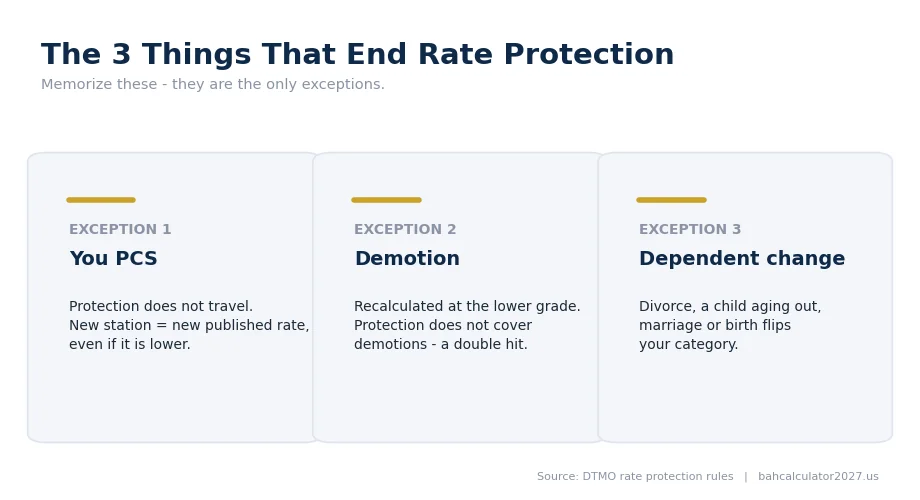
2. You get demoted
If your pay grade goes down, your BAH is recalculated at the new, lower grade. Rate protection doesn’t cover demotions — the logic is that your entitlement changed because you changed, not because the market moved.
Here’s the tricky part most guides skip: if you were protected at your old grade (receiving more than the published rate), and then you get demoted, you don’t just drop to the new grade’s published rate — you lose the protection entirely. It’s a double hit, and it’s worth understanding before it happens.
3. Your dependent status changes
If you go from with-dependents to without-dependents (or vice versa), your BAH is recalculated for the new category. The most common triggers: divorce, a child aging out or moving away, or gaining a dependent through marriage or birth.
Note the asymmetry: gaining a dependent moves you up to the with-dependents rate (good). Losing dependent status moves you down to the without-dependents rate (and protection doesn’t stop that drop, because your category changed).
Tricky Edge Cases Nobody Explains Well
Now the situations that confuse even experienced servicemembers. I’ve pulled these from the official DTMO rules and translated them into plain English.
You get promoted, but the new grade’s published rate is lower than your protected rate
This sounds impossible, but it happens. Say you’re an E-5 with a protected rate of $2,100 (published rate dropped to $1,950, but you’re protected). You get promoted to E-6. The E-6 published rate for your area is $2,050 — higher than the E-5 published rate, but lower than your protected $2,100.
You keep the $2,100. The rule is clear: promotions never lower your BAH. You get whichever is larger — your protected rate or the new grade’s published rate. The promotion still helps (your next increase starts from the higher base), but you don’t take a step back.
Demotion meets a rate drop at the same time
Rare, but brutal. If you’re demoted in the same year your area’s published rate drops, you get the new lower grade’s new lower published rate. No protection on either axis. This is the worst-case scenario, and it’s why the demotion exception exists as a separate rule — it overrides everything.
You lose protection one year, then get re-protected the next
Here’s something the DTMO’s own FAQ confirms but nobody writes about: protection isn’t a one-time thing. Say you PCS in 2025 (losing your old protection). In 2026, your new area’s published rate drops. You’re protected again — this time at your new station’s rate. Each duty station, each year, the January-vs-December comparison runs fresh. Protection is a standing policy, not a single event.
Dual-military couples: protection applies independently
If both spouses serve, rate protection applies to each member separately. If the published rate drops at your shared duty station, both of your individual rates are protected independently. One spouse PCSing doesn’t affect the other’s protection. The rules don’t care that you’re married — each servicemember is evaluated on their own record.
Divorce and BAH-DIFF
Divorce changes your dependent status, which ends rate protection as described above. But there’s a related concept: if you’re paying child support and living in single-type government quarters, you may qualify for BAH-DIFF — the difference between the with-dependents and without-dependents rates. It’s not rate protection, but it’s the safety net that catches people in this specific situation. Your finance office can walk you through the paperwork.
How to Check Your Protected Rate on Your LES
Don’t just trust the system — verify it. Here’s how.
What to look for
Pull up your Leave and Earnings Statement (LES) on myPay. Find the BAH line under entitlements. Compare that number against two things:
- The current published rate for your pay grade, MHA, and dependent status (use our BAH calculator or the official DTMO tables)
- What you received last December (check an old LES)
If the published rate dropped but your LES still shows the old higher number — protection is working. If your LES shows the new lower number and you didn’t PCS, get demoted, or change dependent status — something’s wrong.

What to do if DFAS got it wrong
It happens. DFAS processes millions of pay records, and errors slip through. If your BAH dropped and none of the three exceptions apply:
- Print your December LES and your current LES
- Print the published BAH tables for both years for your MHA and grade
- Take all three to your finance office and ask for a pay inquiry
- If finance can’t resolve it, you can request a formal review — and you’re entitled to back pay for any months you were underpaid
Document everything. The burden is on the system to get it right, but the paper trail is on you to maintain.
Rate Protection and Buying a Home
Two locked numbers
Here’s an angle the realtor sites stumbled onto but didn’t fully develop: if you buy a home with a fixed-rate mortgage and your BAH is protected, you have two locked numbers working in your favor. Your mortgage payment can’t go up. Your BAH can’t go down. That combination is the most financially stable housing situation a servicemember can have — and it’s worth factoring into your buy-vs-rent math.
This doesn’t mean buying is always right (PCS timelines still matter enormously), but it does mean that while you stay, a protected BAH plus a fixed mortgage is as close to a guaranteed housing budget as the military offers.
What to tell your lender
If you’re applying for a VA loan, make sure your lender understands rate protection. Some loan officers — especially those who don’t work with military borrowers regularly — will use the published rate for your area instead of your actual protected rate when calculating your income. If your protected rate is higher (which is the whole point), that’s money they’re leaving out of your qualification. Bring a recent LES and, if needed, a printout of the DTMO rate protection policy.
What Rate Protection Means for 2027
No other guide is talking about this yet, so let’s be first.
Which areas might see decreases
Remember those 60 areas that decreased going into 2026? Some of them may decrease again in 2027 if local rents continue softening. If you’re in one of those areas and staying put, your protection from 2026 carries forward — and if 2027 drops further, you’re protected at your 2026 protected rate, not the 2026 published rate. Protection stacks year over year as long as you don’t trigger an exception.
The 4.2% planning figure vs your protected rate
The DoD’s FY2027 budget request uses a 4.2% BAH increase for planning. But that’s a national average — your area could go up 8%, down 3%, or stay flat. Here’s the key insight: if your area’s 2027 published rate comes in below your protected rate, the 4.2% is irrelevant to you — you keep your protected number. Don’t let headlines about “BAH going up 4.2%” confuse you into thinking your specific rate will move. Check your MHA, check your LES, and know your number.
When the official December 2026 tables publish, I’ll update our 2027 guide with the actual numbers — and you can use our calculator to see exactly where you stand.
Frequently Asked Questions
Can my BAH go down?
The published rate for your area can go down — 60 areas decreased going into 2026. But your personal BAH won’t drop as long as you stay at the same station without a pay grade or dependent status change. That’s rate protection.
What exactly is BAH rate protection?
It’s the DoD policy that guarantees you receive the higher of the new January 1st published rate or the rate you were getting on December 31st. It protects you from market-driven decreases.
Does rate protection apply when I PCS?
No. This is the most misunderstood part. When you move to a new duty station, you get that station’s current published rate — even if it’s lower than what you had. Protection does not travel.
If I get promoted, do I keep my protected rate?
Yes. Promotions never lower your BAH. You get whichever is larger: your protected rate or the new grade’s published rate.
Can rate protection stop my BAH from increasing?
No — it only prevents decreases. If the published rate goes up, you get the increase automatically.
If I lose protection one year, can I be protected again later?
Yes. Protection is evaluated fresh every year at every duty station. Lose it through a PCS, and you can earn it again the next year if rates drop while you stay put.
Do I need to apply for rate protection?
No. It’s automatic through DFAS. The Coast Guard uses a worksheet process, but for all other branches, it just happens.
How do I check my protected rate on my LES?
Compare your current BAH on myPay against the published rate for your grade and area. If the published rate dropped but yours didn’t — and you didn’t PCS, get demoted, or change dependents — protection is working.
Does rate protection work differently for dual-military couples?
It applies independently to each spouse. One member’s PCS, demotion, or dependent change doesn’t affect the other’s protection.
What does rate protection mean for 2027?
If your area’s 2027 published rate drops below your current protected rate, you keep the protected number. The 4.2% national planning figure doesn’t override your individual protection.
The Bottom Line
Rate protection is one of the most servicemember-friendly policies in military compensation — and one of the least understood. Here’s what to remember:
- Your BAH can’t go down while you stay put — that’s the rule
- PCS, demotion, or dependent change ends it — those are the only exceptions
- It happens automatically — but verify it on your LES
- For 2027: know your protected rate before the December tables drop, so you know exactly where you stand
Run your ZIP through our BAH calculator to see your current rate, and check our 2027 guide for projections. And if you’re planning a move, our duty station comparison tool will show you exactly what a PCS means for your housing budget — protection or no protection.