BAH vs OHA: Complete Comparison [2027]
TL;DR: BAH (Basic Allowance for Housing) is a flat monthly payment for service members stationed in all 50 states — including Alaska and Hawaii. If your rent costs less than your BAH rate, you keep the difference. OHA (Overseas Housing Allowance) is the overseas counterpart, but it works as reimbursement: the military covers your actual rent up to a local ceiling, so there’s no leftover to pocket on the rent portion. Which one you receive depends on where you’re stationed, and the switch happens on your PCS timeline — the details are below.
The One Difference That Changes Everything

Everything about BAH vs OHA comes down to one mechanical difference: BAH pays you a flat rate, while OHA reimburses what you spend. Once you understand that, the rest of the details fall into place.
BAH: a flat amount — keep the difference
Say you’re an E-5 with dependents stationed at Fort Hood. Your 2026 BAH rate is $1,695 a month — that’s the actual published DTMO rate, not an estimate. If you rent a place for $1,300, the remaining $395 is yours. No receipts, no payback, no questions. That’s the flat-amount advantage, and it’s why families who rent below their rate often come out ahead on BAH.
BAH also comes with individual rate protection: if rates drop next year, you keep your current higher rate as long as your status doesn’t change — no PCS, no demotion, no dependency change. I covered exactly how that protection works in my BAH rate protection guide.
OHA: reimbursement — the rent difference isn’t yours
OHA flips the model. Take an E-5 with dependents at Ramstein, Germany. The figures in this example are illustrative (rounded to show the mechanics — not official rates): say the local rent ceiling for your grade is €1,900 and your lease is €1,750. You receive €1,750 — your actual rent — not the ceiling. Find a cheaper place at €1,500 and you get €1,500. There is no “profit” on the rent portion, which removes the incentive to hunt for cheaper housing the way BAH rewards it.
The one exception is the utility allowance, which is flat — that piece you do keep. More on that below.
BAH vs OHA at a Glance
| BAH | OHA | |
|---|---|---|
| Where | All 50 states, including Alaska and Hawaii | Overseas stations, including U.S. territories — except Alaska and Hawaii |
| Payment style | Flat monthly rate | Reimbursement up to a ceiling |
| Based on | Locality, pay grade, dependency status | Locality, pay grade, dependency status — plus your actual rent |
| Keep the difference | Yes — leftover is yours | Rent portion: no. Utility portion: yes |
| Utilities | Part of the flat rate (yours to manage) | Separate flat utility allowance (yours to keep) |
| Move-in money | None | MIHA — one-time payment(s) |
| How often it changes | Annually (January 1) | Ceilings every 6 months; currency on the 1st & 16th monthly; utility annually |
| Currency risk | None | Yes — your dollar amount moves with exchange rates |
| Tax treatment | Tax-free | Tax-free |
| Rate protection | Yes — individual rate protection | No equivalent |
| Lease needed to activate | No | Yes — DD Form 2367 plus lease |
| 2027 outlook | 4.2% raise proposed in the FY2027 budget request (not approved) | No annual release — updates continuously |
The 3 Parts of OHA, Explained
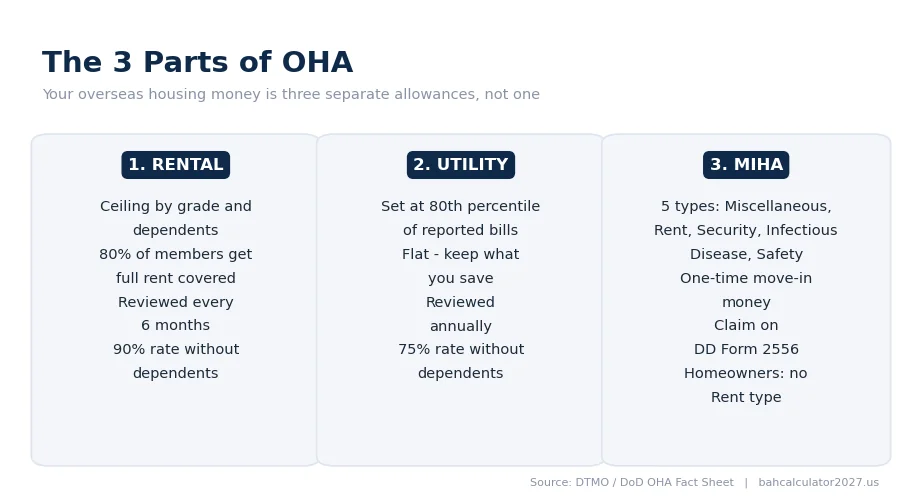
Your OHA isn’t one number — it’s three separate pieces, each calculated differently. Understanding them is the key to budgeting overseas.
1. Rental allowance — the ceiling rule
This is the biggest piece. Every location has a rent ceiling by pay grade and dependency status, reviewed every six months based on the rents troops actually report. You’re paid your rent or the ceiling, whichever is lower. The ceilings are set so roughly 80% of members with dependents get their full rent covered — which means about one in five pays something out of pocket.
If you’re unaccompanied or without dependents, you’re entitled to 90% of the with-dependent rental rate.
2. Utility allowance — the one piece you keep
This is the part most guides gloss over, and it’s the only piece of OHA you can bank. It’s a flat monthly amount set at the 80th percentile of what members report paying for utilities, and it’s reviewed every year. If your bills come in lower, the difference is yours.
A quick illustration (figures rounded): if your utility allowance is €450 and your actual bills are €380, you keep €70. Members without dependents who pay their own utilities get 75% of the with-dependent rate. And if your utilities are bundled into your rent, the allowance gets folded into your rental payment instead of being paid separately.
3. MIHA — the move-in money
The Move-In Housing Allowance is a one-time payment when you move into private housing overseas. Under current DoD rules it has five types — older guides often list only three or four and miss the rest:
| Type | What it covers | Documentation |
|---|---|---|
| Miscellaneous | Lump sum for average move-in costs (transformers, wardrobes, utility connections) — paid with your first OHA | None — no receipts needed |
| Rent | One-time nonrefundable landlord or agent charges | Receipts + DD Form 2556 |
| Security | Security upgrades in designated threat areas (needs senior-officer approval) | Receipts + DD Form 2556 |
| Infectious Disease | e.g., window/door screens in designated areas | Receipts + DD Form 2556 |
| Safety | Safety upgrades required under 15 Foreign Affairs Manual 971.1 | Per the DoD MIHA process guide |
Two notes: MIHA doesn’t cover move-out costs, and homeowners can’t claim the Rent type.
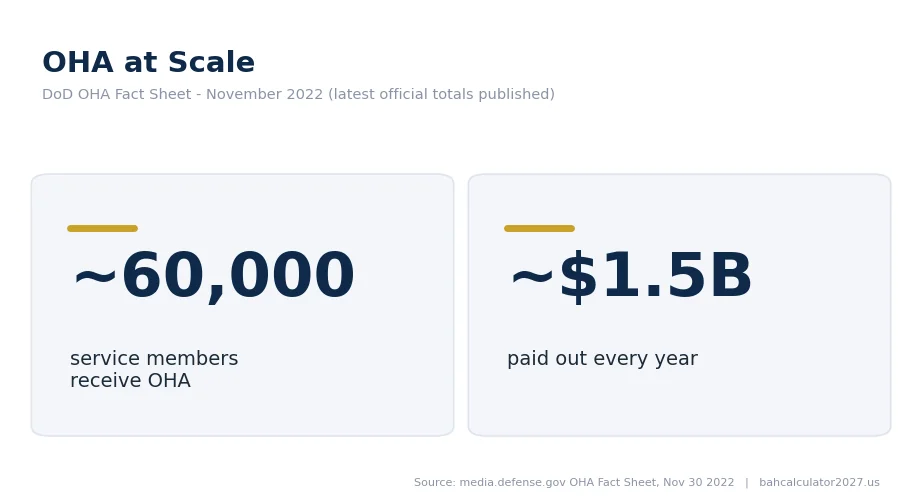
Scale check: per the DoD’s OHA fact sheet (November 2022 — I’m dating this because DoD hasn’t published newer totals), roughly 60,000 service members receive OHA at a cost of about $1.5 billion a year.
Why Your OHA Moves When Your Rent Doesn’t
This confuses everyone the first time. Your lease is in euros (or yen, or won), but you’re paid in dollars — and the exchange rate between the two moves. DoD handles this with a currency adjustment model: one official exchange rate per pay period, with adjustments effective the 1st and 16th of each month. When accumulated rate differences hit 5%, a new rate kicks in, designed to “buy back” the gap over eight weeks — so over time you neither profit nor lose from currency swings.
The practical effect: your dollar OHA can change even when your rent hasn’t. The standard advice from experienced overseas families is to park your OHA (rent plus utility) in a dedicated account and pay your bills from it, so a currency swing never catches your main budget off guard.
COLA Is Not OHA — Don’t Confuse Them
One of the most common mix-ups I see: treating COLA (Cost of Living Allowance) as the overseas version of BAH. It’s not. Overseas COLA covers non-housing goods and services — groceries, clothing, everyday expenses — and by definition excludes housing, because that’s what OHA covers. The two allowances are independent of each other: COLA doesn’t change your OHA and vice versa. OHA is BAH’s overseas counterpart; COLA is a third, separate allowance.
When BAH Stops and OHA Starts
This is the question behind most “bah vs oha” searches: I’m PCSing — when does the switch actually happen? The rules below come from the DoD Financial Management Regulation, Volume 7A, Chapter 26 (May 2025).
Going overseas (CONUS → OCONUS)
Your old station’s BAH keeps running from the day you depart through the day before you report to the new station. OHA starts once the housing office authorizes you for off-post residence — documented on DD Form 2367 — and your lease is filed. If there’s a gap in between (transit, school en route), BAH-Transit (also called BAH RC/T) can cover it.
Coming home (OCONUS → CONUS)
OHA is authorized through the day before you depart the overseas station. On departure day, OHA stops and BAH-Transit applies if you’re not otherwise receiving a housing allowance. Your new CONUS BAH starts when you sign in at the new station.
TLE vs TLA — the gap money
Two allowances bridge the moving gaps, and the TLE rule changed recently:
- TLE (Temporary Lodging Expense) — for CONUS moves: up to 21 days (increased from 14, effective November 27, 2024). If you’re departing CONUS for an overseas station, it’s 7 days. Days can be split across locations.
- TLA (Temporary Lodging Allowance) — for OCONUS: up to 60 days on arrival and 10 days before departure. It’s not automatic — it’s based on housing availability, with reviews every 15 days.

Both require receipts, and neither is a windfall — they reimburse temporary lodging while you’re between homes.
A necessary caveat: these timelines are the general rules. Your exact start and stop dates depend on your orders, your entitlement, and your circumstances — separately residing dependents, Secretarial waivers, and government-quarters assignments can all change the picture. Confirm with your finance office before you sign anything.
Special Situations
Dual-military couples
When both spouses serve and you’re OCONUS with dependents, only one of you receives OHA at the with-dependent rate — and you two choose who. The senior member is only the tiebreaker if you can’t agree. The other spouse receives the without-dependent rate. If you share one lease, your combined reimbursement can’t exceed the actual rent: an illustrative example — $2,500 rent with two $2,000 ceilings gets split to cover the $2,500 — not doubled to $4,000. Our dual-military BAH calculator walks through the stateside version of these rules.
Unaccompanied tours
On an unaccompanied overseas tour, you’re entitled to up to 90% of the rental allowance and 75% of the utility allowance. If you’re housed in government barracks overseas, you generally rate BAH Partial instead of OHA. I covered the deployment side of separated housing allowances in my BAH during deployment guide.
Korea barracks and non-command-sponsored families
Two rules worth knowing: a member housed in government quarters overseas generally receives BAH Partial, not OHA. And if your dependents are with you overseas but aren’t command-sponsored, no OHA is authorized for them.
FSH-O basics
Family Separation Housing–Overseas applies when you’re in OCONUS private rentals but your dependents live elsewhere — it covers the added housing cost of that separation. One hard rule: it’s not payable if your dependents live in the same country as your duty station. For the current rate, check with your finance office rather than trusting older tables you might find online.
Worked Example — E-5 with Dependents: Fort Hood vs Ramstein
Let’s put the two systems side by side for the same family. BAH figures are real published 2026 DTMO rates; OHA figures are illustrative (rounded) to show the mechanics.
| Fort Hood (BAH) | Ramstein (OHA — illustrative) | |
|---|---|---|
| Monthly housing money | $1,695 flat (2026 DTMO rate) | €1,750 rent reimbursed + €450 utility |
| Example rent | $1,300 | €1,750 |
| You keep | $395/month | €70/month (utility savings only) |
| If rent rises 5% | You absorb it — BAH doesn’t change | Reimbursement rises with rent (up to the ceiling) |
| Currency risk | None | Yes — dollar amount adjusts on the 1st & 16th |
The takeaway: BAH rewards frugality, while OHA rewards accuracy — report your real rent, claim the MIHA you’re entitled to, and keep the utility savings.
Want to see your own number? Run it through our BAH calculator.
What Changes in 2027
Short version. On the BAH side, the DoD’s FY2027 budget request proposes a 4.2% BAH raise (alongside 3.4% for BAS) — that’s a proposal, not approved and not final. Final 2027 BAH rates come from DTMO around mid-December 2026, and I’ll update our complete 2027 BAH rates guide when they land.
On the OHA side, there’s no annual “2027 rates” release to wait for — ceilings adjust every six months, utilities annually, and currency twice a month. For current OHA figures, the DTMO OHA calculator is the authoritative source.
Frequently Asked Questions
Is OHA taxed?
No. Like BAH, OHA is a tax-free allowance.
Can I keep leftover OHA?
On the rent portion, no — you’re reimbursed for what you pay, up to the ceiling. On the utility portion, yes — it’s a flat amount, so lower bills mean money kept.
Does OHA cover utilities?
Yes, through the separate utility/recurring maintenance allowance — unless your utilities are included in your rent, in which case it’s folded into the rental payment.
What is MIHA?
The one-time Move-In Housing Allowance: five types (Miscellaneous, Rent, Security, Infectious Disease, Safety) covering move-in costs when you take private housing overseas. Where receipts are required, you claim with DD Form 2556.
Do I get OHA and COLA at the same time?
Yes, if you rate both — they’re independent allowances. COLA covers non-housing costs; OHA covers housing.
What happens to my BAH when I PCS overseas?
It continues through the day before you report to the new station. OHA starts when the housing office authorizes off-post residence (DD Form 2367) and your lease is filed.
How do dual-military couples split OHA?
You choose who takes the with-dependent rate (the senior member only breaks ties); the other takes the without-dependent rate. Combined reimbursement can’t exceed the actual rent.
Does BAH rate protection apply to OHA?
No. Rate protection is a BAH feature. OHA’s rent portion simply tracks your actual rent up to the ceiling.
When exactly does OHA start?
When your housing office approves your DD Form 2367 and your lease is on file — not when your orders are cut.
What is FSH-O?
Family Separation Housing–Overseas: for members in OCONUS private rentals whose dependents live elsewhere. It’s not payable if your dependents are in the same country as your duty station.