
How Much House Can You Afford with BAH? [2027]
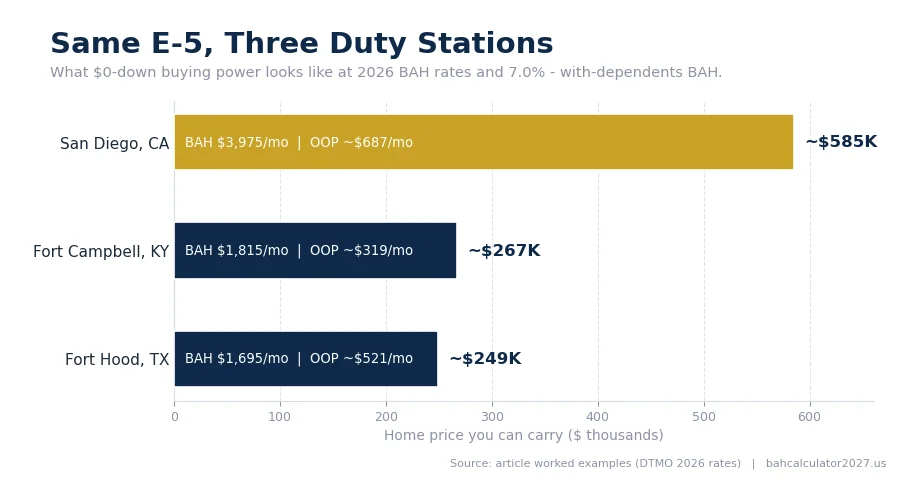
Here’s the short answer: take your monthly BAH, and at today’s rates (~7%), every $1,000 of it covers about $150,000 of home price for principal and interest. An E-5 at Fort Hood ($1,695 BAH) can carry roughly a $249,000 home; the same E-5 in San Diego ($3,975 BAH) can carry roughly $585,000. But BAH doesn’t cover property taxes or insurance — so the honest out-of-pocket number is a few hundred more per month. I’ll show you the exact math below.
BAH + a $0-Down VA Loan Is the Whole Formula
Most buyers overcomplicate this. The formula is actually simple:
Your monthly BAH + a VA loan with $0 down = your buying power.
Two things make this work. First, lenders count your BAH as income — 100% of it. It’s tax-free, it’s stable, and it shows up every month for as long as you’re stationed there. Second, the VA loan removes the part that stops most civilians: the down payment. No 20% to save up, no PMI eating a few hundred a month.
What trips people up is thinking “my BAH is $1,695, so I can afford a $1,695 mortgage payment.” Close — but the mortgage payment isn’t just principal and interest. Let me show you how lenders actually run the numbers.
How Lenders Actually Do the Math
A lender looks at three things: your income (base pay + BAH + any spouse income), your debts, and the VA’s two guardrails.
Guardrail 1: DTI. The VA uses a 41% debt-to-income guideline. That’s not a hard wall — it’s a benchmark. Add up your monthly debts including the proposed housing payment, divide by gross monthly income. Under 41% and you’re in comfortable territory.
Guardrail 2: residual income. This is the one nobody talks about, and it kills more deals than DTI. After your housing payment, taxes, debts, and living costs, the VA wants a minimum amount left over each month. For a family of four borrowing $80,000+, that’s $1,003/month in the South and Midwest, $1,025 in the Northeast, $1,117 in the West (2026 figures, VA Pamphlet 26-7). Fall short and the loan can die even with great credit.
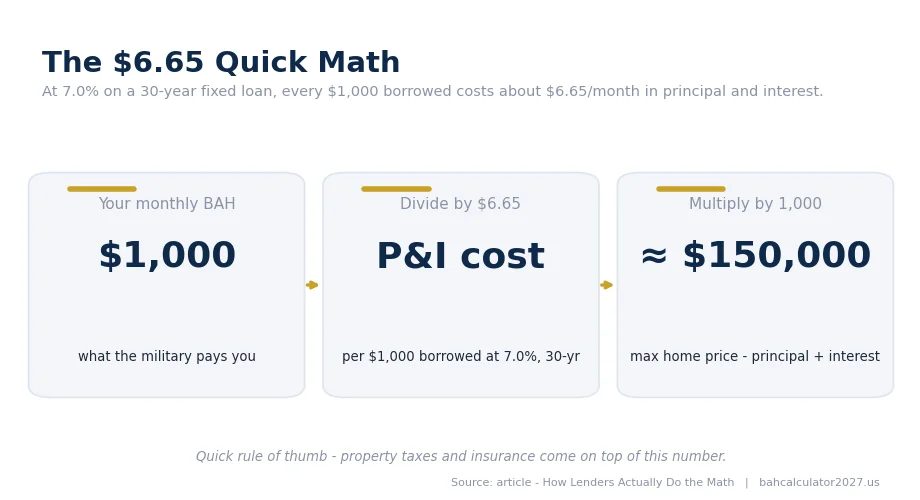
For the monthly payment itself, here’s the quick math I use: at 7% on a 30-year fixed loan, every $1,000 you borrow costs about $6.65/month in principal and interest. So divide your BAH by 6.65, multiply by 1,000, and you have your rough max loan amount. (Rates move — every quarter-point changes the number by roughly $6,000–$7,000 for an E-5. Always rerun with your actual quote.)
The VA Funding Fee: What It Really Costs You
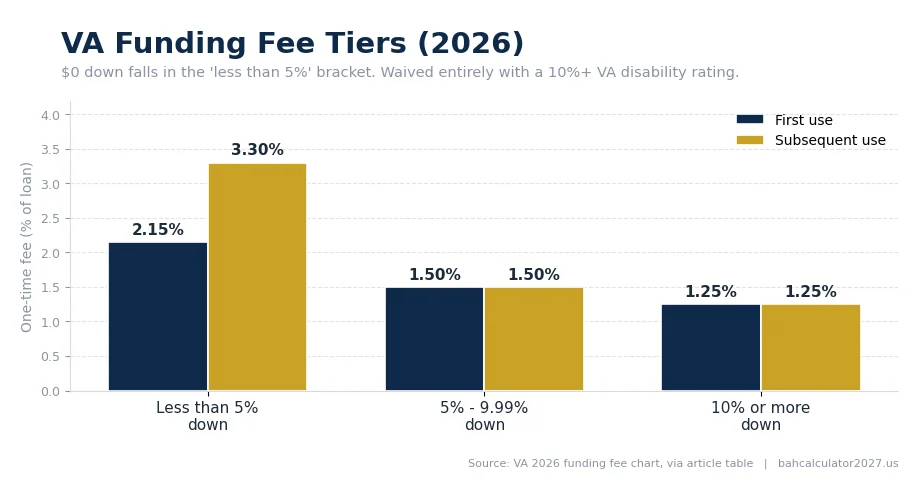
The VA loan has no PMI, but it’s not free to enter. The funding fee is a one-time charge — a percentage of the loan — and most buyers roll it into the loan balance. Here are the verified 2026 rates:
| Down payment | First use | Subsequent use |
|---|---|---|
| Less than 5% | 2.15% | 3.30% |
| 5% – 9.99% | 1.50% | 1.50% |
| 10% or more | 1.25% | 1.25% |
Two things worth knowing. First, you’ll see 2.30% floating around on some sites for first use — that’s wrong; the VA’s current chart says 2.15%. Second, if you have a VA disability rating of 10% or higher, the fee is waived entirely. On a $300,000 loan, that’s $6,450 you simply don’t pay.
On a $0-down purchase, the fee gets added to your loan. A $249,000 home at 2.15% means a $5,354 fee and a $254,354 loan balance. You pay interest on it for 30 years, so it’s real money — but it doesn’t come out of your pocket at closing.
What BAH Does NOT Cover (the Honest Column)
Here’s where most “how much house can you afford” articles lie to you. They show the price your BAH covers for principal and interest, and stop. But your actual monthly check covers PITI — principal, interest, taxes, and insurance — plus HOA if there’s one.
Property tax is the big one and it varies wildly. Texas has no state income tax but property taxes run ~1.8%. California’s effective rate is lower (~1.16%) but on much bigger prices. Insurance runs $120–$180/month depending on the state.
So every example below has two columns: what your BAH covers for principal + interest, and what you actually pay out of pocket once taxes and insurance join the party. That second column is the number that matters.
Worked Example 1: E-5 at Fort Hood ($1,695 BAH)
Fort Hood’s 2026 BAH for an E-5 with dependents is $1,695/month (official DTMO rate — see my BAH rates guide for the full tables).
- Home price: ~$249,000
- VA funding fee (2.15%, financed): $5,354 → loan balance $254,354
- Principal + interest at 7%: ~$1,692/month — fits inside the $1,695 BAH
- Property tax (~1.8% TX): ~$374/month
- Homeowner’s insurance: ~$150/month
- True out of pocket: ~$521/month above BAH
So yes — an E-5 at Hood can buy a $249,000 home with nothing down and the BAH covers the mortgage itself. But budget $500+/month extra for taxes and insurance, because Texas will collect its share one way or another.
Worked Example 2: E-5 in San Diego ($3,975 BAH)
San Diego’s 2026 BAH for an E-5 with dependents is $3,975/month. High BAH, high prices — the math scales.
- Home price: ~$585,000
- VA funding fee (2.15%, financed): $12,578 → loan balance $597,578
- Principal + interest at 7%: ~$3,976/month — right at the BAH line
- Property tax (~1.16% CA): ~$566/month
- Homeowner’s insurance: ~$120/month
- True out of pocket: ~$687/month above BAH
$585,000 sounds like a lot of house for an E-5, and it is — that’s the San Diego BAH doing its job. But notice the out-of-pocket is higher than Hood in dollars, because the tax bill scales with price.
Worked Example 3: E-5 at Fort Campbell ($1,815 BAH)
Fort Campbell’s 2026 BAH for an E-5 with dependents is $1,815/month — the middle ground.
- Home price: ~$267,000
- VA funding fee (2.15%, financed): $5,741 → loan balance $272,741
- Principal + interest at 7%: ~$1,815/month — exactly at BAH
- Property tax (~0.85% TN/KY): ~$189/month
- Homeowner’s insurance: ~$130/month
- True out of pocket: ~$319/month above BAH
Campbell is the sweet spot in this trio: a solid $267,000 home with the smallest out-of-pocket gap, thanks to lower property taxes.
| Duty station | E-5 BAH (2026) | Home price | P&I | Est. tax + insurance | Out of pocket |
|---|---|---|---|---|---|
| Fort Hood, TX | $1,695 | ~$249,000 | $1,692 | ~$524 | ~$521/mo |
| San Diego, CA | $3,975 | ~$585,000 | $3,976 | ~$686 | ~$687/mo |
| Fort Campbell, KY | $1,815 | ~$267,000 | $1,815 | ~$319 | ~$319/mo |
Assumptions: 7.0% 30-yr fixed, $0 down, 2.15% funding fee financed, with-dependents BAH. Taxes/insurance are planning estimates — get the actual tax bill for any house you’re considering.
The Test Nobody Talks About: VA Residual Income
Let me put real numbers on the residual income test, because this is where deals quietly die. The VA publishes minimum monthly leftover income by region and family size (2026, loans of $80,000+):
| Family size | Northeast | Midwest | South | West |
|---|---|---|---|---|
| 1 | $450 | $441 | $441 | $491 |
| 2 | $755 | $738 | $738 | $823 |
| 3 | $909 | $889 | $889 | $990 |
| 4 | $1,025 | $1,003 | $1,003 | $1,117 |
| 5 | $1,062 | $1,039 | $1,039 | $1,158 |
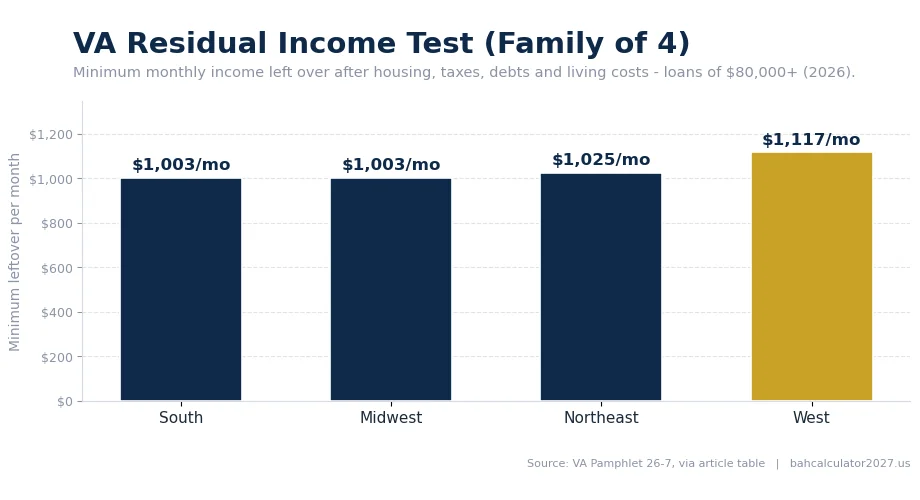
Take a family of four at Fort Hood (South region): after the mortgage, taxes, debts, and living costs, they need $1,003/month still in the bank. If your DTI pushes above 41%, the bar rises 20% higher (about $1,204 for that family).
But it cuts both ways — strong residual income is the VA’s favorite compensating factor. DTI at 45% with $1,500/month residual? Many lenders will still approve you. If you’re tight on residual income, the fastest fixes are paying off a car loan or choosing a slightly cheaper house — both lift the number immediately.
Can You Afford It AFTER You PCS?
Here’s the question almost nobody asks before buying, and it’s the most important one. Your BAH covers the house while you’re stationed there. But the average tour is 2–3 years. Then you PCS, the BAH follows you to the new station, and the old house has to survive on rent. (If you’re heading overseas, the math changes again — I compared BAH and OHA here.)
Run this math before you buy: can the house rent for enough to cover PITI plus ~10% management? At Fort Campbell, where a $267,000 home might rent for $1,900+, the answer is often yes. In San Diego, where that $585,000 home might rent for $3,800 against a $4,662 PITI, you’d bleed ~$860/month plus management — from the BAH you need at your next station.
I’m not saying don’t buy in expensive areas. I’m saying know which game you’re playing: buying to live in for 3 years is different from buying a future rental. If the rent math doesn’t work, either plan to sell at PCS or buy knowingly.
5 Mistakes That Blow Up BAH Home Budgets
1. Spending 100%+ of BAH because you “fell in love with a house.” Going over BAH with a working spouse’s income is a deliberate decision — run the numbers on our dual-military calculator if that’s your situation. Going over because of granite countertops is how people get in trouble.
2. Forgetting the funding fee. It’s rolled into the loan, so buyers ignore it — but 2.15% on $400,000 is $8,600 you’re paying interest on for 30 years. Price it in.
3. Ignoring the PCS math. Covered above. The house has to work as a rental or a sale, not just as your home.
4. Skipping pre-approval. A pre-approval tells you what a lender will actually fund — with your debts, your credit, your BAH. Do it before you fall for a house.
5. Buying at peak PCS season. Summer near big installations means bidding wars. If you have timing flexibility, the off-season market is kinder.
Not sure where to start? Run your own numbers on the BAH calculator first — then come back with your real BAH and rerun the examples above.
Frequently Asked Questions
Does BAH count as income for a VA loan?
Yes — lenders count 100% of your BAH as income. It’s tax-free and stable, which actually makes it stronger than equivalent civilian income in underwriting.
How much house can an E-5 afford with BAH?
It depends on the duty station. At 2026 rates and ~7% interest: roughly $249,000 at Fort Hood ($1,695 BAH), $267,000 at Fort Campbell ($1,815 BAH), and $585,000 in San Diego ($3,975 BAH) — all with $0 down. Budget a few hundred extra monthly for taxes and insurance.
Can I use BAH to buy a house with $0 down?
Yes. The VA loan allows 100% financing with no PMI for eligible service members with full entitlement. Your BAH covers the monthly payment; you don’t need savings for a down payment.
What is the VA funding fee in 2026?
2.15% of the loan for first-time use with less than 5% down; 3.30% for subsequent use; 1.50% with 5%+ down; 1.25% with 10%+ down. It’s waived entirely with a 10%+ VA disability rating.
Does the VA have a DTI limit?
The VA uses a 41% debt-to-income guideline — it’s a benchmark, not a hard cap. Strong residual income can compensate for a higher DTI.
What is VA residual income?
The money left over each month after your housing payment, taxes, debts, and living costs. The VA sets minimums by region and family size — e.g., $1,003/month for a family of four in the South on loans over $80,000.
Can I afford a house on BAH alone, single income?
Often yes. BAH is designed to cover local housing costs, and lenders treat it as solid income. Single-income military families regularly buy with BAH covering most or all of the mortgage — the key tests are DTI and residual income, not the number of paychecks.
What happens to my mortgage when I PCS?
The mortgage stays; your BAH moves with you to the new duty station. Most owners either sell or rent out the home. Run the rental math (rent vs. PITI + management) before you buy so the PCS doesn’t become a financial emergency.
Is it better to rent or buy with BAH?
If you’ll be stationed 3+ years and the rent-vs-buy math works, buying builds equity with money you’d spend on rent anyway. For short tours or markets where rent won’t cover PITI after you leave, renting is often the smarter play.
Will my BAH cover the full mortgage payment?
It usually covers principal and interest closely — that’s by design. But property taxes and homeowner’s insurance come on top, so expect a few hundred per month out of pocket depending on the state.
Independent guide — not affiliated with the U.S. Department of Defense or any military branch. Rates and figures verified against official sources as of October 2026; mortgage rates move weekly — always confirm with your lender.