Dislocation Allowance (DLA): 2026-2027 Guide – Rates, Eligibility & How to Claim
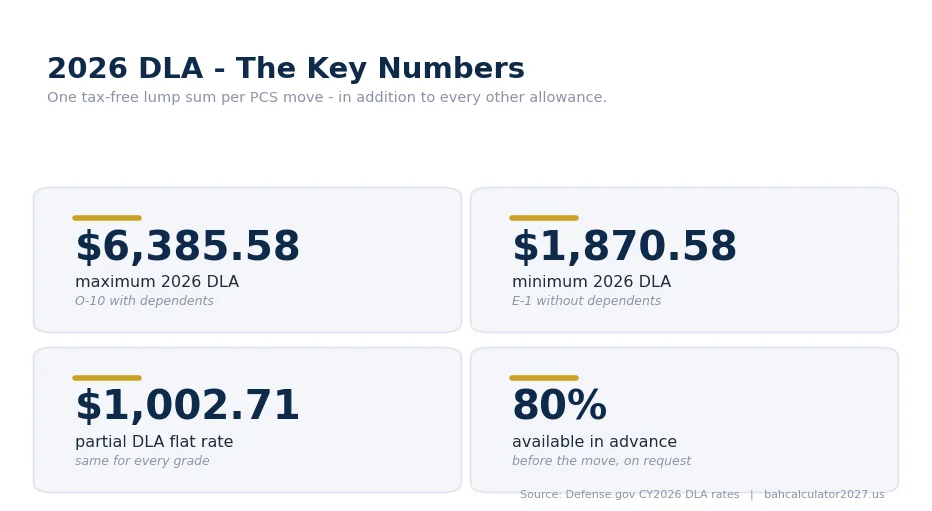
A Dislocation Allowance (DLA) is a one-time, tax-free payment the military gives you when PCS orders force you to move your household. For 2026 it ranges from $1,870.58 for an E-1 without dependents up to $6,385.58 for an O-10 with dependents. It covers the small moving costs nothing else reimburses — utility deposits, cleaning supplies, new curtains — and you can even get up to 80% of it in advance before you move.
What Is Dislocation Allowance?
If you’ve ever PCS’d, you know the move itself isn’t the only expense. The household goods shipment is covered, the mileage and per diem are covered — but the little stuff adds up fast. Deposits to turn on power and water at the new place. A deep-clean of the old apartment so you get the deposit back. Replacing the stuff that broke in transit. Buying things the new place simply needs.
That’s the gap the Dislocation Allowance exists to fill. DLA is the military’s way of saying: “moving costs more than the big-ticket items, and we know it.” It’s authorized under 37 U.S.C. § 477 and spelled out in the Joint Travel Regulations, Chapter 5, and it’s the same across every branch — Army, Navy, Air Force, Marines, Space Force, and Coast Guard all use the same rate table.
A few things that surprise people about DLA (and if you’re new to military allowances generally, our complete 2027 BAH benefits guide is a good companion read):
- It’s a lump sum, not a reimbursement — nobody asks for receipts, and you keep it whether your actual expenses were higher or lower.
- It’s paid in addition to everything else: HHG shipment, per diem, TLE/TLA, mileage. It doesn’t replace any of them.
- It is not taxable (more on that below — a few popular sites get this wrong).
- The amount depends only on your pay grade and whether you have dependents. Your location, distance moved, and home price have nothing to do with it.
2026 DLA Rates: Full Table by Pay Grade
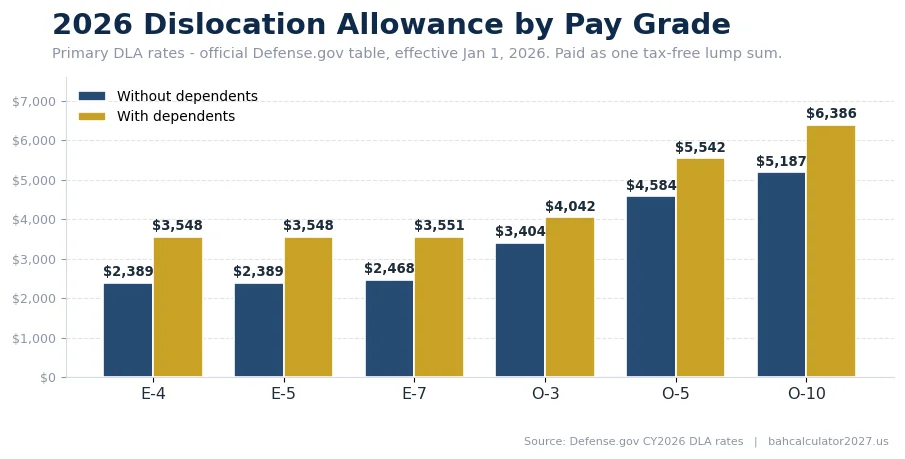
These are the official CY2026 primary DLA rates, effective January 1, 2026, published by the Department of Defense. One important detail: you get the with-dependent rate only if your dependents actually relocate in connection with the PCS — not simply because you’re married. More on that in the eligibility section.
A pattern worth noticing: E-4 through E-6 all share the same rate ($2,389.42 without dependents / $3,548.02 with dependents), and E-1 through E-3 share the same with-dependent rate ($3,548.02). And every general and flag officer grade, O-7 through O-10, gets the same top rate.
| Grade | Without dependents | With dependents |
|---|---|---|
| O-10 | $5,187.33 | $6,385.58 |
| O-9 | $5,187.33 | $6,385.58 |
| O-8 | $5,187.33 | $6,385.58 |
| O-7 | $5,187.33 | $6,385.58 |
| O-6 | $4,758.96 | $5,749.63 |
| O-5 | $4,583.51 | $5,542.06 |
| O-4 | $4,247.61 | $4,885.43 |
| O-3 | $3,404.11 | $4,041.88 |
| O-2 | $2,700.31 | $3,451.28 |
| O-1 | $2,273.82 | $3,085.23 |
| O-3E | $3,675.83 | $4,343.80 |
| O-2E | $3,124.87 | $3,919.27 |
| O-1E | $2,687.09 | $3,621.10 |
| W-5 | $4,315.51 | $4,715.58 |
| W-4 | $3,832.45 | $4,323.11 |
| W-3 | $3,221.08 | $3,960.78 |
| W-2 | $2,860.70 | $3,643.75 |
| W-1 | $2,394.55 | $3,151.31 |
| E-9 | $3,147.54 | $4,149.51 |
| E-8 | $2,888.97 | $3,824.94 |
| E-7 | $2,468.19 | $3,551.31 |
| E-6 | $2,389.42 | $3,548.02 |
| E-5 | $2,389.42 | $3,548.02 |
| E-4 | $2,389.42 | $3,548.02 |
| E-3 | $2,355.48 | $3,548.02 |
| E-2 | $2,025.26 | $3,548.02 |
| E-1 | $1,870.58 | $3,548.02 |
The 3 Types of DLA
Most articles only mention one DLA. There are actually three, and knowing the difference matters:
1. Primary DLA
This is the standard one — what you get for a normal PCS move that relocates your household. Everything in the table above is a primary DLA rate. This is the one 99% of people will ever deal with.
2. Secondary DLA
This one is for an odd but real situation: you receive PCS orders, you move, and then the orders are amended, modified, canceled, or revoked after you’ve already moved. In that case you’re entitled to a reduced “secondary” DLA instead of a second primary payment. For 2026, secondary rates run from about $1,019 (E-1 without dependents) up to about $5,108 (O-10 with dependents).
3. Partial DLA
This covers qualifying moves without PCS orders — for example, when the government orders you to vacate (or occupy) government family housing because of privatization, renovation, or a base requirement, but you’re not on PCS. Partial DLA is a single flat rate for everyone, regardless of rank or family size: $1,002.71 for 2026.
The flat rate adjusts every January. Look at how it’s grown — it has more than doubled since 2002:

You do not get partial DLA if you move out of government housing for your own convenience, for misconduct, or into different government quarters. It’s only for moves the government requires.
Who Qualifies for DLA?
DLA is not automatic — it’s paid when you meet the conditions. Here’s the honest checklist.
You generally qualify if:
- You receive PCS orders and physically relocate your household (with or without shipping household goods — the household move is what counts, not the HHG shipment itself)
- You’re ordered to vacate government quarters for the government’s convenience (BRAC, renovation, privatization)
- You’re single with no dependents, you receive BAH, and you do not move into government quarters at the new duty station
- It’s your first PCS from home or your place of entry to your first permanent duty station — but only if your dependents actually move with the orders
You do NOT qualify if:
- You don’t receive BAH (single members in barracks or dorms, for example)
- You’re a single member assigned to government quarters — including a ship — at the new duty station for more than 60 days
- The move is your final one: separation or retirement moves get no DLA
- Your household doesn’t actually relocate (no move, no DLA — an HHG shipment isn’t even required, but the household itself must move)
- You transfer to a nearby duty station without a pre-authorized household goods move
- You’ve already received DLA in the same fiscal year — the normal limit is one per fiscal year (exceptions exist for genuine emergencies)
- You’re National Guard or Reserve entering or leaving active duty (with one exception: if you enter active duty for more than 20 weeks at one location, get PCS allowances rather than TDY allowances, and move your dependents, you can qualify — see our National Guard & Reserve BAH guide for how these rules interact)
Can You Get DLA Without Dependents?
Yes — this is one of the most common questions, and the answer surprises people. You do not need dependents to get DLA. What you need is BAH and a household move that doesn’t end in government quarters.
The classic case: a single E-5 gets PCS orders, moves off-post at the new duty station, and receives BAH. Full primary DLA applies — $2,389.42 in 2026.
The case that fails: a single E-3 gets PCS orders and is assigned to the barracks at the new duty station. No BAH, no household move to off-post housing — no DLA.
So the test is simple: am I moving a household into the civilian economy? If yes, DLA is on the table. If the move ends in the barracks, dorms, or aboard ship, it’s not.
DLA on Your First PCS Move
Your very first move — from home (or wherever you entered service) to your first permanent duty station — is a special case, and it trips people up.
If you have dependents and they actually move in connection with the orders (to the new duty station or a designated place), you qualify for DLA at the with-dependent rate. If you’re single, or your dependents don’t relocate, DLA is not authorized for that first move.
This is the mirror image of your last move: your first PCS needs dependents moving to unlock DLA; your last PCS (separation or retirement) gets no DLA at all.
Is DLA Taxable?
No. This one matters, because a surprising number of websites get it wrong.
DLA is a qualified military benefit excluded from your gross income — the same family as BAH, BAS, and TLE. The IRS Armed Forces’ Tax Guide (Publication 3) treats DLA the same way it treats temporary lodging and move-in housing allowances: never in income, never deducted. You’ll see it identified on your W-2, Box 12, with code P, but it does not add a dollar to your federal taxable income. The legal backbone is 26 U.S.C. § 134 and IRC § 217(g), which preserved the military moving-expense exclusion when the 2017 tax law suspended it for civilians. For the full picture on which military allowances are taxed and which aren’t, see our complete military tax guide.
Two things to keep straight:
- Some sites claim DLA is taxable. That is wrong for active-duty members moving on PCS orders. Don’t let a bad blog post scare you into setting aside tax money you don’t owe.
- PPM (personally procured move) incentive payments are different. If you do a DITY/PPM move and the incentive payment is more than your actual moving expenses, the excess is taxable income on Form 3903. That’s about the PPM incentive, not DLA — but people mix them up because both involve moving money.
How to Claim DLA: Step by Step
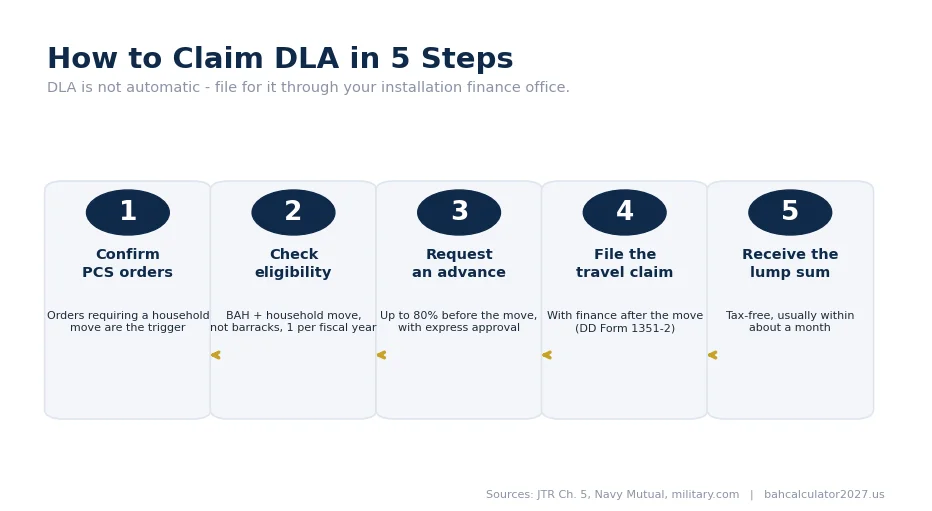
DLA is not automatic — it’s paid when you ask for it through the right channel. Here’s the process:
- Confirm your PCS orders. DLA keys off official orders that require relocating your household. Have them in hand before anything else.
- Verify eligibility. Run through the checklist above. The big disqualifiers: barracks at the new station, a second DLA in the same fiscal year, or a separation/retirement move. When in doubt, ask your installation finance office — that’s literally their job.
- Decide whether you want an advance. If you need the money before the move, you can request an advance of up to 80% of your estimated DLA with express approval. The rest is settled after you file. Not every installation processes advances the same way, so ask early — ideally before you start spending.
- File your PCS travel claim. Submit your claim with your installation’s finance office after the move — this goes in with the same paperwork as your mileage, per diem, and other travel entitlements (normally a DD Form 1351-2 travel voucher). Procedures vary slightly by branch.
- Receive the lump sum. Most members are paid within about a month of submitting completed paperwork. It arrives as one payment, and it stacks with everything else you’re owed — TLE, per diem, mileage — because DLA is a separate entitlement.
One practical tip: keep copies of everything you submit — your orders, your claim, and any receipts. DLA itself doesn’t require receipts, but if anything gets lost in finance’s pipeline, resubmitting from your own file is ten times faster than reconstructing it.
DLA vs TLE vs PPM: How the PCS Money Fits Together
A PCS move throws a lot of different payments at you, and they blur together. (If you’re traveling on orders, our military per diem guide breaks down the daily-rate side in detail.) Here’s how the main ones differ:
- DLA — fixed lump sum by grade/dependency for miscellaneous relocation costs. Not tied to your location or how far you moved.
- TLE (Temporary Lodging Expense) — reimburses actual lodging and meal costs during the move itself, up to 21 days CONUS (eff. Nov 27, 2024; 7 days for CONUS→OCONUS departures).
- Per diem — daily rate for lodging + meals while traveling to the new station.
- PPM (personally procured move) — if you move yourself instead of using government movers, you’re paid a percentage of what the government move would have cost. This is where the taxable-excess nuance lives.
One myth to kill while we’re here: DLA is not “2.5 times your BAH.” I’ve seen that formula on a moving-company blog, and it’s simply not how DLA works. DLA comes from a fixed statutory table — your BAH rate, your duty station, and your distance moved are all irrelevant to the amount. If a calculator asks for your BAH to “estimate your DLA,” it’s guessing.
2027 DLA Rates: When They’re Released
The Department of Defense publishes new DLA rates every January, and the CY2027 table should appear in early January 2027. I won’t guess at the numbers here — when they’re released, this guide will be updated with the official table and the updated date at the top of the page will change.
If you’re PCSing early in 2027, the 2026 rates above are your best planning figure until the new table drops.
Frequently Asked Questions
What is dislocation allowance?
It’s a one-time, tax-free lump-sum payment for service members who must relocate their household under PCS orders (or certain government-ordered moves), covering miscellaneous moving expenses nothing else reimburses.
How much is DLA for an E-5 with dependents in 2026?
$3,548.02. E-4, E-5, and E-6 all share the same with-dependent rate in 2026.
Can a single soldier without dependents get DLA?
Yes, if you receive BAH and don’t move into government quarters at the new duty station. Single members heading to the barracks don’t qualify.
Is DLA taxable?
No. It’s excluded from federal taxable income under 26 U.S.C. § 134 and IRC § 217(g), and appears on your W-2 Box 12 code P.
Do you get DLA for your first PCS move?
Only if you have dependents who actually move in connection with the orders. Single members don’t get DLA for the first move.
Can you get DLA more than once in a year?
Normally no — the limit is one DLA per fiscal year, with exceptions for genuine exigent circumstances.
Can I get DLA in advance?
Yes — up to 80% of your estimated DLA before the move, with express approval. The balance is paid after you file.
What is partial DLA?
A flat-rate payment ($1,002.71 in 2026) for government-required housing moves without PCS orders, like being forced out of privatized housing for renovation.
Do National Guard and Reserve members get DLA?
Not when entering or leaving active duty — unless you enter active duty for more than 20 weeks at one location, receive PCS (not TDY) allowances, and move your dependents.
Do you get DLA when you separate or retire?
No. DLA is not authorized on separation or retirement moves.
The Bottom Line
DLA is one of the few PCS entitlements that arrives as pure cash with no receipts required — $1,870 to $6,386 in 2026 depending on your grade and family status, tax-free, stackable with everything else. The catch is that nobody hands it to you automatically: check your eligibility against the rules above, decide whether you want the 80% advance, and file it with your PCS travel claim. Miss the claim and you’ve left real money behind. And if a PCS is on your horizon, run your BAH numbers on our calculator too — knowing your housing allowance and your DLA together is how you budget a move instead of guessing.
Independent guide — not affiliated with the U.S. Department of Defense or any military branch.
Sources
- Defense.gov — CY2026 Dislocation Allowance (DLA) Rates; Partial Dislocation Allowance Rates
- 37 U.S.C. § 477 — Travel and Transportation Allowances: Dislocation Allowance
- Joint Travel Regulations, Chapter 5 (Dislocation Allowance, §0504/0505)
- IRS Publication 3 (2025), Armed Forces’ Tax Guide; 26 U.S.C. § 134; IRC § 217(g)
- myarmybenefits.us.army.mil — Relocation Assistance
- Navy Mutual — Dislocation Allowance for PCS Moves
- Military.com — 2026 Dislocation Allowance Rates
Last updated: October 19, 2026. Rates are the official CY2026 figures (effective January 1, 2026); this article will be refreshed when the CY2027 DLA rates publish in early January 2027.