What Does Per Diem Mean? 2027 Military Per Diem Rates
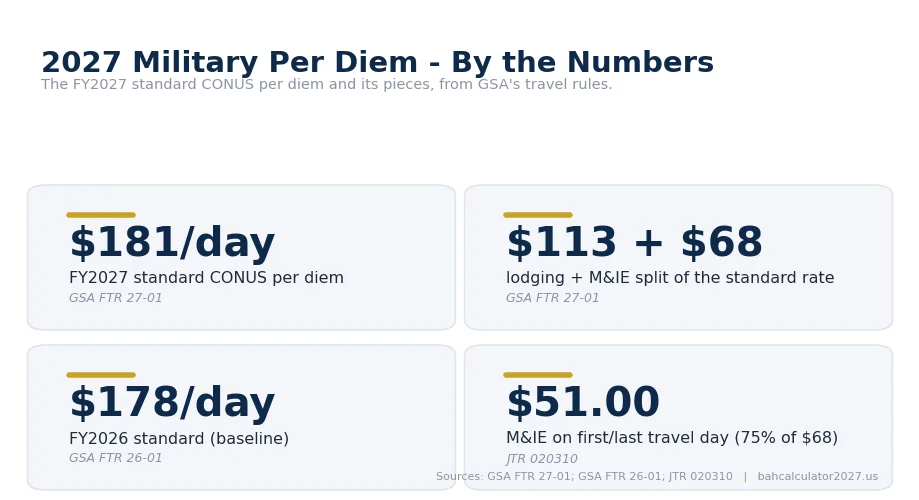
What does per diem mean? Per diem is Latin for “per day” — it’s a fixed daily allowance paid to cover lodging, meals, and incidental expenses while you’re traveling on official business. For service members, it’s the money the military pays you each day you’re on temporary duty (TDY), calculated from federal locality rates. The standard CONUS rate for fiscal year 2027 is $181 a day: $113 for lodging plus $68 for meals and incidental expenses (M&IE). FY2026’s standard was $178 a day — I’ll use it for comparison where it helps.
That’s the one-paragraph answer. One clarification: outside the military, “per diem” also describes day-rate work — a “per diem nurse” picks up shifts as needed, not a travel allowance. This guide is about the travel allowance; FAQ #11 separates the two. This guide covers the 2027 rates, the daily math, the first-and-last-day rule, the repealed flat-rate rule, per diem for your family on a PCS move, how it differs from BAH and BAS, and whether any of it is taxed.
Independent guide — not affiliated with the U.S. Department of Defense or any military branch. All rate figures below come from the General Services Administration (GSA) per diem bulletins and the Joint Travel Regulations (JTR).
The 2027 Standard Rate: $181 a Day
When no special locality rate applies, the federal government pays a “standard” CONUS per diem rate. For FY2027 (October 1, 2026 through September 30, 2027), that standard rate is $181 per day, published in GSA Bulletin FTR 27-01 (August 18, 2026):
- Lodging: $113 per day
- Meals and incidental expenses (M&IE): $68 per day
For comparison, FY2026’s standard was $178 a day ($110 lodging + $68 M&IE) — GSA froze those rates from FY2025. The only thing that moved for FY2027 was lodging, up $3. The M&IE rate didn’t budge. One practical wrinkle: a trip straddling September 30 into October 1, 2026 uses FY2026 rates before that date and FY2027 rates after — so the lodging cap rises from $110 to $113 mid-trip while M&IE stays $68.
The “standard” rate is the floor, not the ceiling. GSA sets higher rates for about 295 non-standard areas — expensive cities where $181 wouldn’t cover a night in a hotel. Your TDY orders pay the locality rate for your specific destination; the standard rate is what applies everywhere else. OCONUS rates are set by the Department of Defense (published on travel.dod.mil), and foreign-area rates come from the State Department.
Where Your $68 in M&IE Actually Goes
The $68 figure isn’t one blob of money — GSA breaks it into a daily meal split (see the official M&IE breakdowns), and the split matters: a government-provided meal gets deducted at exactly these values:
| M&IE tier | Breakfast | Lunch | Dinner | Incidentals |
|---|---|---|---|---|
| $68 | $16 | $19 | $28 | $5 |
| $74 | $18 | $20 | $31 | $5 |
| $80 | $20 | $22 | $33 | $5 |
| $86 | $22 | $23 | $36 | $5 |
| $92 | $23 | $26 | $38 | $5 |
The incidentals portion — $5 at every tier — is the narrowest part of the allowance. The Federal Travel Regulation defines incidentals as fees and tips to porters, baggage carriers, hotel staff, and staff on ships. Note what it does not include: laundry, dry cleaning, and pressing. Those are reimbursable as a separate miscellaneous travel expense on CONUS trips with at least four consecutive nights of lodging (FTR 301-11.31) — not out of your $5.
Notice dinner is always the largest slice.

Who Sets Your Per Diem Rate
Three different offices set per diem rates, and which one applies depends on where you’re going:
- CONUS (the 50 states): the General Services Administration (GSA) — published annually on gsa.gov, effective each October 1
- OCONUS (non-foreign, like Alaska, Hawaii, Guam, Puerto Rico): the Department of Defense
- Foreign areas: the State Department
The military’s own rulebook for all of this is the Joint Travel Regulations (JTR) — the same regulation that governs PCS moves and temporary lodging expense. One thing to know if you’re Googling: the JTR was restructured in November 2024, and per diem rules now live in Chapter 2 (paragraphs 020301 and 020310, plus Table 2-17). Older guides that cite “JTR Chapter 4” are pointing at the old organization.
The 75% Rule: First and Last Travel Day
This is the rule that surprises people on their first TDY: on the day you leave home and the day you return, you don’t get full M&IE. The JTR pays 75% of the M&IE rate for the day travel begins and the day travel ends (JTR paragraph 020310(A)).
At the standard $68 M&IE tier, that works out to $51.00 on each bookend day. Lodging isn’t affected — you only claim a night you actually stayed somewhere.
A common misunderstanding: the 75% applies to the travel days at the ends of the whole trip — the day of departure from your permanent duty station and the day you return — not the first and last day you happen to be at the TDY location. Here’s what a five-day TDY looks like at the standard rate:
| Day | What happened | Lodging | M&IE | Daily total |
|---|---|---|---|---|
| 1 | Travel day — depart PDS | $113 | $51.00 (75%) | $164.00 |
| 2 | Full TDY day | $113 | $68.00 | $181.00 |
| 3 | Full TDY day | $113 | $68.00 | $181.00 |
| 4 | Full TDY day | $113 | $68.00 | $181.00 |
| 5 | Travel day — return home | $0 | $51.00 (75%) | $51.00 |
| Total | $452.00 | $306.00 | $758.00 |
Two things to read carefully here. First, no lodging on day 5 — you slept at home. Second, the table assumes your hotel actually cost the full $113 cap: if your hotel cost $95 a night, you’d get $95, not $113. The lodging portion is reimbursement of your actual cost up to the cap, not a flat nightly payment. This is also why your travel voucher asks for departure and return times: the finance office needs to know which days were travel days.

The Flat-Rate Myth: Why Long TDYs Work Differently Than the Internet Says
If you search “extended TDY per diem,” you’ll find pages claiming that trips over 30 days pay 75% of the rate and trips over 180 days pay 55%. That rule is dead — it was repealed by the FY2019 National Defense Authorization Act, effective August 13, 2018. The Defense Travel Management Office confirms the flat-rate per diem policy was terminated.
The current rule is simple: the military uses lodging-plus for every TDY regardless of length. You get reimbursed for your actual lodging cost (up to the locality rate) plus the full M&IE rate. A six-month TDY pays the same daily rates as a six-day TDY.
I’m flagging this because the repeal is now eight years old and the outdated rule still dominates search results. If your command or an old briefing slide cites 75%/55% tiers, they’re quoting a policy that no longer exists — the JTR as written today has no such tiers.
Government Quarters and Government Meals
Per diem assumes you’re paying commercial rates for a hotel and restaurants. When the government provides the bed or the food, the math changes:
- Government quarters (barracks, on-base lodging you don’t pay for): lodging is reimbursed at the actual cost you paid to the facility — not the $113 locality figure. If the quarters were free, there’s no lodging reimbursement.
- Government-provided meals: the M&IE rate drops to a reduced tier (the JTR’s Table 2-17 lists the options: locality rate, proportional meal rate, standard government meal rate, or incidentals-only). The proportional meal rate is calculated from the standard government meal rate plus the meals portion of your locality M&IE, rounded up, with incidentals added on top.
- A government-furnished meal is deducted at its GSA breakdown value — the same $16/$19/$28 figures from the table above.
But here’s the part people get wrong in the other direction: a complimentary hotel breakfast does not reduce your per diem, and neither do airline meals. The Federal Travel Regulation (FTR 301-11.17) is explicit on this. A meal the government provides or one bundled into a registration fee gets deducted; a free perk from the hotel does not.
PCS Moves: Per Diem for You and Your Family
Per diem isn’t just for TDYs. When you PCS, you and your dependents earn per diem for the authorized travel days between the old and new duty station:
| Traveler | Per diem rate |
|---|---|
| Service member | 100% of the authorized locality rate |
| Dependent age 12 and older | 75% of the member’s rate |
| Dependent under age 12 | 50% of the member’s rate |
The higher rate kicks in on the dependent’s 12th birthday (JTR Table 5-77). The locality rate used is the one for the overnight stopover location, and lodging is reimbursed against receipts — DFAS wants lodging receipts regardless of amount.
A quick worked example: a family of four — member, spouse, a 14-year-old, and a 7-year-old — driving through an area at the standard rate. Per day: member $181 + spouse $135.75 (75%) + teen $135.75 (75%) + child $90.50 (50%) = $543 per day before lodging receipts. Over a four-day authorized trip, that’s $2,172 in per diem alone. Not small money, and it’s one reason the travel office wants your receipts organized.
Per Diem vs BAH vs BAS vs TLE — Don’t Mix Them Up
This is the section that earns this article its place on a BAH site, because these four allowances get tangled constantly:
| Per diem | BAH | BAS | TLE | |
|---|---|---|---|---|
| What it covers | Daily travel costs (lodging + meals) | Monthly housing at your duty station | Monthly food costs | Temporary lodging at/near a duty station |
| When you get it | TDY and PCS travel days | Every month you’re authorized housing | Every month (flat rate) | Up to 21 days CONUS around a PCS (eff. Nov 27, 2024) |
| Based on | Destination locality rate (GSA/DoD/State) | PDS ZIP code, grade, dependent status | National flat rate (enlisted and officer tiers) | Actual lodging cost, percentage-capped |
| Taxed? | No (within federal rates) | No | No | No |
The key distinction: per diem reimburses you for being somewhere you’re not stationed. BAH covers where you live; BAS covers what you eat at home; TLE covers the hotel while you’re between homes on a PCS, and the dislocation allowance (DLA) covers the miscellaneous moving costs nothing else reimburses. If you’re on TDY and wondering why your BAH didn’t change — that’s why. Nothing about a TDY moves your housing allowance. For the full picture on the food side, see our What Is BAS? guide, and for the housing side, what BAH is.

Is Military Per Diem Taxable?
Generally, no — but there’s a condition. The IRS treats per diem under the accountable plan rules (IRS Publication 463): if your per diem doesn’t exceed the federal rate for the area, and you meet three conditions, it’s not reported as wages at all:
- Business connection — the travel was for official duty (your orders cover this)
- Adequate accounting — you substantiate the time, place, and purpose of travel (your travel voucher does this)
- Return of excess — you return any amount above the substantiated expenses within a reasonable time (120 days is the safe harbor)
If your agency pays you more than the federal rate, the excess is taxable wages — it shows up in Box 1 of your W-2. Per diem paid properly under an accountable plan typically shows up in Box 12, code L of your W-2 — not in Box 1 as wages. The military pays at or below the locality rate, so in practice military per diem isn’t taxed. One more comparison worth making: like BAH and BAS, per diem’s tax-free status makes it worth more than the same dollars of taxable pay — our is-BAH-taxable guide works through exactly that math.
How Per Diem Actually Gets Paid
A few practical things the regulations don’t spell out:
- Advances: you can request a travel advance before the trip so you’re not floating the cost on a personal card. Many travelers use the government travel card instead.
- The voucher: after travel, you settle everything on a travel voucher in the Defense Travel System (DTS) — dates, locations, lodging receipts, and any deductions for government meals.
- Receipts: keep receipts for your lodging and your larger expenses. The travel office will tell you exactly what the voucher requires, but the rule of thumb is simple: if you paid for a bed, keep the proof.
- Timing: file promptly. Your voucher is how the money actually reaches you — the advance is just a loan against it.
If your total military pay picture is what you’re really after, run your numbers on our military pay calculator and the dual-military BAH calculator — and for the housing side of every trip and every move, the 2027 BAH complete guide is the companion to this one.
Frequently Asked Questions
1. What does per diem mean?
Per diem is Latin for “per day.” It’s a daily allowance that covers lodging, meals, and incidental expenses while traveling on official business. For service members, it’s paid for each day of TDY or PCS travel at the federal locality rate — $181 a day at the FY2027 standard CONUS rate.
2. What is the standard military per diem rate for 2027?
$181 per day CONUS: $113 for lodging plus $68 for meals and incidentals (GSA Bulletin FTR 27-01, effective October 1, 2026). The FY2026 standard was $178 a day ($110 lodging + $68 M&IE). Higher rates apply in about 295 non-standard areas.
3. What is the difference between per diem and BAH?
Per diem is a daily allowance for travel — it reimburses you for being somewhere you’re not stationed. BAH is a monthly allowance for housing at your permanent duty station, based on your PDS ZIP code, grade, and dependent status. A TDY never changes your BAH.
4. How much per diem do you get on the first and last day of travel?
75% of the M&IE rate — $51.00 at the standard $68 tier — per JTR paragraph 020310(A). Lodging is unaffected (you only claim nights you actually stayed somewhere). The 75% applies to the travel days at the ends of the whole trip, not the first/last day at the TDY location.
5. Is per diem reduced on a long TDY?
No. The old flat-rate tiers (75% for 31–180 days, 55% for trips over 180 days) were repealed by the FY2019 NDAA effective August 13, 2018. Today’s rule is lodging-plus — actual lodging up to the locality rate plus full M&IE — for TDYs of any length.
6. Do government meals reduce your per diem?
Yes. Government-furnished meals are deducted at their GSA breakdown value ($16 breakfast / $19 lunch / $28 dinner at the $68 tier), and the M&IE rate drops to a reduced tier when meals are provided (JTR Table 2-17).
7. Does a free hotel breakfast reduce your per diem?
No. Complimentary hotel breakfasts and airline meals do not reduce per diem (FTR 301-11.17). Only government-provided meals or meals bundled into a registration fee get deducted.
8. How much per diem do dependents get on a PCS move?
Dependents age 12 and older receive 75% of the member’s authorized per diem; dependents under 12 receive 50% (JTR Table 5-77). The member gets 100%. Lodging is reimbursed against receipts.
9. Is military per diem taxable income?
Generally no. Under IRS Publication 463’s accountable-plan rules, per diem up to the federal rate isn’t reported as wages as long as you substantiate the travel and return any excess. Amounts above the federal rate are taxable wages.
10. Who sets military per diem rates?
GSA sets CONUS rates (updated each October 1), the Department of Defense sets OCONUS (non-foreign) rates, and the State Department sets foreign-area rates. The JTR — restructured in November 2024, per diem now in Chapter 2 — is the military’s governing regulation.
11. What does per diem mean on a job application?
Usually one of two things, and context tells you which. A “per diem nurse” or “per diem substitute” listing means as-needed, day-rate employment — you work shifts when called, paid by the day. An engineering or construction posting that says “per diem included” usually means a daily travel allowance for lodging and meals on top of your wage.
Sources: GSA Bulletin FTR 27-01 (FY2027 per diem rates, Aug 18, 2026); GSA Bulletin FTR 26-01 (FY2026 rates); GSA M&IE breakdowns page; Joint Travel Regulations Ch. 2 (par. 020301, 020310(A), Table 2-17, Table 5-77); DTMO “Termination of DoD’s Flat-Rate Per Diem Policy” FAQ; DFAS PCS dependents travel pay page; FTR 41 CFR 301-11.17, 301-11.31, and 301-11.101(e); IRS Publication 463; 37 U.S.C. §§ 402–403; DoD FMR Vol 7A Ch 25–26; military.com PCS allowances page.
Last updated: October 18, 2026. Rates are the official FY2027 figures (effective October 1, 2026); this article will be refreshed when FY2028 rates publish in fall 2027.