BAH for National Guard & Reserve [2027 Guide]
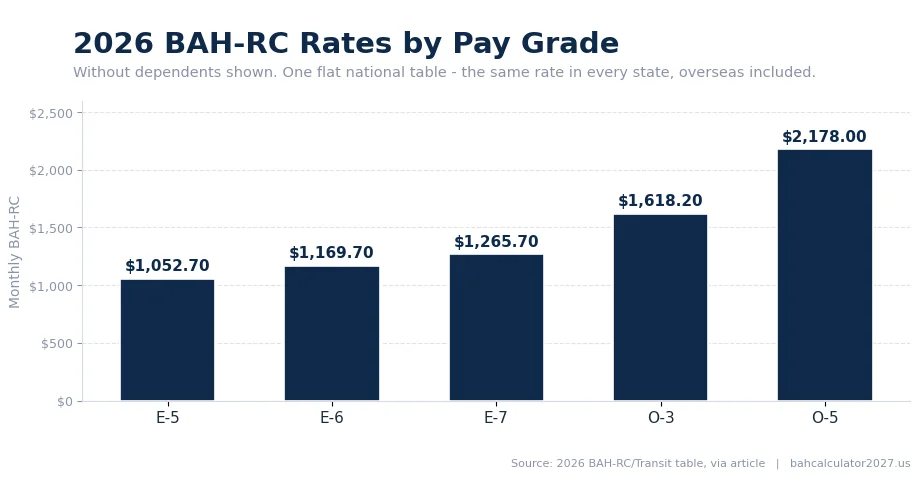
Yes — Guard and Reserve members get BAH when they’re on federal active-duty orders. Orders of 30 days or fewer pay a flat national rate called BAH-RC or Transit (an E-5 gets $1,052.70 without dependents in 2026). Orders of 31 days or longer pay full BAH based on the member’s primary residence. Drill weekends pay no BAH at all.
Part-time service in the National Guard or Reserves comes with its own housing allowance system, and one fact matters more than everything else: the length of your orders decides which type of BAH you get. I’ll walk you through the 30/31-day rule, the actual 2026 rate table, the traps people fall into (extensions, duty-station myths, drill pay), and the special cases — AGR, mobilization, and dual-status technicians.
If you’re running numbers, our BAH calculator estimates full BAH for 31+ day orders — and like all BAH, what we’re discussing here is non-taxable.
The 30/31-day rule: the one thing that decides your BAH type
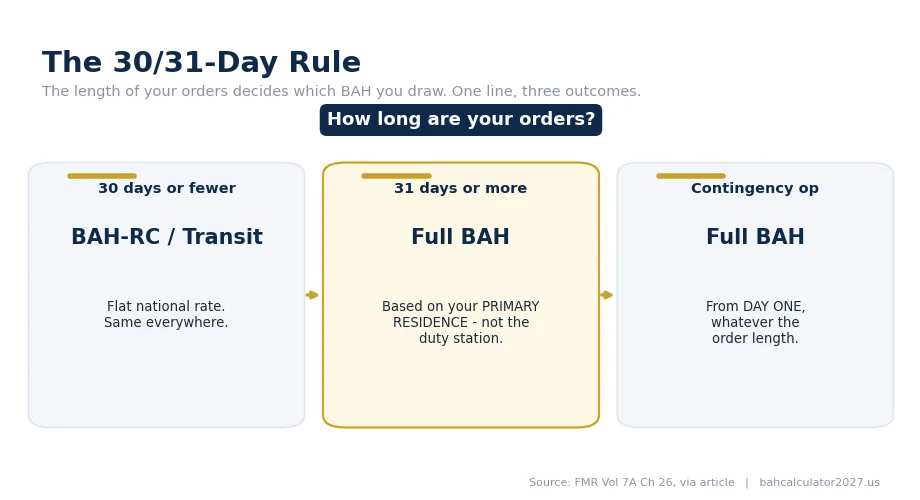
Forget ZIP codes for a moment. The DoD’s financial regulation (FMR Vol 7A Chapter 26) splits everything on one line: is this order 30 days or fewer, or 31 days or more? That one fact decides whether you draw a flat national rate or full location-based BAH:
| Order situation | BAH type you get | Location basis |
|---|---|---|
| Active-duty orders of 30 days or fewer (not for a contingency) | BAH-RC / Transit (flat national table) | None — same rate everywhere |
| Active-duty orders of 30 days or fewer supporting a contingency operation | Full BAH | Your primary residence |
| Active-duty orders of 31–180 days | Full BAH | Your primary residence |
| Active-duty-for-training orders of 31–139 days | Full BAH | Your primary residence at the time you were called up |
| AGR (full-time Guard/Reserve duty) | Full BAH | Your permanent duty station |
The contingency row catches a lot of people by surprise: get mobilized in support of a contingency operation — even on a 15-day order — and you draw full BAH from day one, not the flat RC rate. I’ll cover that in detail below.
What BAH-RC/Transit actually is (and what it isn’t)
BAH-RC goes by several names: Reserve Component/Transit, BAH Transit, BAH Non-Locality, and (especially in the Navy) Type II BAH. They’re all the same thing: a separate, flat-rate housing allowance for reservists and Guard members on short active-duty orders.
Three things to know about it:
It’s one national table. BAH-RC does not vary by location at all. An E-5 on a 20-day order gets the same rate whether the duty is in Texas, Alaska, or overseas. It varies only by pay grade and whether you have dependents. See every 2026 rate by grade in the complete non-locality BAH table.
It’s rooted in 1997. Per FMR §10.5.1.2, the rate is anchored to the old Basic Allowance for Quarters amount from December 31, 1997, escalated each year by the average housing allowance increase. That’s why it lags well behind regular BAH — it was never meant to track local rental markets.
It is NOT partial BAH. These get mixed up constantly, including on pay forums. Partial BAH is a tiny, different monthly amount paid to single members living in government quarters. BAH-RC is its own full flat rate for short orders. (I’ll show you the partial BAH numbers in the last section so you can see the difference.)
2026 BAH-RC rates: find your pay grade
Here’s the complete 2026 BAH-RC/Transit table (verified across three sources updated December 2025, including military.com’s non-locality BAH page). Find your grade, then read across:
| Grade | Without dependents | With dependents |
|---|---|---|
| O-10 | $2,466.30 | $3,035.10 |
| O-9 | $2,466.30 | $3,035.10 |
| O-8 | $2,466.30 | $3,035.10 |
| O-7 | $2,466.30 | $3,035.10 |
| O-6 | $2,261.70 | $2,731.80 |
| O-5 | $2,178.00 | $2,633.40 |
| O-4 | $2,017.80 | $2,320.80 |
| O-3 | $1,618.20 | $1,920.30 |
| O-2 | $1,281.90 | $1,638.30 |
| O-1 | $1,100.70 | $1,466.70 |
| O-3E | $1,746.60 | $2,063.70 |
| O-2E | $1,485.30 | $1,862.40 |
| O-1E | $1,291.80 | $1,721.40 |
| W-5 | $2,051.40 | $2,241.30 |
| W-4 | $1,821.30 | $2,054.70 |
| W-3 | $1,531.20 | $1,883.40 |
| W-2 | $1,359.00 | $1,730.70 |
| W-1 | $1,139.40 | $1,497.90 |
| E-9 | $1,494.90 | $1,971.60 |
| E-8 | $1,374.30 | $1,818.30 |
| E-7 | $1,265.70 | $1,687.20 |
| E-6 | $1,169.70 | $1,559.10 |
| E-5 | $1,052.70 | $1,403.70 |
| E-4 | $915.60 | $1,219.50 |
| E-3 | $850.50 | $1,133.70 |
| E-2 | $811.50 | $1,080.60 |
| E-1 | $811.50 | $1,080.60 |
Two notes on this table. First, O-7 and above are all capped at the same rate — that’s the statutory cap, not a typo. Second, if you’re a single reservist on short orders, the without-dependent column is your rate; the rules for single service members and BAH explain the dependent-side logic in more depth.
These are 2026 rates, and the 2027 BAH-RC table publishes around December 2026 — the same annual cycle as regular BAH. A word of caution: you’ll sometimes see a “4.2% increase” figure quoted for FY2027. That number comes from the DoD’s FY2027 budget request — it’s a proposal, not published rates. Don’t trust any “2027 BAH-RC table” you see before the official release.
31+ day orders: full BAH based on your primary residence
This is the section I most wanted to write, because it’s where even established BAH sites get it wrong.
When a Guard or Reserve member serves on active duty (other than training) for 31 to 180 days, the regulation — FMR Vol 7A Chapter 26, §10.5.3.2.1 — says full BAH is based on the member’s primary residence, beginning on the first day of active duty. For active-duty-for-training orders of 31 to 139 days, it’s the primary residence at the time the member was called to training (§10.5.3.2.2).
Read that again: primary residence, not the duty station. Some sites tell reservists that 31+ day orders pay BAH based on the duty-station ZIP — the regulation says the opposite. A reservist on a 60-day order usually keeps paying rent or a mortgage back home, so the allowance follows the actual housing cost.
There are two exceptions where the permanent duty station does become the basis:
- A PCS with household-goods transportation is issued. For training orders of 140+ days or active-duty orders of 181+ days with a HHG move, BAH is based on the primary residence until the day before you report to the new duty station, then switches to the PDS rate.
- AGR members, who are covered in their own section below — full-time Guard/Reserve is always PDS-based.
One more thing worth knowing: if your orders stretch to 31+ days, BAH rate protection applies to you the same as it does to active-duty members — your primary-residence rate can’t drop mid-tour even if local rates fall.
Drill weekends: why IDT pays $0 in BAH
A standard drill weekend is inactive duty training (IDT), and IDT pays no housing allowance at all — $0 in BAH. The Congressional Research Service is explicit that reservists may be eligible for BAH-RC during annual training but not during IDT, and the DoD’s QRMC confirms drill pay comes with no allowances.
Here’s what a drill weekend actually pays: each drill period earns 1/30th of your monthly basic pay, and a normal weekend is 4 drill periods — roughly four days of base pay for two days of work, with no allowances attached. For an E-5 with under 2 years of service (2026 basic pay $3,342.90/month), that works out to about $446 for the weekend, before taxes — and zero BAH. That’s not a mistake in your pay; it’s how IDT is structured.

Annual training: how BAH-RC works on your two weeks
Annual training is the classic short-order scenario, and it’s where most Guard members first meet BAH-RC. AT is active duty for training — real active-duty days — so the short-order rule applies: on orders of 30 days or fewer, BAH-RC starts on day one. A typical 14-day AT means 14 days of BAH-RC at your grade’s rate (E-5 with dependents: $1,403.70/month, prorated).
AT also pays basic pay at the full active-duty daily rate plus BAS (the subsistence allowance) — drill weekends pay none of this, which is why AT and IDT feel like entirely different pay systems.
When orders get extended past 30 days: the modification-date rule
Here’s the trap. You’re on a 29-day order drawing BAH-RC, and the unit extends you to 45 days. Do you get back pay at the full BAH rate for those first 29 days?
No. The regulation is blunt about this: when an order is modified so the new prospective active-duty period is 31 or more days, full BAH starts on the date of the extension — it is not retroactive to day one. BAH-RC stops being payable as of that same date. So in the example above, days 1–29 pay BAH-RC and days 30–45 pay full BAH based on the primary residence.
Two related rules matter here:
- Breaks in service block combining periods. A gap of one or more calendar days between active-duty periods means the periods can’t be added together to reach 31 days. The clock resets.
- Navy-specific nuance: the Navy allows retroactive Type I BAH when short AT/ADT orders run back-to-back with other funded AT/ADT orders totaling 31+ days — but it’s payable from the issue date of the follow-on order, not day one, and a single IDT day between the periods breaks the succession (see the Navy Reserve BAH infographic and NPPSC OPS Alert 008-21).
The practical lesson: ask your admin shop when the modification was actually issued — that date is what your BAH switches on.
Mobilization & contingency operations: full BAH from day one
When you’re mobilized in support of a contingency operation, the 30/31-day split disappears. FMR §10.5.3.9 is clear: a Reserve member called to active duty in support of a contingency operation gets full BAH from the first day, regardless of how short the orders are — and the basis is the primary residence, not the mobilization station.
A 21-day mobilization order doesn’t pay the flat RC rate — it pays your full location-based BAH (or OHA if your primary residence is overseas), because Congress wrote that exception into 37 U.S.C. §403(g)(4)(B).
One finer point: if you’re injured in the line of duty and placed on incapacitation pay, BAH continues on your primary residence for up to 6 months (extendable). Our BAH during deployment guide picks up the rest of the deployment picture.
Mobilized with dependents back home? Family Separation Allowance pays $300 a month once the separation passes 30 days — it stacks with your BAH, and you claim it with DD Form 1561.
AGR members: the full-time exception
AGR (Active Guard and Reserve) members are the exception to almost everything above. Serve full-time under AGR orders and you’re treated like an active-duty member for BAH purposes: full BAH based on your permanent duty station — not the flat RC table, and not the primary residence.
A few AGR specifics:
- The PDS rate applies even when you’re mobilized for non-AGR active duty, as long as there’s no break in service — the PDS rate carries through the whole tour.
- If there is a break in service when you’re called up for non-AGR duty, you’re treated as a regular Reserve member for that tour (primary-residence basis).
- Otherwise, AGR members get the same BAH benefits as active-duty members, including rate protection and the with-dependent rate when they have dependents.
Dual-status technicians & dual-military couples
Dual-status military technicians live in two worlds: federal civilian employees who are also Reserve members. As civilians, they get no BAH at all — BAH legally requires entitlement to basic pay under 37 U.S.C. §403(a)(1), and civilian pay isn’t basic pay. But when they’re called to active duty with pay, the FMR’s Chapter 26 Reserve rules apply to them exactly as they do to any other Reserve member: short orders mean BAH-RC, 31+ days mean full BAH on the primary residence.
One policy note: you may see references to Legislative Proposal 291, a DoD proposal that would convert dual-status technicians to AGR or civilian roles over about ten years. That is a proposal submitted for FY2027 NDAA consideration — it is not law, and it changes nothing about technician pay today.
Dual-military couples in the Guard and Reserve follow the same framework with a twist. On orders of 30 days or fewer (non-contingency, non-AGR), a Reserve member married to a service member gets BAH-RC at the without-dependent rate, assuming no government quarters. On 31+ day orders, each service member gets full BAH at the without-dependent rate; if the couple has a dependent, the couple chooses which spouse receives the with-dependent rate, with the senior member as the tiebreaker. Our dual-military BAH calculator walks through the scenarios.
Government quarters & partial BAH: don’t confuse them with BAH-RC
Final distinction, and an important one: BAH-RC is not partial BAH. They’re different allowances for different situations, and mixing them up is one of the most common errors I see on pay forums.
Partial BAH is paid to members without dependents who are assigned to government quarters — barracks, ships, and the like. It’s a small statutory amount, essentially a token allowance, and it did not change from 2025 to 2026 (military.com’s 2026 partial BAH page):
| Grade | Monthly partial BAH (2026) |
|---|---|
| E-1 | $6.90 |
| E-4 | $8.10 |
| E-5 | $8.70 |
| E-6 | $9.90 |
| E-7 | $12.00 |
| O-3 | $22.20 |
| O-5 | $33.00 |
| O-7 | $50.70 |
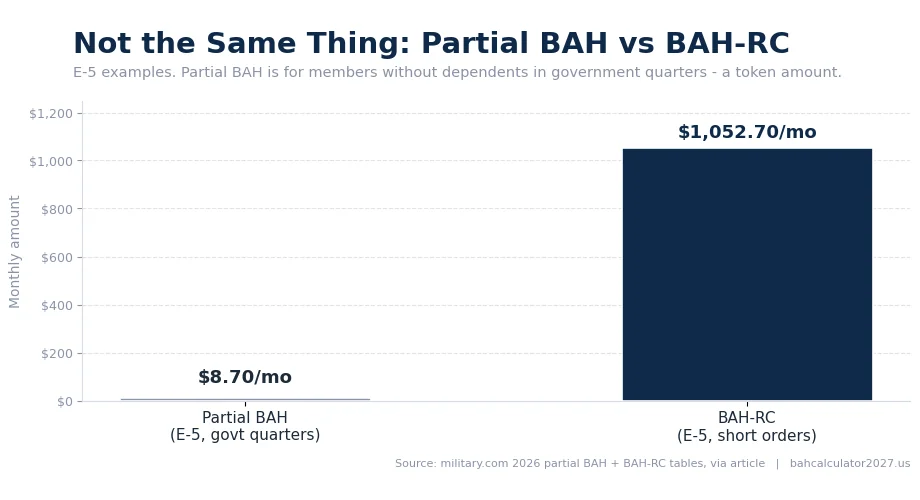
Compare that to BAH-RC: an E-5 on short orders gets $1,052.70/month in BAH-RC versus $8.70 in partial BAH. And note the relationship: the FMR pays BAH-RC at the without-dependent rate only when the member is not assigned government quarters — if your orders put you in adequate government quarters, BAH-RC isn’t payable.
One more “not the same thing”: BAH-DIFF (the differential paid to members in government housing who pay child support) is yet another separate allowance. I won’t unpack it here — just know it’s not BAH-RC either.
Frequently Asked Questions
1. Do National Guard and Reserve members get BAH?
Yes — when they’re on federal active-duty orders. Orders of 30 days or fewer pay the flat BAH-RC/Transit rate; orders of 31+ days pay full BAH based on the primary residence; contingency mobilizations pay full BAH from day one. Members of the IRR or Standby Reserve who aren’t on paid orders get no BAH. One caution: BAH is a federal entitlement tied to federal active duty. If your governor activates you for state active duty, that’s state-paid service and follows your state’s rules.
2. Do you get BAH for drill weekends?
No. Drill weekends are inactive duty training (IDT), which pays 1/30th of monthly basic pay per drill period — typically 4 periods per weekend — with no allowances. BAH-RC is available during annual training, not during IDT.
3. What is BAH-RC and how is it different from regular BAH?
BAH-RC (also called BAH Transit, BAH Non-Locality, or Type II BAH) is a flat national housing allowance for reservists and Guard members on active-duty orders of 30 days or fewer. Unlike regular BAH, it doesn’t vary by location — only by pay grade and dependent status. It’s anchored to the 1997 Basic Allowance for Quarters amount and escalated yearly, so it runs well below regular BAH.
4. How long do my orders need to be to get full BAH?
31 days or more of active duty (other than the without-dependent initial-entry-training exception). At 31+ days you draw full BAH based on your primary residence — not your duty station. There’s one shortcut: orders of any length in support of a contingency operation pay full BAH from day one. There’s one shortcut: orders of any length in support of a contingency operation pay full BAH from day one. New Guard and Reserve enlistees heading to basic training fall under that initial-entry exception — our BAH for new recruits guide covers BAH from BCT through your first duty station.
5. If my 29-day orders get extended to 45 days, do I get back pay at the full rate?
No. Full BAH starts on the date the extension (order modification) is issued — it is not retroactive to day one. You keep BAH-RC for the days before the modification date, then switch to full BAH based on your primary residence. A break in service between order periods prevents combining them to reach 31 days.
6. Do reservists get BAH during annual training?
Yes. Annual training is active duty for training, so BAH-RC starts on the first day. Basic pay and BAS are also payable during AT — unlike drill weekends, which pay neither BAH nor BAS.
7. Is Guard/Reserve BAH based on my home or my duty station?
Your home — specifically your primary residence. On 31+ day orders (other than training), full BAH is based on your primary residence from day one. The exceptions: AGR members and members on a PCS with household-goods transportation use the permanent duty station instead. Some websites say the duty-station ZIP controls; the regulation says primary residence.
8. Do AGR members get the same BAH as active duty?
Effectively yes. AGR members draw full BAH based on their permanent duty station — the same basis active-duty members use — including when mobilized for non-AGR duty, as long as there’s no break in service.
9. Do dual-status military technicians get BAH?
Not as civilian employees — BAH requires entitlement to military basic pay. But when a dual-status technician is called to active duty with pay, the standard Reserve rules apply: BAH-RC on short orders, full primary-residence BAH on 31+ day orders.
Independent guide — not affiliated with the U.S. Department of Defense or any military branch.
If this cleared things up, run your own numbers: our BAH calculator estimates full BAH for 31+ day orders by location, grade, and dependent status.