BAH for New Recruits: First Duty Station Guide [2027]
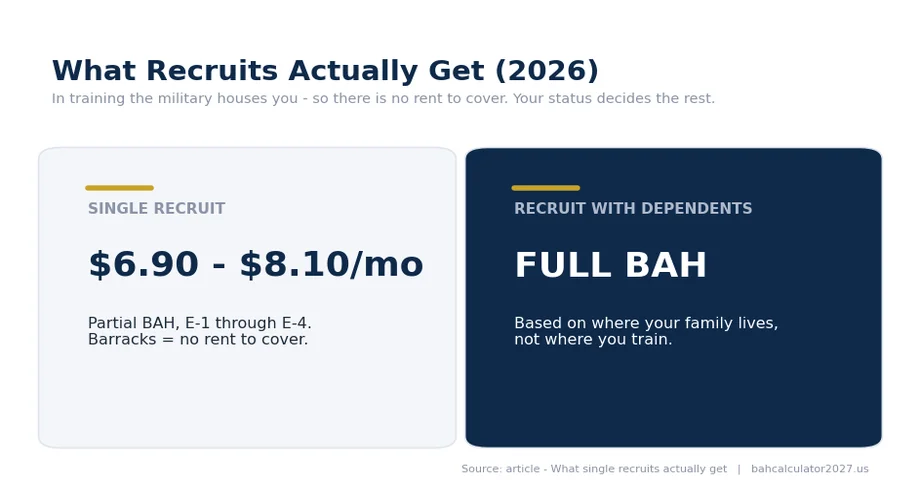
New recruits in basic training don’t get full BAH — the military houses you in the barracks, so there’s no rent to cover. Single recruits get partial BAH ($6.90–$8.10 a month for E-1 through E-4 in 2026 — see the full rates table), while recruits with dependents get full BAH based on where their family lives — and real BAH starts at your permanent duty station.
That paragraph is the whole story in miniature. Below: the exact numbers, the rules behind them, and the mistakes to avoid.
Do you get BAH in basic training?
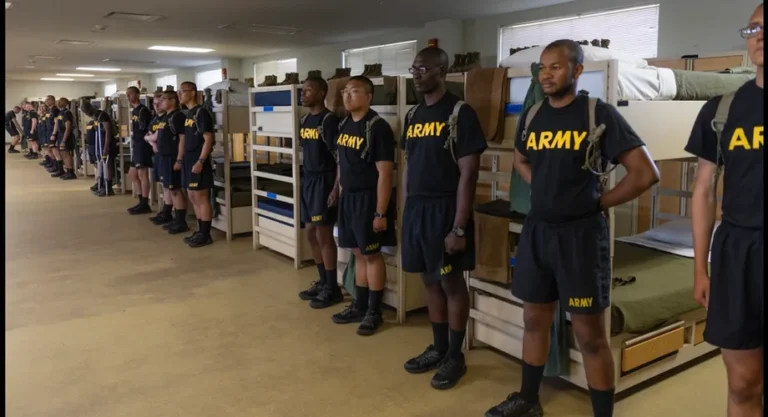
Let’s be direct: if you’re single and heading to basic training — Army BCT, Marine boot camp, Navy boot camp, Air Force BMT — you will not see a full housing allowance hit your paycheck. If you’re wondering what BAH is, it’s the allowance that exists to help you pay for housing — and in basic training the military hands you housing: a bunk in a barracks bay or dormitory, meals in the dining facility, uniforms on your back. No rent to reimburse means no full BAH.
This confuses a lot of families, because recruiters talk up total compensation and the numbers sound big. But “total compensation” in training includes a lot of in-kind benefits — the roof, the food, the medical care — not just cash. Your base pay is real cash. BAH, for a single recruit in training, is not. What you do get is called partial BAH, and it’s so small it surprises people.
What single recruits actually get: partial BAH
Partial BAH is a small monthly payment for service members without dependents assigned to government quarters — barracks, dormitories, BEQ/BOQ, ships. The Army’s field manual (FM 7-21.13) authorizes it for soldiers in single-type government quarters, and it’s defined the same way service-wide.
Here are the 2026 partial BAH rates for the grades new recruits hold (military.com’s official 2026 table confirms they didn’t change from 2025 — these rates don’t track housing markets the way full BAH does):
| Grade | Monthly partial BAH (2026) |
|---|---|
| E-1 | $6.90 |
| E-2 | $7.20 |
| E-3 | $7.80 |
| E-4 | $8.10 |
Yes, $6.90 a month for an E-1 — not a typo, and not an error on your LES. Partial BAH is essentially symbolic, a leftover from older pay structures, meant to cover tiny incidental costs of barracks life.
A few things worth knowing:
- You’ll see it on your LES. Partial BAH shows up as an entitlement on your Leave and Earnings Statement, alongside base pay. When you check your first LES, look for it — it confirms finance has you coded correctly.
- It’s the same at every location. Partial BAH doesn’t vary by duty station.
- Meals work the same way. You won’t see BAS (food allowance) as cash during basic training — you eat at the dining facility, so the meals themselves are the benefit.
If you want the full partial BAH table for every grade from E-1 to O-10, I’ve got it in my single soldiers BAH guide — but for a recruit, the four rows above are all that matter.
If you have dependents, BAH follows your family — not you
Here’s the rule that matters most to married recruits and new parents, and it’s the one almost nobody explains clearly: if you have dependents, you get BAH at the with-dependent rate during training — based on where your dependents live, not where you’re training.
Your spouse and kids still have rent to pay back home while you’re in a barracks bay. So during basic training and job school — when your orders don’t authorize your dependents to move with you — your BAH is calculated for your family’s location. Finance calls this the “designated place” — the residence you certify your dependents will live at — and you declare it during in-processing.
A concrete example: you’re an E-2 in basic training, and your wife and child rent an apartment back in your hometown. You receive BAH at the E-2 with-dependent rate for her ZIP code’s military housing area — not the training post’s rate. When you move to your first permanent duty station, the rule flips: BAH switches to the with-dependent rate for your new duty station, whether or not your family has moved there yet. One related first-move rule: dislocation allowance (DLA) is only paid on that first PCS if your dependents actually move with the orders. Like the rest of your pay, BAH arrives in two installments, on the 1st and the 15th.
Get your DEERS paperwork done before you ship. Finance needs your dependent documentation — marriage certificate, birth certificates — to start with-dependent BAH. Recruits who arrive at in-processing without paperwork are the ones whose BAH starts late.
Two add-ons worth knowing: on top of BAH, members involuntarily separated from their dependents for more than 30 continuous days get Family Separation Allowance — $300 a month effective January 1, 2026 (up from $250, where it sat since 2002), per military.com’s FSA update. And all BAH is tax-free; details in my is BAH taxable guide.
AIT and job school: same rules, longer timeline
After basic comes job training — AIT, tech school, A-school. For BAH purposes, nothing changes: you’re still in government quarters, still in training status. Single members keep partial BAH; members with dependents keep with-dependent BAH based on the dependents’ location.
AIT can run from a few weeks to over a year depending on your MOS. A long school doesn’t change the BAH math — but it means a long stretch where your family holds down the home front on that with-dependent rate, which is where the FSA’s bump to $300 a month actually matters. One thing that can change in a long school: your pay grade. Plenty of recruits pick up E-2 or E-3 during training, and partial BAH ticks up accordingly.
Here’s the whole journey in one view:
| Stage | Where you live | Single: what you get | With dependents: what you get |
|---|---|---|---|
| Basic training | Barracks (mandatory) | Partial BAH: $6.90–$8.10/mo (2026) | With-dependent BAH for your family’s location + $300/mo FSA |
| AIT / job school | Barracks (mandatory) | Partial BAH: $6.90–$8.10/mo (2026) | With-dependent BAH for your family’s location + $300/mo FSA |
| First duty station | Barracks (typical) or off-base / family housing | Partial BAH in barracks; full without-dependent BAH off-base | With-dependent BAH for your duty station’s location |
Arriving at your first duty station: when real BAH starts
When you report to your first permanent duty station, a member assigned to permanent duty in the 50 states who isn’t given government housing gets BAH based on pay grade, dependency status, and the duty station’s ZIP code.
Two things at in-processing decide your BAH:
- Housing assignment. Single junior enlisted are typically assigned to the barracks — which keeps you on partial BAH. Full BAH only starts when you’re authorized off-base or move into family housing.
- Dependency verification. Finance confirms your status from DEERS. Married or with kids → with-dependent rate for your new station. Single → without-dependent rate once you’re off the barracks roster.
Your BAH is also protected from day one: if your station’s rates drop in a future year, you keep your higher rate as long as location, rank, and dependency status don’t change. That’s rate protection — I’ve explained it in my BAH rate protection guide, worth reading before you sign a lease.
What full BAH looks like for a new E-1 through E-4
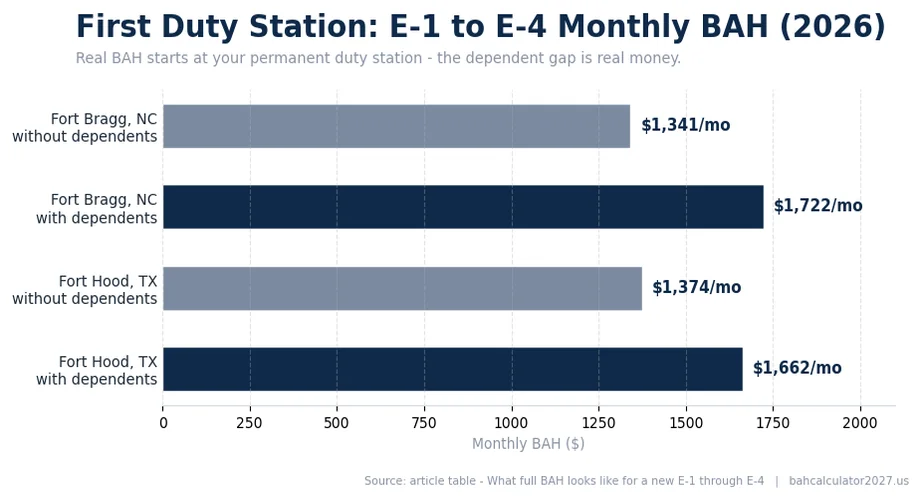
Enough theory — here are real 2026 numbers for two of the most common first duty stations, straight from the official Defense Travel Management Office tables. E-1 through E-4 share the same BAH rates in these locations (the complete BAH rates guide has the full national table):
| First duty station | E-1–E-4 with dependents | E-1–E-4 without dependents |
|---|---|---|
| Fort Hood, TX | $1,662/month | $1,374/month |
| Fort Bragg / Pope, NC | $1,722/month | $1,341/month |
What the table tells you:
- The dependent gap is real money. At Fort Hood, with vs. without differs by $288 a month — $3,456 a year. That’s why DEERS paperwork matters.
- Location decides your number. The same E-2 could get over $2,700 without dependents in a high-cost area like San Diego.
- Want your exact station? Punch your duty station ZIP into the BAH calculator on the homepage, or use my ZIP code lookup guide.
And a forward-looking note: the 4.2% BAH increase you’ve probably heard about for 2027 is a proposal in the FY2027 defense budget request — not a confirmed rate. Official 2027 rates land around mid-December. Don’t sign a lease assuming the bump.
Single at your first duty station: barracks life continues
Most single junior enlisted live in the barracks at their first duty station — and while you’re there, it’s partial BAH, not full BAH. Full BAH at the without-dependent rate starts when your command authorizes you to move off base, which usually depends on rank, barracks space, and branch policy.
This trips up a lot of new soldiers. They arrive, see buddies collecting $1,300+ a month, and wonder why their LES still shows a single-digit number. The answer is always the same: the ones getting full BAH are married or authorized off-base. The process for getting out — in the Army it’s tied to barracks availability and rank — is covered branch by branch in do single soldiers get BAH. Read that before asking your chain of command, so you know what to expect.
BAH-DIFF: the child-support exception every single parent should know
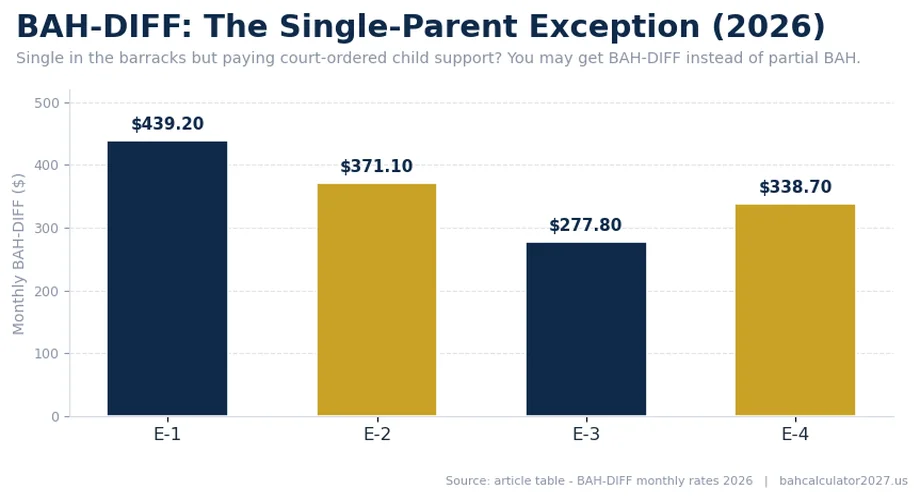
There’s one important exception to the “single in barracks gets almost nothing” rule. If you’re single, live in government quarters, and pay child support, you may qualify for BAH-Differential (BAH-DIFF) — a meaningful monthly payment. The rule: BAH-DIFF goes to soldiers paying child support who aren’t receiving with-dependent BAH, and your monthly child support must equal or exceed the BAH-DIFF amount (veteran.com’s eligibility breakdown confirms the 2026 figures). 2026 rates for junior enlisted grades:
| Grade | Monthly BAH-DIFF (2026) |
|---|---|
| E-1 | $439.20 |
| E-2 | $371.10 |
| E-3 | $277.80 |
| E-4 | $338.70 |
An E-1 single parent paying at least $439.20 a month in court-ordered child support gets $439.20 in BAH-DIFF — versus $6.90 in partial BAH. That’s a life-changing difference for a young parent, and one of the least-known entitlements in the pay system. Bring your child support order to finance during in-processing and ask about it by name.
Marrying during training: what changes
It happens more often than people think. Here’s the pay side:
- BAH switches to the with-dependent rate — based on your spouse’s location during training, then your duty station after.
- Base pay doesn’t change. The military doesn’t pay more base pay for marriage — only BAH, COLA, and family separation allowance move with dependent status.
- Paperwork first, money second. Nothing updates until the marriage is in DEERS. Get the certificate to finance fast; back pay can be sorted, but the clock starts with the paperwork.
If both spouses serve, it gets more layered — typically one gets the with-dependent rate and the other the without-dependent rate. That’s covered in my dual-military BAH guide.
Advance BAH: a way to cover deposits and first month’s rent
When you finally get authorized off-base housing, the move-in costs hit all at once: security deposit, first month’s rent, maybe last month’s. For a young soldier, that’s thousands before the first BAH payment arrives.
The tool for this: advance BAH. You can request up to three months of your local BAH rate in advance (stateside), with command approval — the military’s official pay guidance sets the same three-month ceiling. It’s interest-free, not free money — typically repaid over 12 months through automatic deductions, with 24-month extensions possible. It must go toward the move: advance rent, deposits, initial housing costs. It can’t be used to buy a home.
Example: you’re an E-3 newly authorized off-base at Fort Bragg, where without-dependent BAH is $1,341 a month. Three months of advance BAH is $4,023 toward your deposit and first month’s rent — repaid at about $335 a month over the next year.
Ask your gaining finance office about it during in-processing — and treat it like the loan it is: it shrinks every paycheck for a year, so budget the repayment before you take it.
First-duty-station BAH mistakes new soldiers make
The same errors repeat every training cycle. Avoid these:
- Assuming BAH starts at basic training. It doesn’t — not full BAH. Budget your family’s expenses around base pay plus with-dependent BAH (if applicable), not a fantasy number.
- Late DEERS paperwork. Every week your dependents aren’t documented is a week of with-dependent BAH you chase as back pay. Handle it before you ship.
- Not checking the LES. Your first LES statements are where errors hide — wrong dependency status, wrong location rate, missing FSA. Compare every line against this guide, and walk into finance with specifics.
- Signing a lease before BAH is confirmed. Know your authorized rate before you commit. BAH is set to cover 95% of median local housing costs — sign above your rate and the difference comes out of your pocket monthly.
- Forgetting BAH-DIFF exists. Single parents: if you pay child support and live in the barracks, ask finance about BAH-DIFF by name. Nobody volunteers it.
- Counting the 2027 increase as guaranteed. The 4.2% figure is a budget proposal. Plan on 2026 rates until the official tables publish.
The bottom line: token partial BAH in the barracks during training, with-dependent BAH based on your family’s location if you have dependents, then real location-based BAH at your first permanent duty station. The numbers are public, the rules are written down, and the costliest mistakes are paperwork you can prevent.
Independent guide — not affiliated with the U.S. Department of Defense or any military branch.
Frequently Asked Questions
1. Do you get BAH in basic training?
Single recruits do not get full BAH in basic training — the military provides barracks housing. Instead they receive partial BAH: $6.90 to $8.10 a month for E-1 through E-4 in 2026. Recruits with dependents get full BAH at the with-dependent rate based on where their dependents live.
2. Do new recruits get BAH in AIT or tech school?
Yes, under the same rules as basic training. Single members in AIT barracks keep partial BAH; members with dependents keep with-dependent BAH for the dependents’ location. Full location-based BAH starts at your first permanent duty station.
3. What is partial BAH, and how much is it for an E-1 in 2026?
Partial BAH is a small monthly payment for service members without dependents who live in government quarters. In 2026, an E-1 receives $6.90 per month. The rates are E-2 $7.20, E-3 $7.80, and E-4 $8.10, and they do not vary by location.
4. I’m married and going to basic training — where is my BAH based?
Your BAH is based on where your dependents live, not your training location. You receive the with-dependent rate for your spouse’s or family’s ZIP code area. Once you move to your first permanent duty station, your BAH switches to the with-dependent rate for your new duty station.
5. When does BAH start at my first duty station?
Full BAH starts when you report to your first permanent duty station and aren’t assigned to government quarters. Single junior enlisted are typically assigned to barracks and keep partial BAH until authorized off-base. Members with dependents get with-dependent BAH for the duty station location.
6. Do I get BAH if I live in the barracks at my first duty station?
No — not full BAH. Single members assigned to barracks at their first duty station receive partial BAH only ($6.90–$8.10/month for E-1–E-4 in 2026). Full BAH at the without-dependent rate begins when your command authorizes you to move off base.
7. What is BAH-DIFF for single soldiers who pay child support?
BAH-Differential is a monthly payment for single members in government quarters who pay child support but don’t get with-dependent BAH. In 2026, E-1 through E-4 rates run $277.80 to $439.20 per month. Your child support must equal or exceed the BAH-DIFF amount to qualify.
8. If I get married during training, does my BAH change?
Yes. Gaining a dependent moves you from partial BAH to the with-dependent BAH rate. During training it’s based on your spouse’s location; after training it’s based on your duty station. The change takes effect once your marriage is documented in DEERS — get the paperwork to finance as quickly as possible.
9. Can I get an advance on BAH to pay a security deposit?
Yes. Advance BAH lets you receive up to three months of your local BAH rate (stateside) before moving into non-government rental housing, with command approval. It’s repaid interest-free, typically over 12 months. It can’t be used toward buying a home.