
E-6 & E-7 BAH Rates: Senior NCO Guide [2027]
The short answer
In 2026, an E-6’s BAH runs from $1,335 a month (with dependents, Youngstown, Ohio) to $5,454 (with dependents, San Francisco), with a national median of $2,374. An E-7’s runs from $1,491 to $5,832 — the national maximum is Westchester County, New York, not San Francisco — with a median of $2,439. Your number depends on exactly three things: your duty station’s housing area, your dependency status, and nothing else — not time in service, not the number of kids, not your actual rent. Below is the full E-6 and E-7 picture: the ranges, the duty-station tables, the promotion math, and the 2027 outlook.
I computed every figure on this page from the Defense Travel Management Office’s official 2026 rate tables (all 338 military housing areas) and cross-checked them against the best independent sources. Where a competitor’s number disagrees with the official tables, I’ll say so.
1. Who counts as E-6 and E-7
The names change by service, but the BAH tables only care about the pay grade:
| Grade | Army | Marines | Navy | Air Force | Space Force |
|---|---|---|---|---|---|
| E-6 | Staff Sergeant | Staff Sergeant | Petty Officer First Class | Staff Sergeant | Technical Sergeant |
| E-7 | Sergeant First Class | Gunnery Sergeant | Chief Petty Officer | Master Sergeant | Master Sergeant |
2. The 2026 range for both grades, in one picture
Here are the national numbers for 2026:
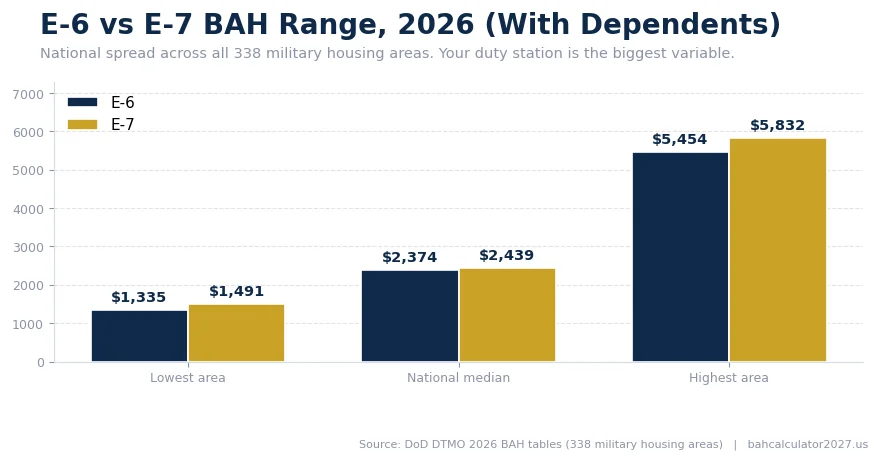
– E-6, with dependents: $1,335 – $5,454, median $2,374 – E-6, without dependents: $1,077 – $5,070, median $1,809 – E-7, with dependents: $1,491 – $5,832, median $2,439 – E-7, without dependents: $1,131 – $5,088, median $1,938
Two quirks worth knowing. First, the E-7 national maximum is Westchester County, New York at $5,832 — it edges out San Francisco’s $5,490. Most “highest BAH” lists just assume San Francisco or New York City at every grade, but the official tables don’t always cooperate. Second, the without-dependents maximum for both grades is New York City ($5,070 for E-6, $5,088 for E-7) — and notice how close NYC’s with-dependents numbers are: $5,097 vs $5,070. The single rate there is so high it nearly erases the dependency premium, which we’ll come back to in section 6.
The median is the number to anchor on: half of all 338 housing areas pay an E-6 with dependents more than $2,374, and half pay less. Averages look close (one well-known rank site cites an E-6 “average” of $2,336.46) but the median is the honest center — the average gets dragged down by how many areas cluster at the low end.
3. What E-6s and E-7s get at real duty stations
The actual 2026 rates at the duty stations people ask about most — E-6 with dependents, E-6 without, E-7 with, E-7 without, straight from the official tables:
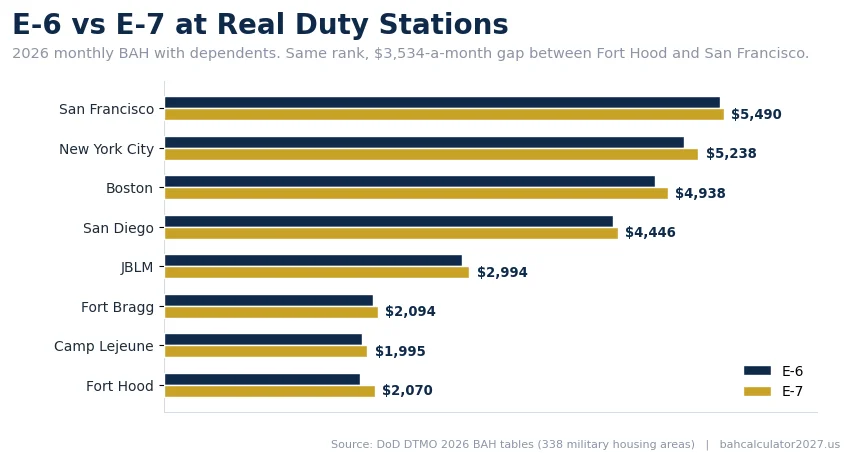
| Duty station (MHA) | E-6 w/deps | E-6 w/o | E-7 w/deps | E-7 w/o |
|---|---|---|---|---|
| San Francisco, CA (CA019) | $5,454 | $4,443 | $5,490 | $4,782 |
| New York City, NY (NY219) | $5,097 | $5,070 | $5,238 | $5,088 |
| Northern New Jersey, NJ (NJ202) | $5,052 | $3,861 | $5,073 | $4,299 |
| Boston, MA (MA120) | $4,812 | $3,948 | $4,938 | $4,365 |
| San Diego, CA (CA038) | $4,404 | $3,387 | $4,446 | $3,678 |
| Camp Pendleton, CA (CA024) | $4,398 | $3,324 | $4,494 | $3,642 |
| Honolulu, HI (HI408) | $3,912 | $3,036 | $4,098 | $3,348 |
| Travis AFB, CA (CA036) | $3,498 | $2,838 | $3,516 | $3,099 |
| JBLM/Tacoma, WA (WA311) | $2,919 | $2,199 | $2,994 | $2,376 |
| Fairbanks, AK (AK405) | $2,454 | $1,887 | $2,610 | $1,989 |
| Phoenix / Luke AFB, AZ (AZ013) | $2,457 | $1,857 | $2,475 | $2,070 |
| Colorado Springs, CO (CO046) | $2,433 | $1,980 | $2,487 | $2,166 |
| Langley AFB, VA (VA297) | $2,421 | $1,905 | $2,439 | $2,088 |
| Fort Stewart, GA (GA080) | $2,439 | $2,049 | $2,493 | $2,178 |
| Fort Hood, TX (TX286) | $1,920 | $1,626 | $2,070 | $1,668 |
| Fort Bragg/Pope, NC (NC182) | $2,049 | $1,638 | $2,094 | $1,722 |
| Fort Benning, GA (GA075) | $1,977 | $1,557 | $2,004 | $1,635 |
| Camp Lejeune, NC (NC178) | $1,944 | $1,569 | $1,995 | $1,593 |
| Yakima Training Center, WA (WA313) | $2,382 | $1,788 | $2,499 | $1,875 |
4. The ten cheapest and ten priciest areas
The extremes, from all 338 areas, with dependents, 2026:
| # | Cheapest — E-6 | $/mo | # | Priciest — E-6 | $/mo |
|---|---|---|---|---|---|
| 1 | Youngstown, OH | $1,335 | 1 | San Francisco, CA | $5,454 |
| 2 | Anniston/Fort McClellan, AL | $1,491 | 2 | Westchester County, NY | $5,367 |
| 3 | Fort Sill/Lawton, OK | $1,494 | 3 | Nantucket, MA | $5,127 |
| 4 | Vance AFB/Enid, OK | $1,512 | 4 | New York City, NY | $5,097 |
| 5 | Hattiesburg, MS | $1,524 | 5 | Northern New Jersey, NJ | $5,052 |
| 6 | Albany, GA | $1,539 | 6 | Santa Clara County, CA | $4,977 |
| 7 | Meridian, MS | $1,545 | 7 | Boston, MA | $4,812 |
| 8 | Altus AFB, OK | $1,563 | 8 | Long Island, NY | $4,773 |
| 9 | Cannon AFB/Clovis, NM | $1,593 | 9 | Maui County, HI | $4,770 |
| 10 | Gulfport, MS | $1,620 | 10 | Martha’s Vineyard, MA | $4,593 |
| # | Cheapest — E-7 | $/mo | # | Priciest — E-7 | $/mo |
|---|---|---|---|---|---|
| 1 | Youngstown, OH | $1,491 | 1 | Westchester County, NY | $5,832 |
| 2 | Anniston/Fort McClellan, AL | $1,560 | 2 | San Francisco, CA | $5,490 |
| 3 | Fort Sill/Lawton, OK | $1,587 | 3 | Nantucket, MA | $5,241 |
| 4 | Vance AFB/Enid, OK | $1,623 | 4 | New York City, NY | $5,238 |
| 5 | Hattiesburg, MS | $1,644 | 5 | Northern New Jersey, NJ | $5,073 |
| 6 | Altus AFB, OK | $1,662 | 6 | Maui County, HI | $5,067 |
| 7 | Monroe, LA | $1,665 | 7 | Santa Clara County, CA | $5,058 |
| 8 | Albany, GA | $1,671 | 8 | Boston, MA | $4,938 |
| 9 | Meridian, MS | $1,692 | 9 | Long Island, NY | $4,878 |
| 10 | County Cost Group 510 | $1,692 | 10 | Martha’s Vineyard, MA | $4,752 |
5. With dependents vs without: what actually changes
The dependency premium at these grades is substantial. At the national median, dependents add $565 a month for an E-6 ($2,374 vs $1,809) and $501 for an E-7 ($2,439 vs $1,938) — $6,780 and $6,012 a year respectively.
But the premium is wildly uneven by area. In San Diego an E-6 gains $1,017 a month ($4,404 vs $3,387). In New York City that collapses to $27 ($5,097 vs $5,070) — because the without-dependents rate is already near the ceiling, there’s almost nothing left to add. For an E-7 in NYC it’s $150 ($5,238 vs $5,088). These are the extremes; most areas land between roughly $400 and $800.
Three rules:
– One rate, not per-child. The with-dependents rate is a single number. An E-7 with one child draws exactly what an E-7 with four children draws. – Barracks rules still apply. A single E-6/E-7 assigned government quarters may be required to live in them and draw no locality BAH at all — though at these grades, off-post authorization is common. The single-soldier BAH guide covers the service rules. – Life events change the column, not the table. Marriage, divorce, or a child’s birth changes which rate you draw. Report changes promptly; retroactive pay corrections are painful.
6. The promotion ladder: what each stripe buys you
National medians, all 338 areas, 2026:
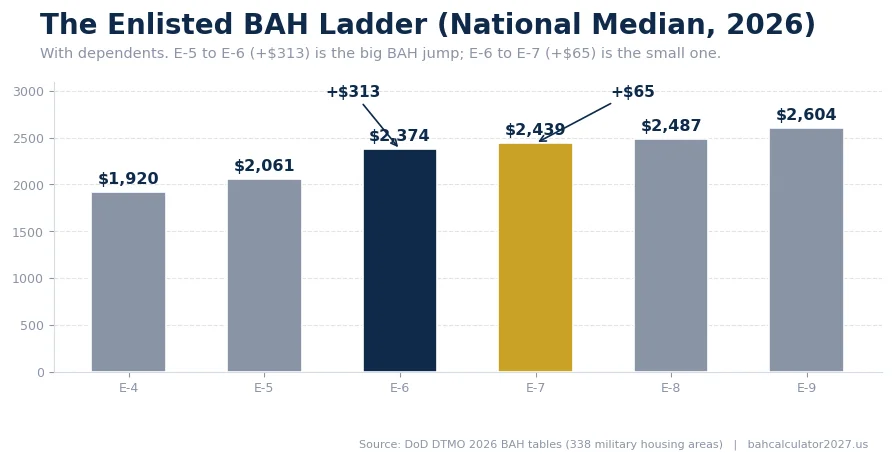
| Grade | Median w/deps | Median w/o deps | BAH bump vs prior grade (w/deps) |
|---|---|---|---|
| E-4 | $1,920 | $1,520 | — |
| E-5 | $2,061 | $1,670 | +$141 |
| E-6 | $2,374 | $1,809 | +$313 |
| E-7 | $2,439 | $1,938 | +$65 |
| E-8 | $2,487 | $2,134 | +$48 |
| E-9 | $2,604 | $2,210 | +$117 |
– E-5 → E-6 is the BAH jump. +$313 a month at the median, the biggest enlisted BAH increase — because E-6 with dependents is priced at a larger housing profile (a bigger home for the family). Base pay at the “over 4” step rises only $122.10 ($3,946.80 → $4,068.90), so the combined raise is about $435 a month — and most of it is housing money. – E-6 → E-7 is the base-pay jump. BAH barely moves: +$65 a month, the smallest bump on the ladder, because the E-7 housing profile is nearly identical to E-6’s. But base pay at the “over 4” step jumps $604.20 ($4,068.90 → $4,673.10). The combined raise is about $669 a month, $8,030 a year — and almost all of it is paycheck, not housing.
If you’re advising a junior soldier on the math of promotion (and senior NCOs do), that’s the real story: the E-6 stripe is worth more in housing, the E-7 stripe is worth more in pay. Our 2026 military pay chart has the full base-pay tables by grade and years of service. And if the commissioned path is on your mind, our O-3 BAH rates guide runs the same ladder math for the officer side.
7. Why your buddy’s E-6 BAH is different from yours
Same rank, different number — one of these is always the reason:
1. Different duty station. The dominant factor. Even nearby posts differ: Fort Hood’s E-6 rate ($1,920) trails Fort Bragg’s ($2,049) by $129 a month in similar regions. 2. Rate protection. If your area’s rates dropped on January 1 (San Antonio fell about 3% for 2026), members already stationed there keep the higher prior-year rate; new arrivals get the new table. Two staff sergeants in the same platoon can legitimately draw different numbers. Our rate-protection guide explains it in full. 3. Dependency status. The single biggest per-person variable after location. 4. Barracks vs off-post. An unmarried E-6 in the dorms draws no locality BAH; one authorized off-post draws the full without-dependents rate.
None of these are errors, and none require a pay inquiry unless your location or status was entered wrong.
8. Special E-6/E-7 rates: partial, RC/T, and BAH-DIFF
Not every situation uses the locality tables:
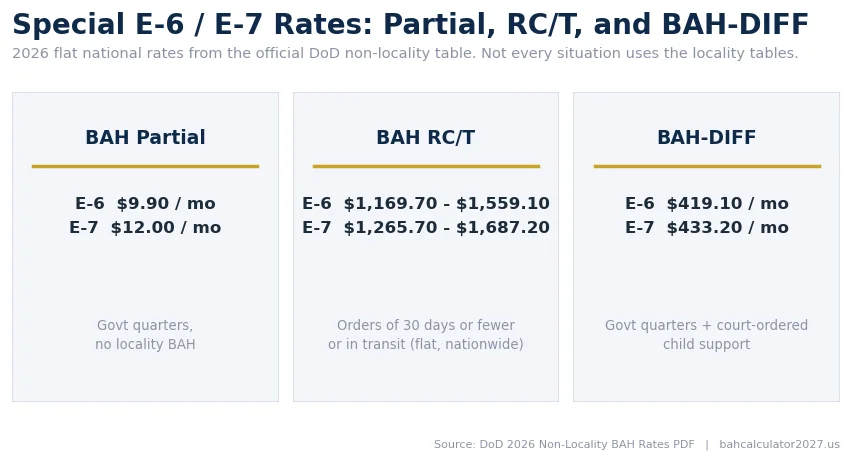
– BAH Partial — $9.90/mo for E-6, $12.00/mo for E-7: the small allowance for members assigned to government quarters who don’t draw locality BAH. It offsets incidental costs, not rent, and the rates are constant year to year. – BAH RC/T (Reserve Component/Transit) — E-6: $1,169.70 (w/o) / $1,559.10 (with); E-7: $1,265.70 (w/o) / $1,687.20 (with): the flat national rate for members on orders of 30 days or fewer, or in transit between stations. Geography doesn’t matter — same number in Manhattan or rural Mississippi. – BAH-DIFF (differential) — $419.10/mo for E-6, $433.20/mo for E-7: for members in government housing who pay court-ordered child support. If you live on the local economy and pay child support, you draw the normal with-dependents rate instead.
All three are covered in depth in what partial BAH is and the non-locality BAH tables.
9. BAH and the VA loan: housing money that counts double
BAH is tax-free, which makes it worth more than face value to a lender. On a VA loan application, lenders “gross up” non-taxable income — the standard bump is 25%. So the E-6 median $2,374 counts as roughly $2,968 in taxable-equivalent income, and the E-7 median $2,439 as roughly $3,049. That directly raises how much house you can qualify for — and at these grades, with 6–14 years of service behind you, a VA loan purchase is often on the table. Our how-much-house guide runs the full math.
(One cross-reference for E-5 readers who landed here: the Post-9/11 GI Bill’s monthly housing allowance is built on the E-5 with-dependents BAH — covered in the E-5 BAH guide.)
10. The 2027 outlook for E-6s and E-7s
Two numbers are in play for 2027, and both are currently proposals, not decisions:
– BAH: the administration’s FY2027 budget request proposes a 4.2% increase. If that survived the legislative process, the median E-6 rate of $2,374 would become roughly $2,474 (+$100/mo), and the E-7 median of $2,439 roughly $2,541 (+$102/mo). Congress has not enacted it — don’t budget it yet. – Base pay: the President’s alternative pay plan (August 2026) proposes tiered raises of 7% for E-1–E-5, 6% for E-6–O-3, and 5% for O-4 and above. A 6% raise would take an E-6 at the “over 4” step from $4,068.90 to about $4,313.03 a month (+$244.13), and an E-7 from $4,673.10 to about $4,953.49 (+$280.39). The House NDAA passed with matching tiers; the Senate’s flat 3.6% stalled — final outcome pending the December NDAA process.
The official 2027 BAH tables land around mid-December, and we track the release date in when 2027 BAH rates are released — with the 2027 increase guide covering what the numbers mean once they’re real.
11. Frequently Asked Questions
1. How much BAH does an E-6 get?
In 2026 it ranges from $1,335 to $5,454 a month with dependents ($1,077–$5,070 without), depending on the duty station’s housing area. The national median is $2,374 with dependents and $1,809 without.
2. How much BAH does an E-7 get?
From $1,491 to $5,832 a month with dependents ($1,131–$5,088 without). The national median is $2,439 with dependents and $1,938 without.
3. How much more BAH does an E-6 get when promoted to E-7?
Only about $65 a month at the national median ($2,374 → $2,439) — the E-7 housing profile is nearly identical to E-6’s. The real E-6→E-7 raise is in base pay, not housing.
4. Where is E-7 BAH highest?
Westchester County, New York: $5,832 a month with dependents in 2026 — slightly above San Francisco’s $5,490. For E-6, San Francisco is the national maximum at $5,454.
5. Why is the dependency bump so small in New York City?
Because the without-dependents rate there is already near the ceiling: an E-6 gains only $27 ($5,097 vs $5,070) and an E-7 only $150 ($5,238 vs $5,088). In San Diego, by contrast, an E-6 gains $1,017.
6. Do single E-6s and E-7s get BAH?
If authorized to live off post or in privatized housing, yes — the without-dependents rate. If assigned to government quarters, you may be required to live there and draw no locality BAH (though off-post authorization is common at these grades).
7. What is BAH RC/T for an E-6 or E-7?
The flat national transit rate: E-6 $1,169.70 without dependents / $1,559.10 with; E-7 $1,265.70 / $1,687.20 — paid on orders of 30 days or fewer or while in transit.
8. What is BAH-DIFF for E-6 and E-7?
$419.10 a month for E-6, $433.20 for E-7 — paid to members in government housing who pay court-ordered child support.
9. Is E-6/E-7 BAH taxable?
No — BAH is federal and state income-tax free, including the dependency premium. (Full detail in our tax guide.)
10. When do 2027 E-6/E-7 BAH rates come out?
Around mid-December 2026, when DTMO publishes the official tables. The 4.2% increase currently cited is a budget-request proposal, not an enacted rate.
Independent guide — not affiliated with the U.S. Department of Defense or any military branch.
Last updated: October 23, 2026.