How to Find Your BAH Rate by ZIP Code [2027]
To find your BAH rate by ZIP code, enter your permanent duty station’s ZIP code — not your apartment ZIP — into the DTMO BAH Rate Lookup on travel.dod.mil, with your pay grade and rate year. The lookup maps your ZIP to a Military Housing Area, which sets your rate, then shows both the with-dependents and without-dependents amounts. Use 2026 rates: 2027 rates aren’t released yet.
The #1 Mistake: It’s Not Your Home ZIP
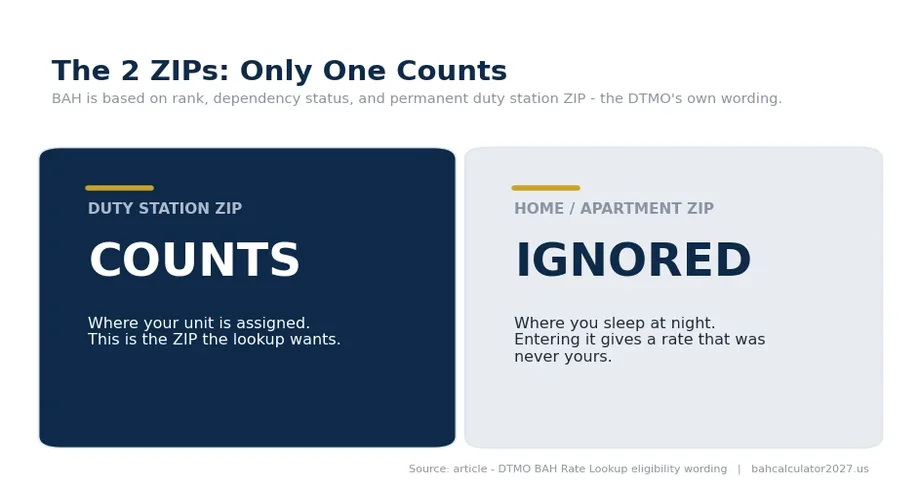
When you look up bah rates by zip code, the ZIP that matters is your duty station’s — where your unit is, not where you sleep at night. Not your apartment complex, not the neighborhood with the nicer schools, not the ZIP on your driver’s license.
It sounds backward, but the DoD sets BAH by where you’re assigned. Every duty station ZIP maps to a Military Housing Area (MHA) covering the whole commuting zone around the base. Two service members at the same base get the same BAH for their grade and dependent status even if one lives on base and the other commutes from a different county.
The walkthrough sites gosoced and milhousingnetwork both flag this as the mistake people make most, and the DTMO lookup says it in its own eligibility wording: BAH is based on “the member’s rank, dependency status, and permanent duty station zip code.” Duty station ZIP — remember that and you’re already ahead of most people doing this lookup.
What “Your ZIP Code” Actually Means for BAH
So what does the lookup actually do with your ZIP? It doesn’t look up the ZIP itself — it uses the ZIP to figure out which Military Housing Area you belong to. The MHA is the real unit of BAH. DoD divides the country (all 50 states, plus DC — not “CONUS-only”) into these housing areas based on local rental costs, sets one rate per pay grade and dependent status for each area, and publishes them annually.
This is why the wrong-ZIP mistake matters: if your apartment’s ZIP falls in a different housing area than your base, you’ll get a rate that was never yours. And the reverse is common too — people type a ZIP near base, the lookup quietly matches it to their base’s MHA, and they assume the tool is doing something ZIP-specific when it just rounded them back to their duty station’s area.
One more thing: the lookup only covers stateside areas. Stationed overseas? You’re under OHA (Overseas Housing Allowance), calculated individually from your actual rent — no ZIP lookup will give you that number. More on the special cases below.
The Official DTMO BAH Rate Lookup — Step by Step
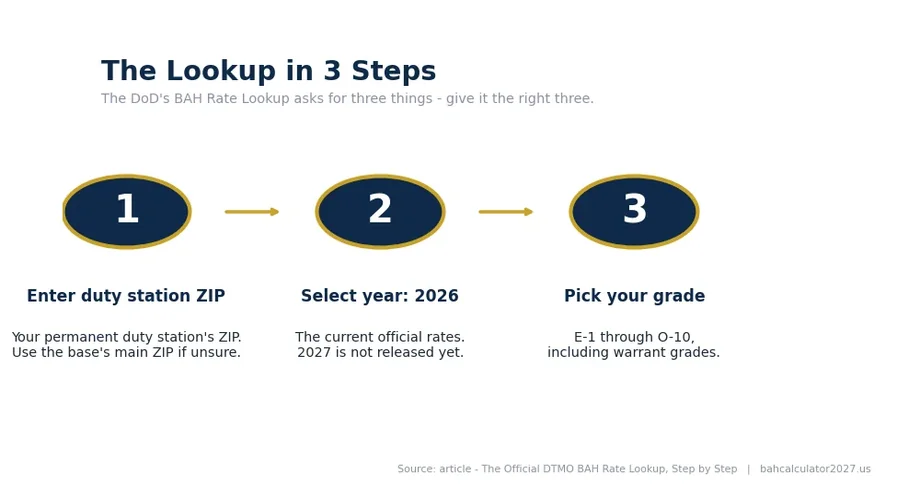
The fastest official way to find your rate is the DoD’s own BAH Rate Lookup on travel.dod.mil. It asks for three things:
- Step 1: Enter your duty station ZIP code. Again — your permanent duty station, not your home address. If you’re not sure which ZIP belongs to your base, use the base’s main ZIP (the one on the installation’s mailing address usually works; the tool maps it to the right MHA).
- Step 2: Select the rate year. The dropdown defaults to whatever’s current. Right now that’s 2026. I’ll say more about the year trap below, because this is where people quietly break their own lookup.
- Step 3: Select your pay grade. E-1 through O-10, including warrant grades. Use your current grade — the one on your orders and your LES.
Hit submit and the tool shows your monthly BAH rate — both the with-dependents and without-dependents amounts for your grade, so read the column that matches your status. That’s the official number — the same data your finance office works from.
If the official lookup feels clunky or you want a fast answer on your phone, use our BAH calculator — it runs the same official rate tables and gives you the number in seconds.
The Year-Selection Trap (2027 Rates Are Not Out Yet)
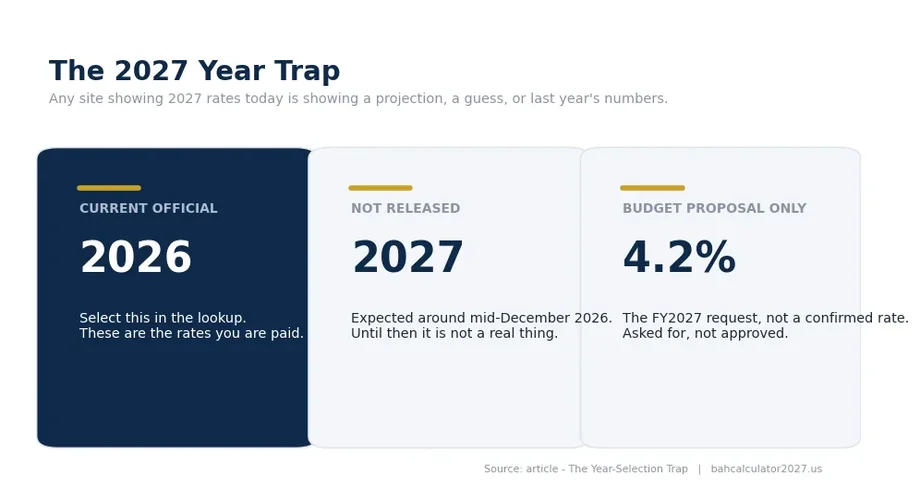
Here’s the trap: you’re searching “bah rates by zip code 2027,” and the lookup dropdown lets you pick 2027 — or you land on a site that claims to already know the 2027 rates. Stop.
The official 2027 BAH rates have not been released. DoD publishes the new rates around mid-December 2026. Anything labeled “2027 BAH rates” right now is a projection, a guess, or last year’s numbers wearing a new label. If a site shows you 2027 numbers today, ask where they came from — the DoD hasn’t published them yet.
The number you’ll see floating around is 4.2% — and that figure is the FY2027 budget-request proposal only. It’s what the Pentagon asked for, not what was approved and not what you’ll be paid. Treat it as a planning guess, nothing more.
So what should you actually do right now?
- Select 2026 in the lookup. Those are the current official rates — for example, the 2026 rate for an E-5 with dependents stationed around Norfolk is $2,430/month, 4.5% over 2025 (per the DoD calculator, via militarytimes). Use them.
- When the 2027 rates drop in mid-December, re-run the lookup with 2027 selected. That’s the only moment “2027 rates” become a real thing.
- Don’t panic if your number changes. If the 2027 rate for your duty station comes in lower than what you’re getting, rate protection — grandfathering — keeps your current higher rate as long as you stay at that station.
I wrote a full timeline at 2027 rates release timeline, and there’s a deeper dive in the 2027 BAH increase explainer. Short version: until mid-December, 2026 is the year that counts.
Cross-Check Your Number Against Your LES
The lookup tells you what the official rate is. Your LES — your Leave and Earnings Statement — tells you what you’re actually being paid. Those two numbers should match. When they don’t, you want to know sooner rather than later.
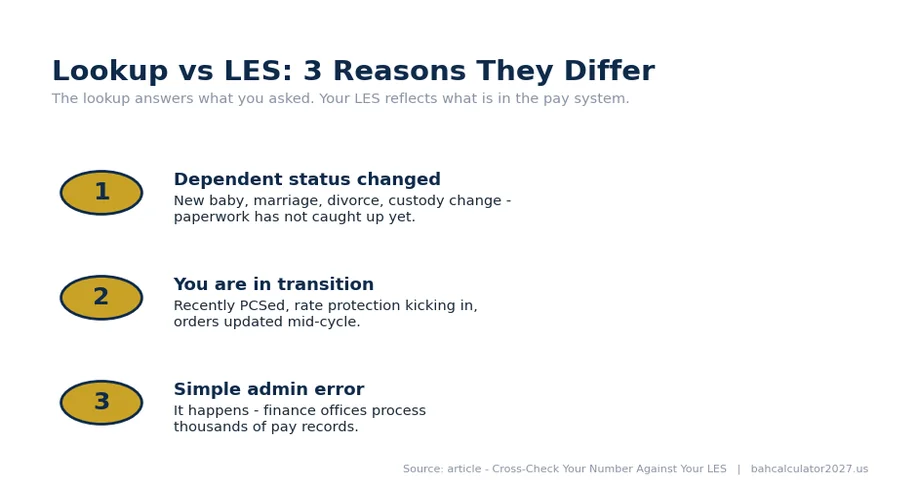
Find the BAH line on your most recent LES and compare it to the lookup result for your grade, dependent status, duty-station ZIP, and the current rate year. A mismatch usually means one of three things:
Your dependent status changed and the paperwork hasn’t caught up — new baby, marriage, divorce, custody change. The lookup uses what you tell it; your pay uses what’s in the system.
You’re in a transition — PCS’d recently, rate protection kicking in, or orders updated mid-cycle.
Simple admin error — it happens. Finance offices process thousands of pay records.
Small timing differences (back-pay adjustments, mid-month changes) resolve on their own. A persistent, unexplained gap is what your installation finance office exists to sort out — bring both numbers and ask. For tax time, see is BAH taxable.
And if the 2027 tables come out lower and your LES drops — that shouldn’t happen. Rate protection (grandfathering) means your rate holds. If it doesn’t, that’s a finance-office visit, not a shrug.
What the Lookup Needs vs What People Enter
Here’s the whole thing in one table. If you get these four right, your result is right.
| Field | What to enter | The most common mistake |
|---|---|---|
| ZIP code | Your permanent duty station’s ZIP | Your apartment, neighborhood, or home-of-record ZIP |
| Rate year | 2026 (current official rates) | Selecting 2027 before the mid-December release and trusting the result |
| Pay grade | Your current grade on orders/LES | Using the grade you’re promoting into before it takes effect |
| Dependency status | Read the rate column matching your status (with or without dependents) | Reading the wrong column, or not updating after marriage, divorce, birth, or custody changes |
Every one of those mistakes produces a perfectly confident wrong number. The lookup won’t warn you — it just answers the question you asked, not the question you meant. If a divorce changed your dependency status, read what happens to BAH in divorce first — then re-run the lookup with the right status.
ZIP Code → MHA: How the Mapping Works
To make the mapping concrete, here are two real examples of how a duty-station ZIP resolves. I’m using plain area names here on purpose — the internal MHA codes don’t matter to you; what matters is the base and the area around it.
| Duty station ZIP | Base / area | What the lookup shows |
|---|---|---|
| 92152 | Naval Base San Diego area, California | The San Diego housing area’s rate for your grade and dependent status |
| 22134 | Marine Corps Base Quantico area, Virginia | The Quantico housing area’s rate for your grade and dependent status |
Notice what’s not in that table: your street address, your off-base neighborhood, the town 30 minutes away with cheaper rent. None of that changes the result. Everyone assigned to the same base and in the same grade/dependent-status bucket gets the same number, and that number follows you — which brings us to moving.
PCS Moves: Which ZIP to Use
PCS season is when this gets genuinely confusing, because your ZIP situation is in flux. The rule:
- While you’re in transit — traveling, on leave en route — your BAH stays tied to your old duty station until you report in at the new one.
- The moment you sign in, your rate switches to the new station’s ZIP and housing area. Effective the date you report, not the date you find an apartment.
- House-hunting trips and early arrivals don’t change anything by themselves. The reporting date on your orders is what matters.
If you’re doing a bah rate lookup zip code search before a move, run it twice: your current duty station’s ZIP (what you’re paid now) and your gaining station’s ZIP (what you’ll be paid after you report). That’s the number to budget around. The 2027 BAH rates complete guide covers how the annual tables work.
Heading to your first permanent duty station after training? Your first real BAH rate is the gaining station’s — our BAH for new recruits guide walks through the whole timeline from basic training to that first paycheck.
Special Cases: Dual-Military, Custody, Reserves, OHA
The standard three-input lookup covers most active-duty situations. These are the ones that don’t fit neatly:
Dual-military couples. When both spouses serve, BAH works differently — the couple decides who receives the with-dependent rate (the senior member is the tiebreaker if you can’t agree), and the details depend on kids and whether you’re stationed together. The lookup gives each person’s individual rate, but the household picture needs the special rules. Use our dual-military BAH calculator instead of adding two lookup results together.
Custody changes. With-dependent status hinges on dependent support. Gain or lose primary custody and your status can change with it; there’s also a separate BAH-Differential rate for members paying child support without primary custody. Finance-office territory — don’t guess, ask.
Reservists and Guard on short orders. Members on drill weekends or active-duty orders of 30 days or fewer get a flat, non-locality BAH rate (BAH-RC/T) — no ZIP lookup is involved at all. On longer orders the rules differ, so check with your unit’s pay section about which rate type your orders trigger.
Overseas (OHA). Stationed outside the U.S.? No ZIP-code lookup for you. Overseas Housing Allowance is calculated from your actual rent, utilities, and location — individually, not from a rate table. Your housing office handles it.
On-base / privatized housing. You still have a BAH rate — it just goes straight to housing as rent. Looking it up is still useful (it tells you what you’d get if you moved off base), but don’t expect it in your bank account.
The Fastest Way: Our Calculator + the Official Lookup
If you’ve read this far, here’s the workflow I’d actually recommend — it’s what the whole article boils down to:
- Quick answer: punch your duty-station ZIP, grade, and dependent status into our BAH calculator. Same official rate tables as DoD, ten seconds. Bookmark your result.
- Official confirmation: run the same three inputs through the DTMO BAH Rate Lookup on travel.dod.mil. The numbers should match. If they do, you’re done.
- Reality check: compare the result to your LES. Matching? Great. Not matching? Finance office, with both numbers in hand.
- December ritual: when the 2027 rates release around mid-December, re-run all three steps with the new year selected.
That’s it. The lookup is a two-minute job — the value is in knowing which ZIP to type, which year to trust, and what to do when the number looks wrong. For the bigger picture — how rates are set each year, the history, the policy — the 2027 BAH rates complete guide is where that lives.
Frequently Asked Questions
Why does my ZIP give the wrong rate?
Usually one of three things: you entered your home ZIP instead of your duty station’s ZIP; you selected 2027 before the rates were released; or your grade or dependent status doesn’t match what’s in the pay system. Fix the input and re-run. If the lookup still disagrees with your LES, your finance office is the tiebreaker — bring both numbers.
Can I use my home ZIP?
No — not for the standard active-duty lookup. BAH is set by your permanent duty station’s ZIP. The only situations where a home or residence ZIP enters the picture are the special cases above (for example, some longer reserve orders key off your primary residence). For everyone else, home ZIP in = wrong answer out.
How do I look up the rate for a future duty station?
Enter the gaining station’s ZIP instead of your current one — the base’s main ZIP works if you don’t have unit details yet. Smart move before a PCS: it tells you what you’ll be paid after you report, so you can budget for the new area. Just use the correct rate year — and while you’re budgeting, don’t forget the dislocation allowance (DLA), the tax-free lump sum that covers the move’s miscellaneous costs.
Why doesn’t my LES match the official lookup?
The lookup computes from the inputs you give it; your LES reflects what’s in the pay system. A gap usually means your dependent status, grade, or duty station changed and the paperwork hasn’t caught up — or you’re mid-PCS. Small timing differences resolve on their own; a persistent mismatch doesn’t — take both numbers to your finance office. And if the new year’s tables come in lower, rate protection keeps your existing rate; a drop on your LES would be an error, not policy.
What happens to my rate if I move off base to a different ZIP?
Nothing. Your rate follows your duty station, not your address — move across town into a cheaper ZIP and keep the same BAH. That’s by design. Only a change of duty station, grade, or dependent status changes your rate.
Which year should I select — are 2027 rates out yet?
Select 2026 — those are the current official rates. The 2027 rates are expected around mid-December 2026 and have not been released as of this writing. Anything showing you “2027 rates” right now is a projection or last year’s data. The much-quoted 4.2% figure is the FY2027 budget-request proposal, not a confirmed rate. Re-run the lookup with 2027 selected once DoD publishes the tables.
Do Reservists or overseas members use ZIP codes?
Reservists on drill weekends or orders of 30 days or fewer receive the flat, non-locality BAH-RC rate — no ZIP lookup applies to that rate type. On longer active-duty orders, different rules apply — check with your unit’s pay section. Overseas members: no ZIP codes at all. You’re under OHA (Overseas Housing Allowance), which is calculated from your actual rent and location through your housing office, not from a rate table.
What if I live in on-base or privatized housing — do I still look up my rate?
You can, and it’s still useful to know — it tells you what your allowance is worth and what you’d receive if you moved off base. But don’t expect to see it in your paycheck: in privatized housing, your BAH is typically paid directly to the housing company as rent. The lookup gives you the number; your housing agreement determines where it goes.
What if the lookup doesn’t recognize my ZIP?
Use your installation’s main ZIP — the one on the base’s mailing address. PO boxes and brand-new ZIPs sometimes aren’t in the tool’s mapping, and APO/FPO/DPO addresses are overseas, which means OHA territory, not a BAH ZIP lookup. If a stateside base ZIP still won’t resolve, your installation housing or finance office can confirm which housing area you’re in.
What is a Military Housing Area (MHA)?
An MHA is the geographic zone the DoD actually prices when it sets BAH — a cluster of ZIP codes around a duty station (or a metro area) grouped by local housing costs. Your duty-station ZIP is just the key the lookup uses to find your MHA; the MHA is what carries the rate. That’s why two different ZIPs near the same base return the same number, and why your apartment’s ZIP can’t change your rate.
The Bottom Line
Finding your BAH rate by ZIP code is a two-minute task wrapped in a ten-minute understanding problem. Type your duty station’s ZIP — not your home ZIP — into the official lookup with your grade, dependent status, and the 2026 rate year (2027 isn’t out yet), and you’ll get the right number. Cross-check it against your LES, and let your finance office settle any disagreement. Everything else is knowing which version of “your ZIP” applies to you.
Independent guide — not affiliated with the U.S. Department of Defense or any military branch.