Is BAH Taxable? Complete Military Tax Guide [2027]
No — BAH is not taxable. Under 26 U.S.C. §134, Basic Allowance for Housing is a “qualified military benefit,” which means it is excluded from your gross income. You pay no federal income tax on it, no Social Security or Medicare tax either, and you don’t report it on your tax return. The same goes for BAS.
If you’ve ever put a military Leave and Earnings Statement next to a civilian pay stub, you’ve seen something strange. The civilian stub has one big number with chunks carved out for taxes. The LES has a line that looks almost too good to be true: thousands of dollars arriving every month with zero tax withheld. No mistake — that untaxed line is BAH, and understanding why it’s tax-free — and what that actually saves you — is one of the most useful things a service member can learn about their own pay.
Quick note before we go further: I’m not a CPA or tax professional. This guide explains the rules as written in federal law and IRS publications, but for your specific situation — especially state taxes — talk to a tax pro or a free military tax counselor.
Why BAH Is Tax-Free: The Law Behind It
Here’s the short version of a very deliberate piece of lawmaking. In 1986, Congress passed the Tax Reform Act and wrote Section 134 into the Internal Revenue Code. It says, in plain English: gross income does not include any qualified military benefit. BAH is one of those benefits.
That matters for two reasons. First, it’s a statute — an actual law — not an annual policy decision. Nobody in Washington votes each year on whether to keep BAH tax-free. It’s been the law for roughly four decades. Second, the IRS spells it out directly in IRS Publication 3, the Armed Forces’ Tax Guide, which lists BAH among the allowances excluded from income.
The logic is simple once you see it. Basic pay is earned compensation — you pay tax on it like any salary. BAH is an allowance — money the government gives you to cover a specific cost (housing) because military life requires you to live where you’re sent. Congress decided allowances like this shouldn’t be taxed, and wrote it into law so firmly that later Congresses can’t quietly undo it.
Federal Income Tax: $0 on Every BAH Dollar
Every dollar of BAH you receive is invisible to the IRS for income tax purposes. If you get $2,000 a month in BAH, that’s $24,000 a year that never enters your taxable income. A civilian earning an extra $24,000 in salary would owe federal income tax on all of it. You owe nothing on yours.
This applies to every flavor of BAH — with-dependents rate, without-dependents rate, partial BAH, BAH-DIFF. They’re all BAH, and they’re all excluded. If you’re stationed overseas, OHA (Overseas Housing Allowance) gets the same treatment — I compared BAH and OHA side by side here.
The Part People Miss: No Social Security or Medicare Tax Either
Most articles stop at “no income tax” and miss the second layer. BAH is also exempt from FICA taxes — that’s the 6.2% Social Security tax and the 1.45% Medicare tax that come out of every civilian paycheck, a combined 7.65%.
Think about what that means. On $24,000 of BAH, a civilian-style paycheck would lose about $1,836 to FICA alone. Yours loses nothing. When you add the income tax savings on top, the total value of the exclusion is much bigger than most people realize. I’ll put real numbers on this in the worked example below — it’s the closest thing to a hidden raise in military compensation.
Your LES and W-2: Where BAH Shows Up (and Doesn’t)

This is the part that confuses first-time filers, so let me walk through it.
On your Leave and Earnings Statement (LES), BAH and BAS appear as their own separate allowance lines, apart from your taxable basic pay. That separation is the whole story in miniature: the LES is literally showing you which dollars get taxed and which don’t.
On your W-2 at tax time, BAH and BAS do not appear in Box 1 (wages, tips, other compensation). Box 1 is the number the IRS taxes. Since your allowances aren’t in it, there’s nothing to report — you don’t list BAH anywhere on your federal return. It isn’t “income you forgot to declare.” It’s income the law says doesn’t count.
One related detail worth knowing: if you ever receive per diem at or below the federal rate under an accountable plan, it shows up only under Box 12, code L — again, not in Box 1, not taxable. More on per diem rules in a moment.
BAS Is Tax-Free Too
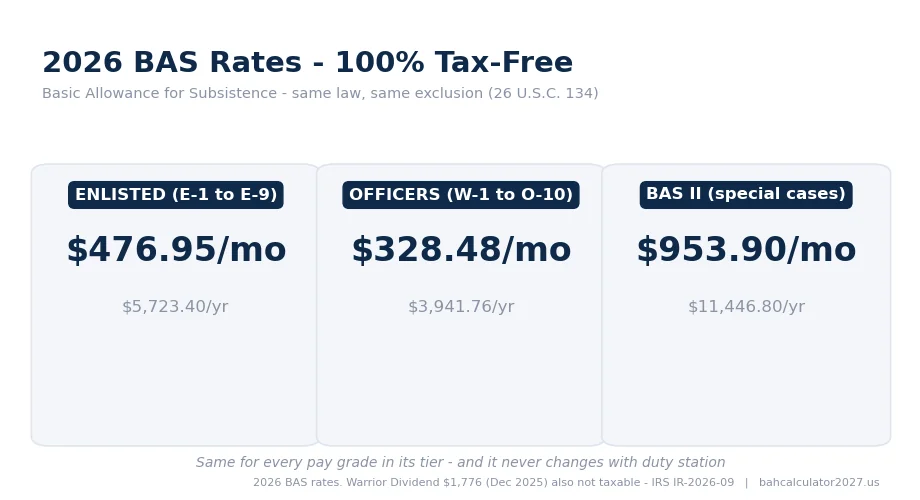
The same law covers BAS — Basic Allowance for Subsistence, the monthly food allowance. For 2026, that’s $476.95 a month for enlisted members and $328.48 a month for officers (about $5,723 and $3,942 a year, respectively), all tax-free. There’s also a BAS II rate of $953.90 for specific situations.
Two things worth knowing about BAS: it’s the same for every pay grade within its tier — an E-3 and an E-9 get the identical amount — and unlike BAH, it doesn’t change with your duty station or whether you have dependents. It’s for your meals, not your family’s. I’ll be covering BAS in much more depth in a dedicated guide soon.
| Member category | 2026 monthly BAS | 2026 annual value |
|---|---|---|
| Enlisted (E-1–E-9) | $476.95 | $5,723.40 |
| Officers (W-1–O-10) | $328.48 | $3,941.76 |
| BAS II (special cases) | $953.90 | $11,446.80 |
Is Per Diem Taxable? The Accountable-Plan Rule
Per diem works differently from BAH, so it gets its own rule. Per diem you receive on official travel is tax-free as long as it’s paid under an “accountable plan” and doesn’t exceed the federal rate for the area. That’s straight from IRS Publication 463.
An accountable plan has three requirements: the travel has to be for official business, you have to account for it (time, place, and business purpose — generally within 60 days), and you have to return any amount above the federal rate (generally within 120 days). Meet those, and the per diem never touches your taxable income.
Where people get tripped up: any amount above the federal rate becomes taxable wages — it lands in Box 1 of your W-2 and gets hit with income and FICA tax. And if there’s no accountable plan at all (no accounting required, no excess returned), the entire per diem becomes taxable. The military’s travel system follows these rules, so for most service members on TDY, per diem stays tax-free. I’ll break down per diem rates and the lookup process in a separate guide.
Worked Example: What an E-5 Actually Saves
Let me make this concrete with verified 2026 numbers. Take an E-5 with dependents stationed at Fort Hood:
- BAH (2026 published rate): $1,695/month
- BAS (2026 enlisted rate): $476.95/month
- Combined tax-free allowances: $2,171.95/month → $26,063.40/year
Now the savings. At a 22% federal marginal rate plus 7.65% FICA, that’s a combined 29.65% that would have been taken from this money in a civilian paycheck:
| Monthly | Annual | |
|---|---|---|
| Tax-free allowances (BAH + BAS) | $2,171.95 | $26,063.40 |
| Tax avoided (29.65%) | $643.98 | $7,727.80 |
| Taxable-pay equivalent (at 22%) | $2,784.55 | $33,414.60 |
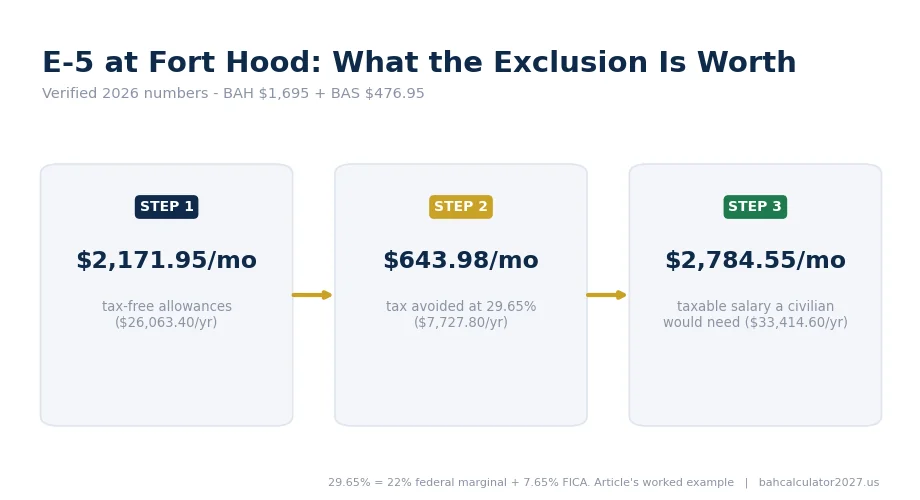
Read that last row carefully: to put the same spending power in your pocket, a civilian employer would have to pay you roughly $2,785 a month in taxable salary. That’s the real value of the exclusion — and it’s why the DoD’s official “Regular Military Compensation” figure adds a calculated tax advantage on top of BAH and BAS when it compares military pay to civilian salaries.
What IS Taxable: The Contrast
To keep this honest, here’s the other side. Plenty of military pay is taxed normally:
| Taxable (in W-2 Box 1) | Not taxable (excluded) |
|---|---|
| Basic pay | BAH (all types) |
| Special & incentive pays (flight pay, hazardous duty, etc.) | BAS |
| Enlistment / reenlistment bonuses | OHA (overseas housing) |
| Accrued leave paid at separation | Family separation allowance |
| CONUS COLA (Cost of Living Allowance) | OCONUS COLA |
| Per diem (within federal rate, accountable plan) |
The pattern is consistent: pay for your service gets taxed; allowances for costs the service imposes on you generally don’t. (One exception to know: pay earned in a designated combat zone can be excluded from federal tax too — but that’s a separate rule — covered in my hazard pay guide, including exactly which pays the combat-zone exclusion touches.
State Taxes and the MSRRA: Read This Carefully
Here’s where I have to be careful, because this is where generic articles mislead people. Since BAH is excluded from your federal gross income, and most states calculate state tax starting from federal adjusted gross income, BAH effectively escapes state income tax in most situations too.
But “most” isn’t “all,” and your state tax situation as a service member depends heavily on one law: the Military Spouses Residency Relief Act (MSRRA) of 2009. It lets service members — and their spouses — keep a single state of legal residence for tax purposes no matter how many times the military moves them. So your state tax picture follows your domicile state, not necessarily the state you’re stationed in.
Bottom line: don’t assume, and don’t take a blogger’s word for your state. Check your domicile state’s rules or ask a military tax counselor — it’s free.
The VA Loan Angle: Your Tax-Free BAH Counts as More Income
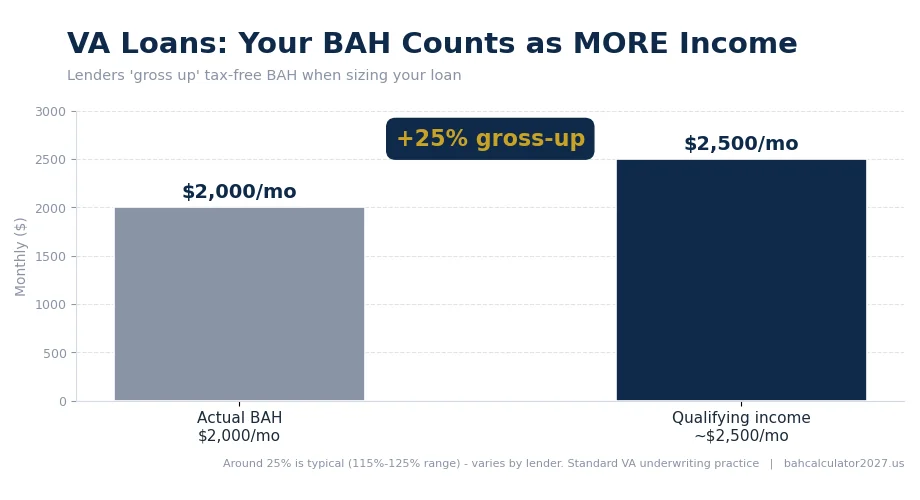
This is my favorite underappreciated consequence of the tax exclusion. When you apply for a VA home loan, lenders verify your BAH from your LES and count it as qualifying income. And because it’s tax-free, many lenders “gross it up” — they inflate it on paper to reflect what it would be worth as taxable pay.
In practice, lenders often gross up non-taxable income by around 25% (the exact factor varies by lender and loan type — anywhere from roughly 115% to 125% — so ask your lender for their number). That means $2,000 a month in BAH might count as $2,500 in qualifying income when the lender calculates your debt-to-income ratio. It doesn’t change your actual payment, but it can meaningfully change how much house you qualify for. I ran the full buying-power math — VA funding fee, DTI limits, and residual income — in my guide to how much house you can afford with BAH. If a lender isn’t grossing up your BAH, that’s worth a conversation — it’s standard practice under VA underwriting guidelines.
Knock-On Effects Worth Knowing
The tax exclusion ripples into a few other corners of your financial life:
- Earned Income Tax Credit: BAH and BAS don’t count as earned income, so they won’t help you qualify for the EITC. (They don’t hurt you either — they’re just invisible to it.)
- Needs-based programs: Some programs like SNAP may count BAH as income when they test eligibility. Always check the specific program’s rules.
- TSP contributions: Your Thrift Savings Plan contributions — and the government’s matching — are calculated on your taxable basic pay only, not on BAH/BAS.
- Mortgage deductions: Here’s a nice one — you can still deduct mortgage interest and property taxes even if you paid them with tax-free BAH. The law specifically allows it (26 U.S.C. §265(a)(6), via IRS Publication 3).
5 Myths About BAH and Taxes
| Myth | Reality |
|---|---|
| “BAH shows up on my LES, so it must be taxed.” | The LES lists it separately because it’s not taxed. Only Box 1 of your W-2 matters. |
| “I’ll owe state tax on BAH even if federal doesn’t tax it.” | Usually no — most states start from federal AGI, and MSRRA protects your domicile. But verify your state. |
| “If I don’t report BAH, I’m committing tax fraud.” | No. Excluded income isn’t reported. The IRS wrote the exclusion itself. |
| “The tax-free status could disappear next year.” | It’s been federal statute since 1986. Changing it would take an act of Congress — and none is on the table. |
| “BAH counts as income for everything.” | Not for EITC, not for TSP calculations. It counts for VA loans and some benefit programs. Context matters — for example, courts do count BAH as income when setting child support during a divorce. |
What About 2027?
Two things to watch. First, the tax treatment: §134 is statute, and changing it would require an act of Congress — none is currently on the table. When the official 2027 BAH rates land (expected ~December 2026), every dollar of them will be tax-free under the same law.
Second, the rates themselves: the DoD’s FY2027 budget request proposes a 4.2% BAH increase — that’s a proposal, not a final number. Whatever the final 2027 BAH rates are, the tax math in this guide applies to them unchanged. I’ll update the worked example with real 2027 rates when DTMO publishes them.
Frequently Asked Questions
Is BAH taxed at the federal level?
No. BAH is excluded from gross income under 26 U.S.C. §134 as a qualified military benefit. You owe no federal income tax on it and don’t report it on your return.
Do I pay state tax on BAH?
In most cases, no — states that start from federal adjusted gross income won’t tax what the federal government excluded. But state rules vary, and your domicile under MSRRA determines which state’s rules apply to you. Verify your specific state.
Do I need to report BAH on my tax return?
No. BAH doesn’t appear in Box 1 of your W-2, so there’s nothing to enter. Don’t add it as “other income” — that would mean paying tax you don’t owe.
Is BAS taxable?
No. BAS is also a qualified military benefit under §134. The 2026 rates ($476.95 enlisted, $328.48 officer per month) are entirely tax-free.
Is per diem taxable?
Not if it’s paid under an accountable plan at or below the federal rate — then it’s a reimbursement, not income. Amounts above the federal rate, or per diem with no accountable plan, become taxable wages.
Does tax-free BAH put me in a lower tax bracket?
It doesn’t lower your bracket — your bracket is set by your taxable income (mainly basic pay). But because $26,000+ of your compensation never enters taxable income at all, your effective tax rate on total compensation is much lower than a civilian earning the same total.
Can I deduct mortgage interest if I paid it with BAH?
Yes. Federal law specifically allows the mortgage interest and property tax deductions even when the payments came from tax-free BAH.
Does BAH help me qualify for a VA home loan?
Yes, twice over: lenders count BAH as qualifying income, and many gross it up (~25%, varies by lender) to reflect its tax-free value — boosting how much you can borrow.
Is BAH taxable for Guard and Reserve members?
The same §134 exclusion applies to any BAH a Guard or Reserve member receives. Drill pay itself, though, is taxable basic pay.
Was the $1,776 Warrior Dividend taxable?
No. The IRS confirmed in January 2026 (IR-2026-09) that the one-time December 2025 supplemental BAH payment was not includible in income — it’s a qualified military benefit like regular BAH.
I’m not a tax professional, and this guide isn’t tax advice. The rules above come from federal statute (26 U.S.C. §134), IRS Publication 3, IRS Publication 463, and Military OneSource’s tax guidance — but state rules vary and personal situations differ. For free, personalized help, military tax centers and Military OneSource financial counselors (800-342-9647) are available to you.
Want to see what your own BAH looks like next to these numbers? Run your duty station, grade, and dependency status through the BAH Calculator 2027 on our homepage — every rate it shows you is tax-free money.