Do Single Soldiers Get BAH? Barracks Rules [2027]
Yes. Single service members get BAH at the without-dependent rate — but only when authorized to live off base. Assigned to the barracks, dorms, or a ship? Then it’s partial BAH: a token $6.90–$50.70/month in 2026, not full BAH. Moving off base depends on your rank, branch, and barracks space.
That’s the short answer. But the details are where soldiers lose — or save — real money, so let’s walk through all of it: the three BAH types, the barracks rules for each branch, the exact 2026 rates, and the one form that gets single soldiers out of the barracks.
The Short Version: Three BAH Types for Single Members
Not all BAH is the same BAH. As a single service member, which type you get depends entirely on where you sleep at night:
| BAH type | Who gets it | What it pays (2026, E-5) |
|---|---|---|
| Full BAH (without-dependent rate) | Single members authorized to live off base | Full locality rate — four figures a month in most areas |
| Partial BAH | Single members living in government quarters (barracks, dorms, ships) | $8.70/month |
| BAH-DIFF (differential) | Single members in government quarters who are legally required to pay child support | $380.10/month |
Read that middle row again. Eight dollars and seventy cents. Per month. That’s not a typo, and it’s the number that surprises most new soldiers who do the math for the first time. The rest of this guide explains why it works that way — and how to end up in the first row instead of the second.
Do You Get BAH in the Barracks?
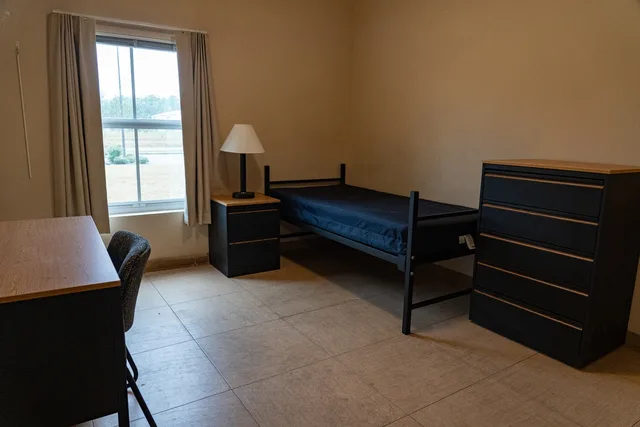
No — not full BAH. If you’re assigned to government quarters, you get partial BAH only.
The logic is straightforward once you see it: BAH exists to help you pay for housing. When the military is already housing you — barracks room, dorm, ship berth — there’s no rent to cover, so there’s no full allowance. The partial BAH is essentially symbolic, a small payment that dates back to older pay structures. For an E-5, it’s $8.70 a month. For an E-1, it’s $6.90. Even a senior officer in government quarters tops out at $50.70. Here’s the full partial BAH rates table — every pay grade, verified against the official 2026 table.
Here’s the part that trips people up: moving into the barracks voluntarily doesn’t protect your BAH. If you were getting full BAH off-post and then move into the barracks (or get assigned there), your BAH drops to the partial rate. This confusion comes up constantly in military forums — soldiers assuming the allowance follows them. It doesn’t. It follows your housing situation.
One related note: BAH rate protection (keeping your higher rate when locality rates drop) applies to full BAH recipients — partial BAH is a flat token amount that doesn’t move with housing markets anyway. (I cover rate protection in detail in my BAH rate protection guide.)
Barracks Rules by Branch [2027]
So when can you actually move off base? Each branch sets its own barracks policy, and it generally comes down to rank plus time in service. Here’s where things stand:
| Branch | Single members typically authorized off base | Notes |
|---|---|---|
| Army | E-6 and above | Some installations allow E-5s, depending on barracks space |
| Air Force | E-4 with 3+ years of service | Dormitory policy is the most junior-friendly |
| Navy | E-5 and above; E-4 with 4+ years | Shipboard sailors are a special case (see below) |
| Marine Corps | E-6 and above | Some bases allow E-5, occasionally E-4, when barracks are full |
Two big caveats. First, these are service-wide baselines, not guarantees. Your installation’s actual policy depends on barracks occupancy — if the barracks are full, junior members move off base sooner; if there’s plenty of room, the thresholds hold firm. Second, local command guidance controls. Always check with your installation housing office rather than assuming the table above is your ticket out.
The underlying principle across all branches: junior enlisted without dependents are generally required to live in the barracks after initial training. That’s not just tradition — it’s documented in a GAO review of barracks conditions, which found each service requires it as standard policy.
How Single Soldiers Get BAH: The CNA Process (Army)
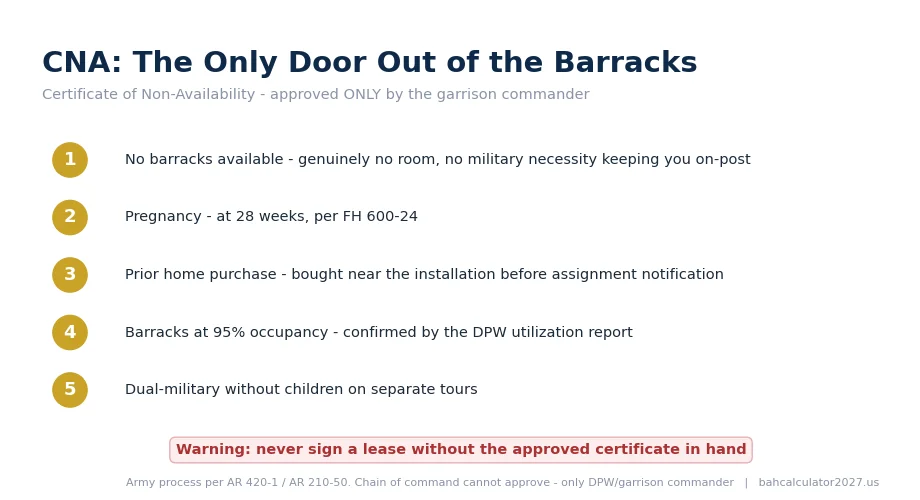
If you’re below the off-post threshold but want out of the barracks, there’s exactly one legitimate door: the Certificate of Non-Availability (CNA). This is the Army’s process, governed by AR 420-1 and AR 210-50 (Chapter 3), and understanding it correctly matters because getting it wrong has real consequences.
What a CNA is: an official document stating that adequate government quarters aren’t available for you — which authorizes you to live off-post at government expense and receive full BAH.
Who approves it: this is the critical part. Only the garrison commander (through the Directorate of Public Works, DPW) can approve a CNA. Not your chain of command. Not your squad leader, not your platoon sergeant, not your company commander. There are documented IG complaints from soldiers who were told by their leaders they could move off-post — and then got in trouble because no CNA existed. If someone in your chain says “yeah, go ahead and move,” that means nothing without the certificate.
When the garrison commander may approve it for single soldiers at sergeant and below:
- No barracks available — there’s genuinely no room, and no military necessity keeping you on-post
- Pregnancy — at 28 weeks, per FH 600-24
- Prior home purchase — you bought a home near the installation before being notified of the assignment
- Barracks at 95% occupancy — confirmed by the DPW barracks utilization report
- Dual-military without children on separate tours — each spouse stationed apart
The warning that matters: do not sign a lease off-post without an approved CNA in hand. Without it, you’re paying rent out of pocket with no BAH to cover it — and you’ll still be expected in the barracks. Get the certificate first, lease second. Always in that order.
2026 Partial BAH Rates (Full Table)
For reference, here are the complete 2026 partial BAH rates — the token amounts paid to single members in government quarters. These didn’t change from 2025 to 2026, which tells you something about how symbolic they are:
| Grade | Monthly |
|---|---|
| E-1 | $6.90 |
| E-2 | $7.20 |
| E-3 | $7.80 |
| E-4 | $8.10 |
| E-5 | $8.70 |
| E-6 | $9.90 |
| E-7 | $12.00 |
| E-8 | $15.30 |
| E-9 | $18.60 |
| W-1 | $13.80 |
| W-2 | $15.90 |
| W-3 | $20.70 |
| W-4 | $25.20 |
| W-5 | $25.20 |
| O-1 | $13.20 |
| O-2 | $17.70 |
| O-3 | $22.20 |
| O-4 | $26.70 |
| O-5 | $33.00 |
| O-6 | $39.60 |
| O-7–O-10 | $50.70 |
Source: 2026 partial BAH rates, published December 2025. 2027 note: partial BAH held flat from 2025 to 2026 — I’ll update this table when 2027 rates publish (expected ~December 2026).
BAH-DIFF: Single, In the Barracks, Paying Child Support
There’s one important exception to the “$8.70” story. If you’re a single service member living in government quarters and you’re legally required to pay child support, you may qualify for BAH-DIFF (BAH differential) instead of partial BAH.
The rules:
- Your court-ordered child support payment must be at least as much as the BAH-DIFF rate for your grade. If you pay less than the rate, no BAH-DIFF.
- BAH-DIFF is a flat national rate per grade — it adjusts each year with the military pay raise, not with local housing costs.
- Key nuance: if you live off base (not in government quarters) and pay child support, you don’t get BAH-DIFF — you get the full with-dependent locality BAH rate instead, which is almost always higher.
2026 BAH-DIFF rates (selected grades):
| Grade | Monthly |
|---|---|
| E-1 | $439.20 |
| E-2 | $371.10 |
| E-3 | $277.80 |
| E-4 | $338.70 |
| E-5 | $380.10 |
| E-6 | $419.10 |
| E-7 | $433.20 |
| E-8 | $374.40 |
| E-9 | $399.30 |
| O-1 | $324.60 |
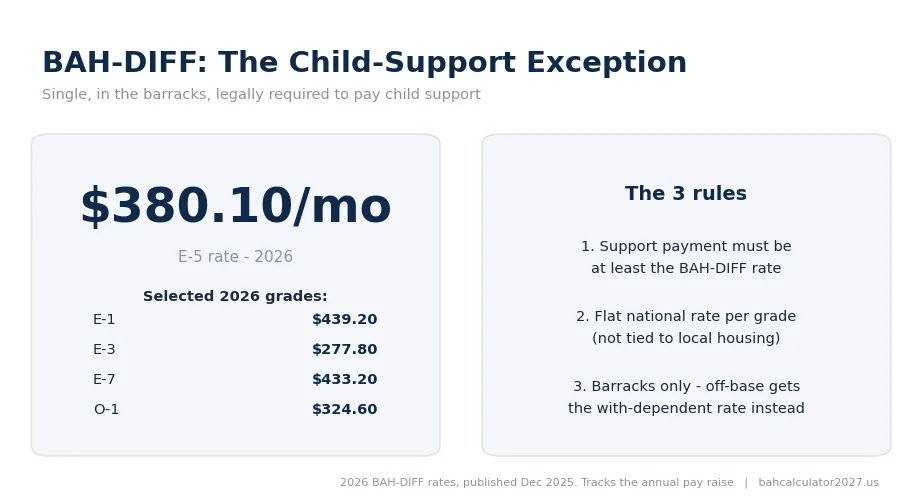
Source: 2026 BAH differential rates, published December 2025. 2027 note: BAH-DIFF tracks the annual pay raise — I’ll update when 2027 figures publish. For the full 2026 table — every grade, with Partial and RC/T alongside — see the complete non-locality BAH table.
The E-5 Math: Barracks vs. Off-Post
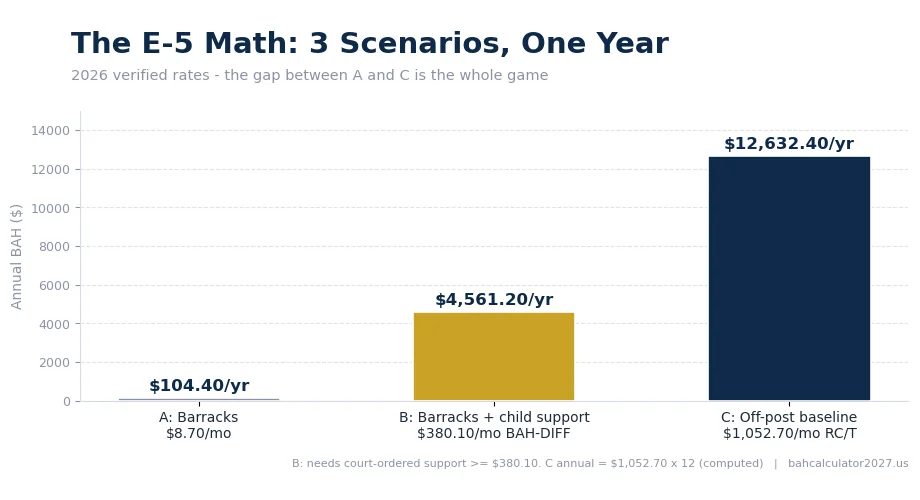
Let’s put real numbers on the three scenarios, because this is the comparison that actually changes decisions:
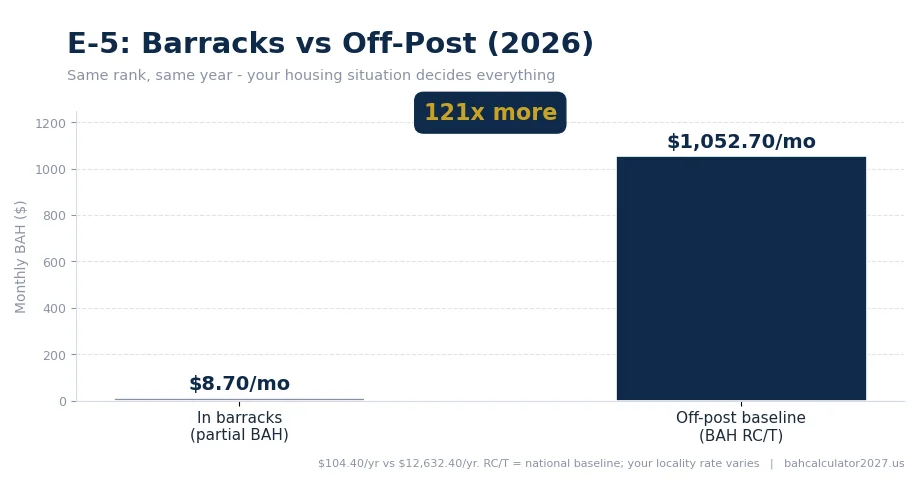
Scenario A — E-5 in the barracks: $8.70/month partial BAH. That’s $104.40 for the entire year.
Scenario B — E-5 in the barracks, paying $400/month in court-ordered child support: $380.10/month BAH-DIFF (since $400 ≥ the $380.10 threshold). That’s $4,561.20/year.
Scenario C — E-5 authorized to live off-post: the full without-dependent locality rate, which varies by duty station. To put a verified number on the scale: the 2026 national non-locality baseline (BAH RC/T) for E-5 is $1,052.70/month — your actual locality rate comes from your duty station’s ZIP. Run it through our BAH calculator to see your exact 2026 figure.
The gap between Scenario A and Scenario C is the entire game: roughly $8.70 vs. $1,000+/month. That’s why the CNA process and the branch thresholds above aren’t bureaucratic trivia — they’re worth potentially $12,000+ a year to a junior enlisted member.
2027 outlook: locality BAH rates are projected to rise ~4.2% under the DoD’s FY2027 budget request — but that’s a proposal, not final rates. The official 2027 tables publish around December 2026, and I’ll update every figure on this page when they do.
Special Situations
Basic training and AIT. Single trainees live in barracks, so it’s partial BAH — $6.90/month for a brand-new E-1. But if you have dependents, it’s a different story: you get the full with-dependent BAH rate based on where your dependents live, not where you’re training. If you’re shipping to training soon, our BAH for new recruits guide walks through BAH from basic training and AIT all the way to your first duty station.
Shipboard sailors. A ship counts as government quarters. Single sailors assigned to a ship get partial BAH, same as barracks residents.
Dual-military couples without children. Each spouse receives BAH at the without-dependent rate for their own locality and grade. (The couple chooses who receives the with-dependent rate only when there are dependents involved — with no kids, each spouse simply gets the without-dependent rate.) I break down every dual-military combination in my dual-military BAH calculator guide.
Divorce. The day your divorce is final, your dependent status changes: you become single for BAH purposes, and the with-dependent rate stops. I cover the full timeline — separation, the final decree, kids and custody, and BAH-DIFF — in what happens to BAH in divorce. From there, you’re treated like any other single member — barracks and partial BAH unless you qualify for off-post housing (the CNA path above applies to you too). One thing divorce does not automatically do: joint custody alone doesn’t qualify you for with-dependent BAH.
In transit between duty stations. Members traveling from one permanent duty station to another receive BAH RC/T (also called Type II or non-locality BAH) — a flat national-average rate by rank ($1,052.70/month for E-5 in 2026), not a locality rate. Same for reservists on active duty under 30 days.
Deployment. Single soldiers who were authorized BAH before deploying keep it during deployment — including the well-known (and completely legal) move of terminating your lease and pocketing the BAH while your household goods sit in government-paid storage. I cover the full deployment pay picture, including the $300/month Family Separation Allowance, in what happens to BAH during deployment.
Myths That Cost Soldiers Money
“My commander said I can move off-post, so I’m good.”
No. Only the garrison commander — through DPW, via a CNA — can authorize it. Verbal permission from your chain of command has put soldiers in front of IG investigators. Paper first, lease second.
“Once I make E-4, BAH is automatic.”
No. In the Army and Marines, E-4s are generally still in the barracks. The Air Force lets E-4s with 3+ years of service move out; the Navy allows E-4s with 4+ years. Rank alone doesn’t do it — branch, time in service, and barracks space all matter.
“I’ll just go geographic bachelor.”
That program is over. The geographic bachelor program — where married members voluntarily separated from their families could live in the barracks stateside — was ended by all five branches. It doesn’t exist anymore, stateside or otherwise.
“Single soldiers get BAH Type 1.”
You’ll still see “BAH Type 1 / Type 2” language on some old websites (it’s from the pre-1998 Basic Allowance for Quarters era). It’s obsolete. The modern categories are full BAH, partial BAH, BAH-DIFF, and BAH RC/T. If a site is still talking about “Type 1,” its information is decades out of date — which is exactly why I wrote this guide with current numbers.
Frequently Asked Questions
At what rank do single soldiers get BAH?
There’s no single rank — it depends on your branch. Army: E-6+ (some E-5s by barracks space). Air Force: E-4 with 3+ years. Navy: E-5+, or E-4 with 4+ years. Marines: E-6+ (some E-5/E-4 by space). Below those thresholds, the CNA exception process is the path.
Do you get BAH in basic training?
Single trainees get partial BAH only ($6.90/month for E-1 in 2026) since they live in barracks. If you have dependents, you receive full with-dependent BAH based on your dependents’ location.
Do single soldiers get BAH if they live in the barracks?
Only partial BAH — $6.90 to $50.70/month depending on rank (2026 rates). Full BAH requires authorization to live off base.
Can a single E-4 get BAH?
In the Army and Marine Corps, generally not without a CNA exception. In the Air Force (3+ years of service) and Navy (4+ years), yes — off-base housing is authorized at E-4 with sufficient time in service.
Do single officers get BAH?
Yes — officers are normally authorized to live off base and receive full BAH at the without-dependent rate. An officer assigned to government quarters would receive partial BAH instead ($13.20–$50.70/month in 2026).
Do you lose BAH if you move into the barracks?
Yes. Moving from off-post housing into the barracks drops your BAH to the partial rate. The allowance follows your housing situation, not you.
Is BAH taxable?
No. BAH is not subject to federal income tax — it’s one of the most valuable parts of military compensation precisely because every dollar is tax-free.
What is a Certificate of Non-Availability (CNA)?
An official document, approved only by the garrison commander through the housing office (DPW), stating that adequate barracks space isn’t available for you. It authorizes off-post living at government expense — and with it, full BAH.
If I pay child support and live off base, do I get BAH-DIFF?
No — BAH-DIFF is only for members in government quarters. Living off base with a child support obligation qualifies you for the full with-dependent locality BAH rate, which is higher.
Does BAH continue during deployment for single soldiers?
Yes, if you were authorized BAH before deploying. It continues at your normal rate for the entire deployment. (See my full deployment BAH guide for the details, including FSA.)
The Bottom Line
Here’s everything on one line: single service members get full BAH when authorized to live off base, partial BAH ($6.90–$50.70/month) in the barracks, and BAH-DIFF ($277.80–$439.20/month) in the barracks with a child support obligation. The difference between the barracks and an off-post authorization can be worth $12,000+ a year — so know your branch’s thresholds, understand the CNA process, and never sign a lease without the certificate in hand.
Want your exact number? Run your ZIP, rank, and dependency status through our BAH calculator 2027 — it uses the official 2026 DTMO rates with the 4.2% DoD budget-request projection applied for 2027, and I’ll swap in the real 2027 tables the day they publish.