BAH-DIFF Explained: What It Is & Who Gets It [2027]
BAH-DIFF is the flat housing allowance paid to a service member who lives in government quarters and pays court-ordered child support at least equal to their pay grade’s DIFF rate. In 2026 it runs from $159.00 to $465.60 a month by grade — $380.10 for an E-5 — and it is the same at every duty station in the country.
Independent guide — not affiliated with the U.S. Department of Defense or any military branch. Last updated: October 24, 2026
The three conditions for BAH-DIFF
BAH-DIFF has a narrow door, and all three of its conditions have to be true at the same time. Miss one and there is no DIFF at all — not a smaller amount, not a partial version of it. Here is the test, exactly as your finance office applies it:
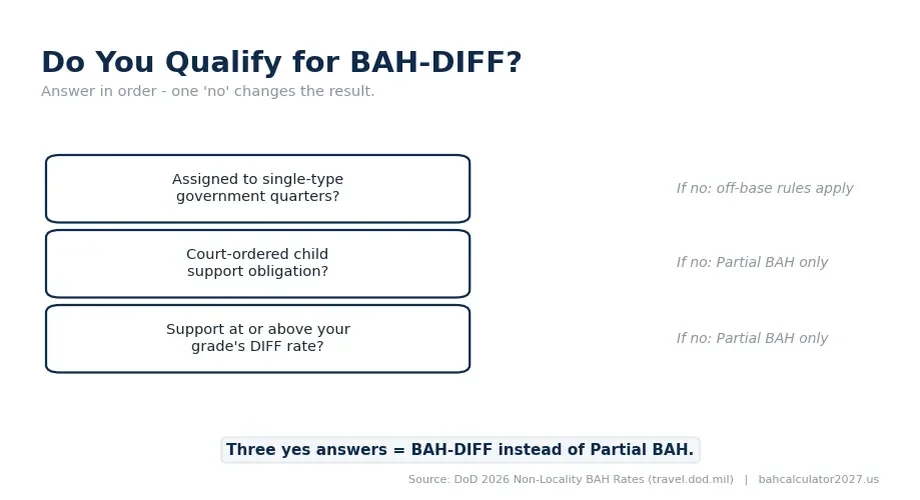
First, you must be assigned to single-type government quarters. That means the barracks, a dorm, a bachelor officer quarters, or a ship. The military is already housing you, so in the normal run of things you do not get full BAH at all.
Second, you must be authorized BAH solely because you pay child support. In plain terms: the only reason you qualify for any housing allowance is that a court order (or an equivalent legal requirement) says you support a child who does not live with you. If you had no support obligation, you would be a single member in quarters getting nothing but Partial BAH.
Third, your monthly child support payment must be at least as much as the BAH-DIFF rate for your pay grade. This threshold is where most of the confusion lives: a payment one dollar below the rate means no DIFF, while a payment exactly at the rate qualifies.
If all three hold, you get BAH-DIFF instead of Partial BAH. Note that word: instead. DIFF replaces Partial; the two are never paid together. If any condition fails, you fall back to Partial BAH, which for most junior enlisted members is under ten dollars a month.
2026 BAH-DIFF rates: the full table
These are the official 2026 rates, effective January 1, 2026, checked against the Department of Defense’s own non-locality rate table. They are flat nationwide — your grade decides the number, not your ZIP code.
| Grade | Monthly BAH-DIFF |
|---|---|
| E-1 | $439.20 |
| E-2 | $371.10 |
| E-3 | $277.80 |
| E-4 | $338.70 |
| E-5 | $380.10 |
| E-6 | $419.10 |
| E-7 | $433.20 |
| E-8 | $374.40 |
| E-9 | $399.30 |
| W-1 | $302.70 |
| W-2 | $312.30 |
| W-3 | $295.50 |
| W-4 | $196.20 |
| W-5 | $159.00 |
| O-1 | $324.60 |
| O-2 | $300.60 |
| O-3 | $254.70 |
| O-4 | $255.00 |
| O-5 | $382.50 |
| O-6 | $395.70 |
| O-7 | $465.60 |
| O-8 | $465.60 |
| O-9 | $465.60 |
| O-10 | $465.60 |
| O-1E | $374.10 |
| O-2E | $318.60 |
| O-3E | $266.10 |
For the full non-locality picture — Partial BAH and BAH RC/T alongside DIFF in one verified table — see my non-locality BAH rates guide. If you want the deep dive on Partial BAH itself, that is in my what is Partial BAH guide.
The $380.10 test: how the threshold works
Let me make the threshold concrete with an E-5, because E-5 is the grade where this question comes up most. The 2026 BAH-DIFF rate for an E-5 is $380.10 a month. Now run three versions of the same soldier:
If your court-ordered child support is $400 a month, $400 is more than $380.10, so you qualify. You receive $380.10 a month in BAH-DIFF — $4,561.20 over a full year — instead of the $8.70 Partial BAH.
If your court-ordered child support is $300 a month, $300 is less than $380.10, so you do not qualify at all. You receive Partial BAH only: $8.70 a month, $104.40 a year. The gap between qualifying and not qualifying is $371.40 a month, or $4,456.80 a year, and it turns on an $80.10 difference in the support order.
If your court-ordered child support is exactly $380.10, you qualify. The rule is “at least” the DIFF rate, not “more than” it. Exactly at the line counts.
A few practical points follow from that. First, it is the court-ordered amount that matters, not what you feel you can afford or what you actually handed over in a given month — finance works from the order on file. Second, if your support order changes, your DIFF eligibility can change with it, in either direction. Third, do not assume a small support payment still gets you a small DIFF payment. There is no sliding scale. You either clear the threshold and get the full DIFF rate for your grade, or you do not clear it and get Partial BAH. That all-or-nothing shape is the single most misunderstood thing about BAH-DIFF, and it is worth checking against your own order before you assume anything about your LES.
Why DIFF is the same everywhere
Here is the correction that most articles about BAH-DIFF never make, and it matters because it changes how you think about the money. BAH-DIFF is not the gap between the with-dependent and without-dependent BAH rates at your duty station. It is a flat national figure, set once a year, identical at every base.
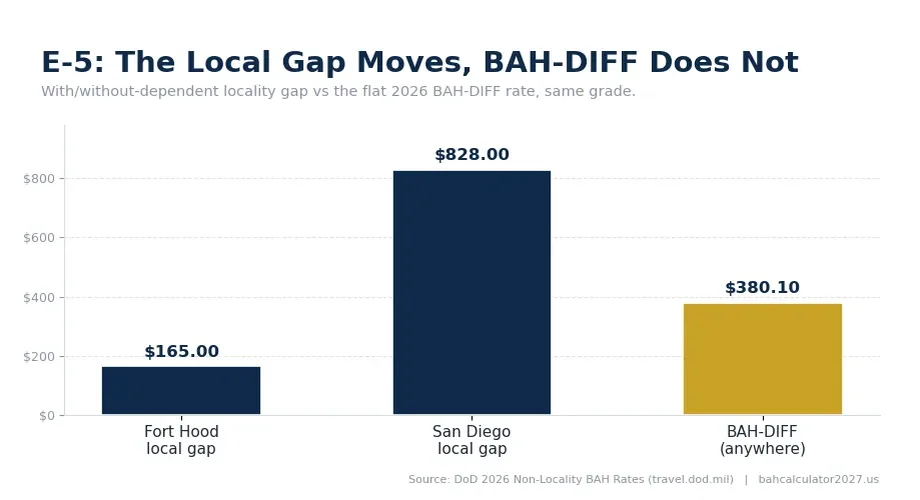
Look at an E-5 to see the difference. At Fort Hood, the 2026 locality rates are $1,695 a month with dependents and $1,530 without — a gap of $165. At San Diego, the same E-5 rates are $3,975 with dependents and $3,147 without — a gap of $828. If DIFF were the local gap, an E-5 at Fort Hood would get $165 and an E-5 in San Diego would get $828. In reality, both get $380.10.
| Duty station | E-5 with dependents | E-5 without dependents | Local gap | E-5 BAH-DIFF |
|---|---|---|---|---|
| Fort Hood | $1,695 | $1,530 | $165 | $380.10 |
| San Diego | $3,975 | $3,147 | $828 | $380.10 |
Why DIFF does not rise with rank
If you stared at the table and wondered why an E-1 out-earns an E-3 on DIFF, or why a senior warrant officer gets the lowest rate in the military, here is the answer: BAH-DIFF is a leftover from an older pay system. It equals the difference between the old Basic Allowance for Quarters (BAQ) rates with and without dependents. Those BAQ figures were set decades ago, grade by grade, and they never formed a smooth ladder. When BAQ was replaced by modern BAH, the DIFF amounts were carried forward as their own table rather than rebuilt from scratch.
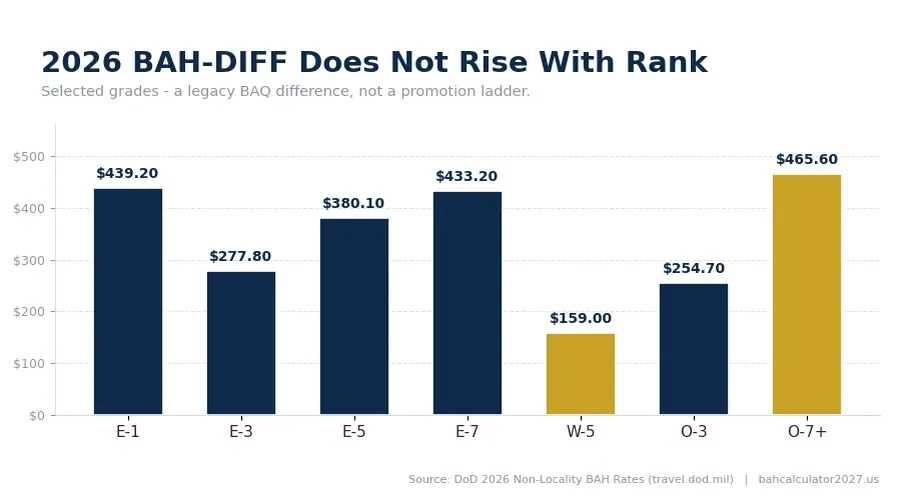
So the pattern is genuinely uneven, and no promotion fixes it in a straight line. An E-1’s $439.20 is higher than an E-5’s $380.10, which is higher than an O-3’s $254.70, while a W-5 sits at the very bottom with $159.00. None of that reflects what anyone “deserves” — it reflects arithmetic from a system that no longer exists. The practical takeaway: never estimate your DIFF rate from seniority. Look it up in the table.
DIFF vs Partial vs full BAH: the three-way comparison
For a single member, there are really three housing outcomes, and the distance between them is the whole story of this article. Take an E-5 in the barracks as the example again:
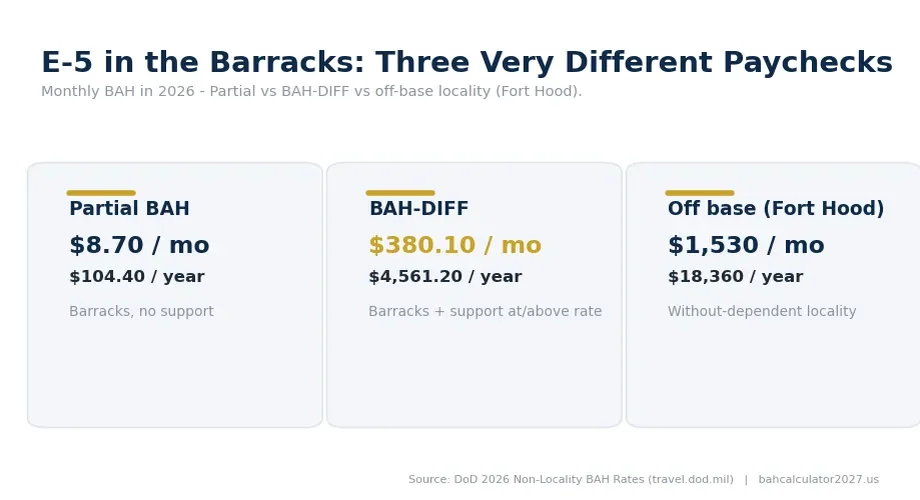
| Situation | Monthly BAH | Annual BAH |
|---|---|---|
| In barracks, no child support (Partial BAH) | $8.70 | $104.40 |
| In barracks, child support at/above $380.10 (BAH-DIFF) | $380.10 | $4,561.20 |
| Authorized off base (full locality BAH, without dependents) | Varies by station ($1,530 at Fort Hood, $3,147 at San Diego) | $18,360–$37,764 |
One more distinction in this table: a member who lives off base and pays child support does not get DIFF at all. That member gets the full with-dependent locality rate instead, which is almost always higher than DIFF. DIFF is strictly a government-quarters allowance. If someone tells you they collect both DIFF and full BAH, one of those claims is wrong.
DIFF vs BAH RC/T: two flat rates, different doors
BAH-DIFF is often confused with BAH RC/T, because both are flat, both ignore your ZIP code, and both sit on the same official non-locality table. But they open through completely different doors, and you cannot qualify for one by meeting the other’s conditions.
BAH RC/T (Reserve Component/Transit) is for Guard and Reserve members on active-duty orders of 30 days or fewer, and for members in transit between duty stations when no prior BAH rate applies — for example, returning from an overseas assignment. It has nothing to do with child support. For an E-5 in 2026, RC/T pays $1,052.70 a month without dependents or $1,403.70 with dependents — several times the DIFF rate, because it stands in for a full housing allowance during short orders or a move, not a top-up for a barracks resident.
The 30-day line matters here too: orders longer than 30 days generally mean full locality BAH, not RC/T, with a contingency-operation exception in the statute (37 USC 403). I cover RC/T in my National Guard and Reserve BAH guide and in the non-locality rates guide.
Divorce, custody, and support changes
Divorce is where most members first meet BAH-DIFF, so let me lay out how the pieces fit. If you have custody of your children after a divorce, the children are your qualifying dependents and you get the with-dependent locality BAH rate (assuming you live off base) — DIFF never enters the picture. If you do not have custody but pay court-ordered child support, and you are assigned to government quarters, that is the classic DIFF case. And if you are separated but not yet divorced, the service support rules still apply: you must support your dependents at the required level, and the support rules in AR 608-99 (Army) and the other services’ equivalents are what finance will check.
Custody alone, without a support obligation, does not create DIFF. Joint custody where the children live with you does not create DIFF either — that is a with-dependent BAH situation. What creates DIFF is quarters plus a support payment at or above your grade’s rate. I go through the full divorce picture — custody, separation support, DEERS updates, and the timeline — in my what happens to BAH in divorce guide.
The other thing divorce teaches is that DIFF is not permanent. It lasts exactly as long as the conditions last. A new custody order, a modified support amount, a move out of the barracks, or a remarriage that changes your dependent status can all end it. Which brings us to the section nobody wants to need but everyone in this situation should read.
Deployment and DIFF
Deployment by itself does not create BAH-DIFF, and it does not take it away by itself either. The rule that matters is the one from my what happens to BAH during deployment guide: BAH you were already authorized before deploying generally continues during the deployment. So if you were receiving DIFF before you deployed — in quarters, paying qualifying support — deployment does not automatically switch it off.
What can change during a deployment is everything around the entitlement. A support order can be modified while you are gone, a barracks assignment can change, a child can age out of support eligibility. Any of those changes can end DIFF, and being deployed does not pause the requirement to report them. If anything, deployment makes reporting more important, because months can pass before anyone notices the LES still shows an allowance you no longer qualify for — and those months become a debt.
The mistakes that create a DFAS debt
This is the warning I would give first if I could only give one. When BAH-DIFF stops being payable — your support drops below the threshold, your support order ends, you move out of quarters — but finance keeps paying it because nobody told them, the overpaid amount becomes a debt you owe the government, collected from your pay by DFAS. DFAS does not stop a support-related payment on your say-so alone; for payments set up through a child support agency or court order, it keeps paying until it receives a termination order. That is why the gap between “the order changed” and “finance knows” is so expensive: every month in that gap is money you will have to pay back.
Three habits prevent almost all of it. First, tell finance the same week anything changes — support amount, custody, quarters, marital status. Do not wait for the next LES to confirm the problem; by then another month has already been paid. Second, read your LES every month and check the BAH line specifically, not just the net pay. Third, if a debt does appear, talk to finance and legal assistance right away rather than letting deductions start without a conversation. And a related caution from the service regulations: a member whose BAH depends entirely on supporting a family member must actually provide at least the DIFF amount in monthly support to keep the entitlement.
2027 outlook: what changes, and what does not
BAH-DIFF does not move with housing costs. By the rule printed on the official rate table, DIFF moves with the military basic pay raise percentage. That gives you the shape of 2027 even before the numbers publish: whatever the final 2027 basic pay raise turns out to be, DIFF rates will move by that same percentage, while Partial BAH — which is constant by rule — should stay exactly where it is.
The official 2027 non-locality table from DTMO is expected around mid-December 2026, and I will update every figure on this page when it publishes. Until then, the 2026 rates above are the current, correct numbers, and the 4.2% figure you may see quoted elsewhere is the FY2027 budget-request proposal only — not a final rate. For the full 2027 picture across every BAH type, see my complete BAH rates guide, and check your own estimate on our BAH calculator. If you and your spouse are both serving, the dual-military BAH calculator covers your combination — note that DIFF itself is a single-member, quarters-based allowance and works differently from dual-military BAH.
Frequently Asked Questions
What is BAH-DIFF?
BAH-DIFF (BAH Differential) is a flat monthly housing allowance for single service members who live in government quarters and pay court-ordered child support at least equal to their pay grade’s DIFF rate. It replaces Partial BAH. In 2026 it ranges from $159.00 to $465.60 a month by grade.
Who qualifies for BAH-DIFF?
You qualify if all three conditions hold: you are assigned to single-type government quarters (barracks, dorms, bachelor quarters, or a ship), you are authorized BAH solely because you pay child support, and your monthly child support is at least your grade’s DIFF rate. Miss any one condition and you do not get DIFF.
How much is BAH-DIFF for an E-5 in 2026?
$380.10 a month, or $4,561.20 over a full year. That is the flat national rate — the same at Fort Hood, San Diego, and every other duty station.
What if my child support is less than the DIFF rate?
You do not get BAH-DIFF at all. You receive Partial BAH instead — $8.70 a month for an E-5 in 2026. There is no partial or reduced DIFF payment; the threshold is all or nothing.
Does BAH-DIFF change by duty station?
No. BAH-DIFF is a non-locality rate: the same dollar figure nationwide. It is not the gap between with-dependent and without-dependent locality rates at your base — for an E-5 that gap is $165 at Fort Hood and $828 at San Diego, while DIFF is $380.10 in both places.
Can I get BAH-DIFF and Partial BAH together?
No. BAH-DIFF is paid instead of Partial BAH, never on top of it. If you qualify for DIFF, Partial stops; if you stop qualifying for DIFF, you fall back to Partial.
I live off base and pay child support — do I get DIFF?
No. Living off base with a child support obligation qualifies you for the full with-dependent locality BAH rate, which is almost always higher than DIFF. DIFF exists only for members in government quarters.
Is BAH-DIFF taxable?
No. Like all BAH, BAH-DIFF is excluded from federal income tax. See my is BAH taxable guide for the full tax picture, including why tax-free allowances still matter for things like VA loan qualifying income.
What happens to DIFF if my support order changes?
Your eligibility changes with it. If support drops below your grade’s DIFF rate, DIFF stops and Partial BAH resumes. If a support order ends or you move out of quarters, DIFF ends. Report any change to finance immediately — overpaid DIFF becomes a DFAS pay debt.
When will 2027 BAH-DIFF rates come out?
With the official DTMO 2027 non-locality table, expected around mid-December 2026. DIFF will move by the final 2027 basic pay raise percentage. I will update this page’s table when the official rates publish.
Sources
– DoD 2026 Non-Locality BAH Rates (travel.dod.mil, effective January 1, 2026) — full 27-grade table, adjustment footnote. – militarypay.defense.gov — Different Types of BAH (official definitions, DIFF = BAQ with/without-dependent difference, support-below-rate rule). – military.com — 2026 BAH Differential Rates (updated December 11, 2025). – veteran.com — 2026 Non-Locality BAH Rates (eligibility, E-5 worked example). – IRS Publication 3, Armed Forces’ Tax Guide — BAH excluded from federal income tax. – 37 USC 403 — Basic Allowance for Housing (including RC/T 30-day rule and contingency exception). – DAFI 36-2906; AR 608-99 para 1-7c — service support requirements and the support-at-least-DIFF rule.