Geobachelor Rules: BAH When Voluntarily Separated [2027]
If your family stays behind when you PCS, you are a “geobachelor,” and your BAH stays at your duty station’s with-dependent rate. Your spouse’s ZIP code does not set your rate, you get no money for two households, and you do not qualify for Family Separation Allowance. Only an assignment that requires separation, or an approved waiver, changes that.
I have spent a lot of time untangling this topic because the internet makes it sound far more generous than it is. Some pages imply you can pick whichever ZIP pays more. You cannot. This guide walks through the actual rules — voluntary versus involuntary, the barracks question, the support you still owe a separated spouse, dual-military couples, and the school waiver that is the one real exception for many families — with real 2026 dollar figures so you can see exactly what is at stake.
Independent guide — not affiliated with the U.S. Department of Defense or any military branch. Last updated: October 25, 2026
What “geobachelor” actually means
A geographic bachelor — “geo-bach” for short — is a service member whose family lives somewhere else during a PCS while the member serves at the new duty station. The family might stay put so the kids finish the school year, so a spouse keeps a job, or because the tour is short and moving everyone twice feels pointless.
Here is the first surprise: “geobachelor” is not an official military status. It does not appear in the law that creates BAH (37 U.S. Code 403) or in the Pentagon’s pay regulation (DoD Financial Management Regulation, Volume 7A, Chapter 26). It is a nickname the community invented for a living arrangement. That matters because nicknames do not come with entitlements: there is no “geobachelor allowance,” no “geobachelor housing,” and no “geobachelor application” in the pay system.
The one rule that decides your rate
BAH is built around one idea: it compensates you for housing costs near your duty station. Once your duty station is known, your rate is fixed by that location’s military housing area, your pay grade, and whether you have dependents. Where you personally choose to sleep, and where your family lives, do not change it.
The regulation says it plainly: unless otherwise authorized or approved, a service member’s housing allowance is based on the permanent duty station (FMR Volume 7A, Chapter 26). The services chose this rule on purpose — if BAH followed the family’s address, anyone could claim a high-cost ZIP and pocket the difference. So the system pays for the place the military sent *you*, and your family arrangements are your business.
That single rule answers most geo-bach questions. If you PCS and your family stays in New York, check your own estimate on our BAH calculator, your BAH does not become a New York rate. It becomes your new station’s rate. Full stop — unless you fall into one of the two exceptions below.
Voluntary separation: what you actually get
When the separation is your family’s choice — dependents *could* move at government expense but do not — you keep drawing BAH at the with-dependent rate for your duty station, as long as you live off base and are not assigned government quarters.
| Your situation (E-5, with dependents, 2026) | Rate | What you actually receive |
|---|---|---|
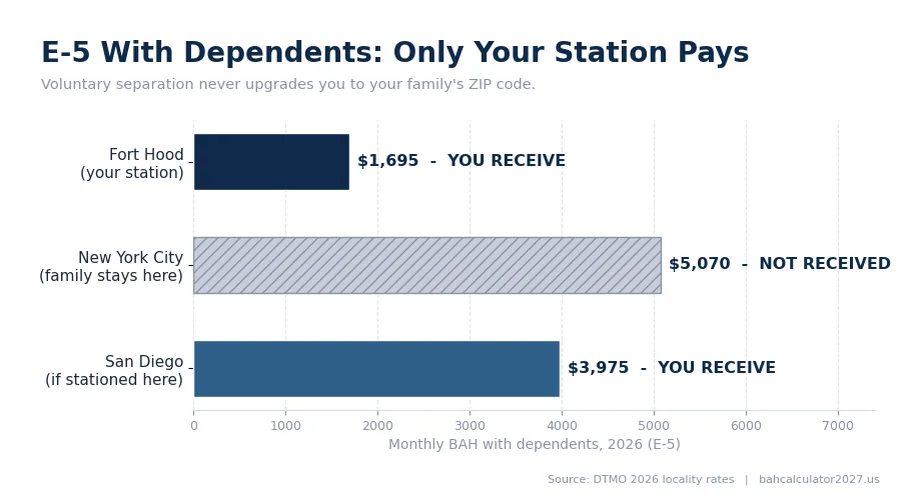
| Stationed at Fort Hood, family stays in New York City | Fort Hood $1,695/mo | $1,695 — the duty-station rate, not New York’s $5,070 |
| Stationed in San Diego, family lives somewhere cheaper | San Diego $3,975/mo | $3,975 — the full duty-station rate, kept in full |
| The gap you do NOT get (Fort Hood vs New York City) | $5,070 − $1,695 = $3,375/mo | $0 from the military — out of your family’s pocket |
Let me put real numbers on that, using 2026 rates. Say you are an E-5 with dependents stationed at Fort Hood, Texas, where the with-dependent rate is $1,695 a month. Your spouse and kids stay in New York City, where the E-5 with-dependent rate is $5,070 a month. You still receive $1,695 — not $5,070. The $3,375-a-month gap between the two areas comes out of your family’s pocket, not the military’s. Flip it around and the rule can work in your favor: if you are stationed in San Diego ($3,975 for an E-5 with dependents) while your family lives somewhere cheaper, you still receive the full San Diego rate. The rule cuts both ways, and that is exactly the point — it is neutral about your choices.
One competitor page claims a geo-bachelor drops to the without-dependent rate or to BAH-DIFF. That is wrong for a member with dependents living off base. The without-dependent rate applies when you have no dependents; BAH-DIFF is a different animal entirely (covered below). If you have dependents and live off base at your duty station, you draw the with-dependent rate for that station. Period.
You also do not get extra money for the second household. No allowance exists for maintaining two homes by choice, and the military will not reimburse the rent on the place your family stayed behind. Budget for two households on one BAH payment, or do not choose the arrangement — that is the honest math.
Involuntary separation: when your family’s location sets the rate
Now the exception. The law — 37 U.S. Code 403(d)(3) — says that when a member’s assignment, or the circumstances of that assignment, *require* dependents to live in a different area, the Secretary of the service concerned can set BAH based on where the dependents live or on the member’s last duty station, whichever is more equitable.
The same subsection adds two more narrow prongs, and only these: (B) a low-cost or no-cost PCS, where BAH may stay at the last duty station’s rate if the Secretary finds the new area’s rate inequitable; and (C) a PCS for professional military education or training of not more than one year, where the Secretary picks the more equitable basis. That is the full list of statutory exceptions — which is why claims that qualifying geo-bachelors “generally” receive the dependent-location rate are misleading. The dependent-location rate is the exception, not the norm, and voluntary choice alone (schools, a spouse’s job, preference) never earns it.
Notice the word “require.” This covers situations like an unaccompanied or dependent-restricted tour, where dependent travel is not authorized at government expense. It does not cover “we would rather stay.” A school year, a spouse’s career, or a house you own are reasons a family might *want* to stay — they do not make the assignment *require* separation, and they do not trigger this exception on their own.
For overseas unaccompanied tours the package is specific and worth knowing: you receive BAH at the with-dependent rate based on your dependents’ U.S. ZIP code, plus Overseas Housing Allowance at the without-dependent rate if you are not furnished government quarters overseas. Separately, the same subsection provides Family Separation Housing (FSH) — the without-dependent rate at the duty station — for members at locations where dependent movement is not authorized and quarters are unavailable. Like FSA, FSH belongs to involuntary separation, not to voluntary geo-baching. The Marine Corps applies the same idea with its own guardrails — for an unaccompanied tour, BAH may be based on the previous duty station, an approved member-designated location where the family has a pre-existing tie, or the dependents’ actual location, capped at the previous station’s rate.
Voluntary vs involuntary at a glance
| Situation | Your BAH rate is based on | Family Separation Allowance? | Government quarters for you? |
|---|---|---|---|
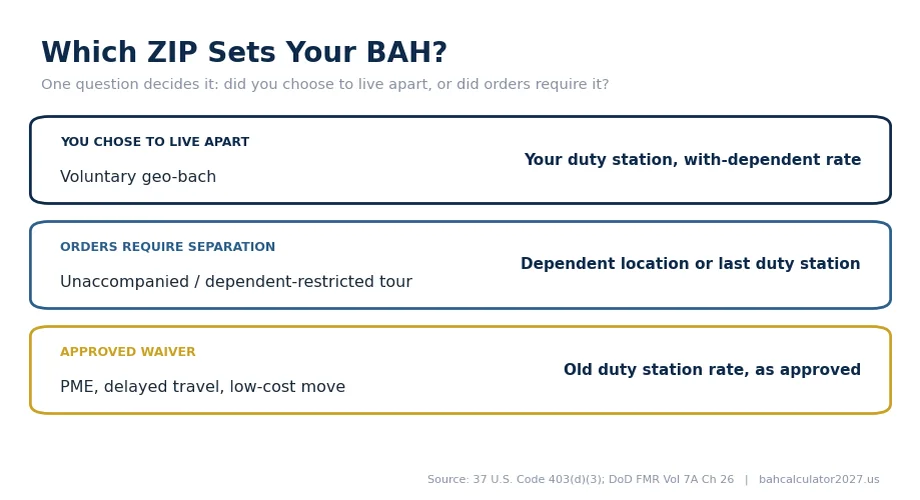
| Family chooses to stay behind (voluntary geo-bach) | Your duty station, with-dependent rate | No | Only if locally available AND you give up BAH |
| Orders bar dependent travel (unaccompanied tour) | Dependents’ location or last duty station, per service Secretary | Yes, $300/mo if separated over 30 days | Per tour rules |
| Approved waiver (PME, delayed travel, low-cost move) | Old duty station or dependent location, as approved | Depends on the waiver | Per waiver terms |
Can you live in the barracks and keep BAH?
No. This is the second most common misunderstanding, and it costs people money. You cannot live in government quarters and draw full BAH at the same time (see my do single soldiers get BAH guide) — the two are alternatives, not add-ons. A voluntary geo-bachelor has no *right* to barracks space or bachelor quarters at the new base. Installations decide locally based on what is available; some bases with excess space offer rooms, many do not, and availability can change.
Where a room is offered, the trade is stark: you may move into quarters only by voluntarily giving up your BAH. As one Army Q&A put it bluntly, you cannot legally have both. For a member drawing $1,695 at Fort Hood, that trade rarely makes sense — unless the alternative is paying for an off-base room you cannot afford. Do the math before you volunteer anything away, and remember that giving up BAH does not end any support obligation to your family (next section).
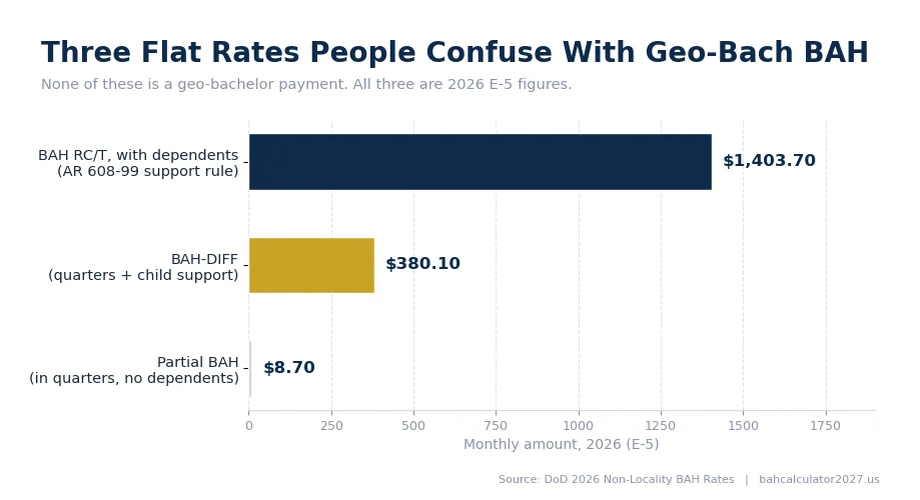
| Rate (E-5, 2026) | Monthly amount | What it actually is |
|---|---|---|
| BAH RC/T, with dependents | $1,403.70 | Flat national support measuring stick under AR 608-99 |
| BAH-DIFF | $380.10 | Quarters + court-ordered child support at/above the DIFF rate |
| Partial BAH | $8.70 | Small payment for members without dependents in government quarters |
Two narrow exceptions exist for members *in* quarters, and neither is a geo-bach benefit. Partial BAH is a small payment to members without dependents who live in government quarters — for an E-5 in 2026, just $8.70 a month. BAH-DIFF goes to a member in quarters who pays child support: the difference between the old with- and without-dependent quarters rates — $380.10 a month for an E-5 in 2026. If someone tells you “geo-bachelors get BAH-DIFF,” they are mixing up two different rules. BAH-DIFF is about child support and quarters, not about where your spouse lives.
Family support while separated: AR 608-99 and the RC/T measuring stick
Here is the part many geo-bach guides skip, and it matters most for Army families. Living apart does not pause your duty to support your family. Under Army Regulation 608-99, a Soldier who separates from a spouse must provide interim minimum financial support (see also my what happens to BAH in divorce guide) unless a court order or a written agreement between the spouses already sets an amount. A court order or agreement wins; without one, the regulation’s number applies.
And the number is not your BAH. It is the BAH Reserve Component/Transit (RC/T) with-dependent rate for your grade — a flat national rate that ignores geography entirely. For 2026, that is $1,403.70 a month for an E-5, $1,687.20 for an E-7, and $1,920.30 for an O-3. You owe it even if you receive no BAH at all — for example, if you gave up BAH to live in the barracks. If only some dependents are “at issue” (say your spouse moved out but the kids stayed with you), you pay a pro-rata share: one dependent at issue out of three total dependents means one-third of the RC/T with-dependent rate.
Other branches have their own family-support rules, so do not assume the Army formula travels with you — but do assume *some* support obligation travels with you. Talk to your legal assistance office before you agree to anything informal, and get any arrangement in writing.
Dual-military couples: why “geo-bachelor” does not apply to you
If both spouses are on active duty and stationed apart (see the dual-military BAH calculator), you are not geobachelors — you are a dual-military couple, and different rules already cover you. Each spouse draws BAH based on their own duty station. If you have no children, each draws the without-dependent rate. If you have children, the couple chooses which spouse receives the with-dependent rate; the senior spouse is only the tiebreaker if you cannot agree.
That distinction matters because dual-military couples sometimes search for geo-bach answers and find rules that do not apply to them. Your separation is an assignment reality, not a voluntary family choice, and your BAH was never going to follow your spouse’s ZIP in the first place.
PME and school orders: the waiver that can keep your old rate
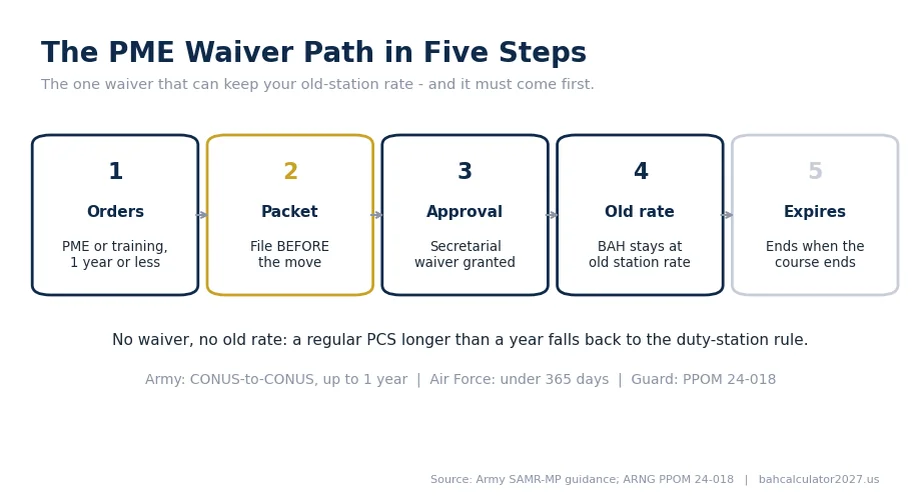
This is the one exception that helps a lot of voluntary-style separations, and it is the section I would read twice. When a member with dependents is reassigned from one U.S. duty station to another for professional military education (PME) or a training course lasting not more than one year, the service Secretary can approve a BAH waiver that keeps the member on the old duty station’s rate while the family stays behind.
| Service path | Time limit | Key condition |
|---|---|---|
| Army PME / training PCS (CONUS to CONUS) | Up to 1 year | Dependents remain at the old station; waiver approved before you rely on it |
| Air Force PME / training | Under 365 days | DAF Form 594; no retroactive pay before notification or amended order |
| Army National Guard (PPOM 24-018) | Per PME course | Waiver approved first, then DFAS SmartVoucher reimbursement |
The Army’s implementation guidance covers exactly this case: a CONUS-to-CONUS PCS for PME or training of up to one year, with dependents remaining at the old station. The Air Force runs a parallel program for PME and training courses under 365 days, using DAF Form 594 (the Air Force’s general BAH application/recertification form, not a geo-bach-specific waiver); the member’s eligibility typically depends on returning to the previous duty station afterward, and there is no retroactive pay for time before the assignment notification or amended order. For Army National Guard Soldiers, PPOM 24-018 lays out the sequence: get the PME Secretarial BAH waiver approved first, then claim reimbursement through DFAS SmartVoucher. Two hard exclusions in the Guard guidance: Soldiers without dependents in training of 20 weeks or more cannot get the waiver, and it never applies to Initial Entry Training.
The practical lesson: apply *before* the move, not after. Waivers are approved prospectively and route through your chain to the Secretarial Process authority. If your school is longer than a year, or your orders are a regular PCS rather than a school move, this waiver does not apply — and you are back to the default duty-station rule.
Delayed and advance dependent travel: the other waiver path
A second waiver path covers families whose travel is split from the member’s move. If your family travels ahead to settle before school starts, or stays behind until the school year ends, the pay regulation allows BAH based on the dependent’s location or the old duty station when authorized or approved through the Secretarial Process. The same framework covers low- or no-cost moves: when orders do not authorize dependent or household-goods movement, and you keep commuting from the residence you established at the old station without moving your household, you may be considered for the old station’s rate.
All three paths share the same DNA: an order or an approved waiver, not a preference. The Navy’s close-proximity policy shows how strict the paperwork gets — the gaining commanding officer must approve, household-goods funding must come off the orders, and a later personal-expense move kills the old-station authorization. Start the packet early and keep every order and amendment: the approval *is* the entitlement.
What happens when orders end or you PCS
Waivers are assignment-specific. When the school ends, the tour ends, or new PCS orders arrive, the waiver ends with that assignment and your BAH resets to the new duty station’s rate. Rate protection — the rule that shields you when your *same* station’s rates drop — does not let you carry a waiver rate to a new station. If your family finally joins you, your BAH simply becomes the with-dependent rate at that station, which is where it would have been all along had everyone moved together.
Plan the transition before it happens. If your family stayed behind for a school year, decide in advance whether they move at the next PCS or stay again — and if they stay again, whether a fresh waiver packet is needed. Assuming an old approval keeps paying at a new station is the most expensive geo-bach mistake there is.
Tax treatment and the mistakes that trigger recoupment
BAH itself is not taxable income. Federal law (26 U.S. Code 134) excludes qualified military benefits from gross income, and IRS Publication 3 lists BAH among the excluded items.
The recoupment risk is real and simple: BAH paid on a basis you were not entitled to gets collected back. The classic triggers are failing to report that your dependents moved, claiming a dependent-location rate without an approved waiver, and drawing BAH while living in government quarters. If your dependents move mid-tour, notify your command and finance office immediately — your rate may need to change, and the longer an overpayment runs, the harder it is to repay. If a waiver is what stands between you and the rate you are receiving, keep the approval with your pay records for as long as you receive that rate. For the full 2027 rate picture, see my complete BAH rates guide.
Independent guide — not affiliated with the U.S. Department of Defense or any military branch.
Frequently Asked Questions
What is a geobachelor in the military?
A geobachelor (or geo-bach) is the unofficial nickname for a service member whose family voluntarily lives apart from them during a PCS. It is not an official status and carries no special allowance.
Do geobachelors get BAH at their spouse’s location?
No — not by choice. Voluntary separation keeps your BAH at your duty station’s with-dependent rate. Only an assignment that requires separation, or an approved waiver, can base BAH on your dependents’ location or your old station.
Can I get BAH for two households if my family stays behind?
No extra allowance exists for a voluntary two-household setup. Your single BAH payment at your duty-station rate must cover both homes, or your family absorbs the difference.
Can a geobachelor live in the barracks?
You have no right to barracks space as a voluntary geo-bachelor; installations offer rooms only if available. If you take quarters, you must give up your BAH — you cannot have both.
Do geobachelors get Family Separation Allowance?
No. FSA ($300 a month) requires involuntary separation from dependents for more than 30 continuous days under orders. A family choosing to live apart does not qualify.
How much support do I owe my spouse if we live apart?
Under Army Regulation 608-99, absent a court order or written agreement, a separated Soldier owes interim support equal to the BAH RC/T with-dependent rate for their grade — $1,403.70 a month for an E-5 in 2026 — even if they draw no BAH. Other branches have their own rules; get legal assistance involved.
Do dual-military couples count as geobachelors?
No. Dual-military couples follow dual-military BAH rules: each spouse is paid at their own duty station, and if they have children, the couple chooses who receives the with-dependent rate (senior spouse breaks ties only).
Can I keep my old BAH rate during PME or a school?
Possibly, through a Secretarial BAH waiver: Army PME/training PCS moves of up to one year (CONUS to CONUS) and Air Force courses under 365 days can qualify, but the waiver must be approved before you rely on it, and it expires when the course ends.
What happens to my BAH when my geo-bach tour ends?
It resets to your new duty station’s rate at the next PCS. Waivers do not carry forward, and rate protection does not preserve a waiver rate at a new station.
Is geobachelor BAH taxable?
No. BAH is excluded from federal gross income under 26 U.S. Code 134 and IRS Publication 3, whether you are a geo-bachelor or not.
Sources
– 37 U.S. Code 403 — Basic Allowance for Housing (esp. (b) and (d)(3))
– DoD FMR Volume 7A, Chapter 26 — Housing Allowances (May 2025), §10.7
– Army SAMR-MP — Implementation Guidance for BAH/OHA/COLA Secretarial Waiver Program
– ARNG PPOM 24-018 — PCS Allowances when participating in PME or Training Classes
– U.S. Air Force — PCS Allowances for Students who PCS for Military Education or Training less than 365 days
– Army Regulation 608-99 — Family Support (via Army legal assistance summaries)
– U.S. Army MyArmyBenefits — Basic Allowance for Housing
– 26 U.S. Code 134; IRS Publication 3 — Armed Forces’ Tax Guide
– DoD 2026 Non-Locality BAH Rates (RC/T, BAH-DIFF, partial) and 2026 locality rates (Fort Hood, New York City, San Diego)
– Military.com — Geobachelor Fact and Fiction (2017)